
image:
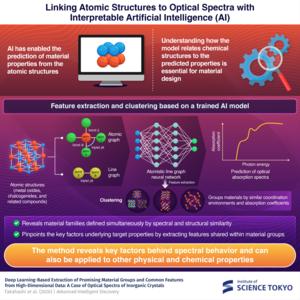
The proposed method combines graph neural networks and hierarchical clustering to extract important features that link crystal structure and optical spectra, grouping materials with similar structural and spectral properties and revealing patterns that can guide material design.
view more
Provided by: Tokyo University of Science
A method for interpreting artificial intelligence (AI) models used for materials discovery by analyzing learned features has been developed by Japanese researchers. The method extracts key features from an AI model trained on atomic structure data and optical absorption spectra to group materials with similar structural and spectral properties. This approach can be extended to reveal how atomic arrangement affects other material properties, paving the way to more efficient materials design.
In recent years, artificial intelligence (AI) has emerged as a powerful tool for predicting how materials will behave based on their atomic structure, helping researchers discover new materials faster and reduce reliance on trial-and-error methods. However, many of these models function like “black boxes.” They can make accurate predictions, but they don’t explain how those predictions are made. This makes it difficult to understand the relationship between a material’s structure and its properties, limiting the usefulness of these models in guiding the development of new designs.
Research currently scheduled for publication in a journal Advanced intelligent discovery June 15, 2026 Researchers at the Tokyo Institute of Science (Science Tokyo) have developed a method to make these models easier to interpret. Their approach works by analyzing a trained AI model and extracting the key features it has learned about how crystal structure relates to optical spectra. Using these characteristics, researchers grouped materials that shared similar optical spectra and structural properties.
This research was led by Assistant Professor Akira Takahashi, Professor Fumiyasu Ohba (also the KISTEC project leader), and Master’s student Arata Takamatsu (at the time of the research) from the Materials and Structures Laboratory, University of Tokyo, in collaboration with Professor Masaru Kumagai from the Institute for Materials Research, Tohoku University.
“Our proposed classification method provides a detailed understanding of how AI predictive models make predictions, that is, how to extract key elements of a desired spectral shape, thereby providing useful physical and chemical insights for material design,” says Takahashi.
The properties of materials often depend on several parameters and are described using spectral data (for example, optical absorption spectra that capture how light interacts with the material over different wavelengths). Compared to single numerical properties, spectral data is much richer and more complex, making it difficult to interpret using traditional AI techniques.
The researchers used an existing graph neural network architecture, the Atomic Line Graph Neural Network (ALIGNN), and trained it to predict optical absorption spectra from atomic structures using data from 2,681 metal oxides, chalcogenides, and related compounds. They extracted features from the internal layers of the trained model and applied hierarchical clustering, a method of grouping items based on similarity. This allowed the classification of materials into different groups that share both structural features such as elemental composition, atomic coordination, bond lengths, and bond angles, as well as similar spectral shapes.
Remarkably, the model learned these patterns from atomic structure alone, without oxidation state or electronic configuration as input, indicating that it internally captured meaningful relationships between structure and properties.
Optical properties play an important role in many applications. They affect the appearance of materials, which is important for pigments and dyes, and control how materials interact with light in devices such as solar cells and photodetectors. Therefore, understanding the elemental species and structural features that form these spectra is key to establishing rational design guidelines for such materials.
Moreover, this approach is not limited to the optical spectrum. It can be extended to determine how a material’s structure affects its behavior under different conditions such as temperature and pressure, opening new possibilities for designing materials with specific useful properties. As demonstrated here for optical absorption, this approach can be applied to a variety of spectral properties, allowing researchers to identify common factors shared by different materials and infer the origins of desired spectral properties.
“Until now, it has been difficult to interpret what machine learning models have learned about spectral properties. In this work, we have developed a general method to extract such insights, which we believe will prove broadly useful in materials research,” concludes Takahashi.
***
About Tokyo University of Science (Science Tokyo)
Tokyo University of Science (Science Tokyo) was established on October 1, 2024 through the merger of Tokyo Medical and Dental University (TMDU) and Tokyo Institute of Technology (Tokyo Institute of Technology), with the mission of “promoting science and human well-being and creating value for society and society.”
journal
Advanced intelligent discovery
Research method
Computational simulation/modeling
Research theme
not applicable
Article title
Extraction of promising material groups and common features from high-dimensional data using deep learning: Example of optical spectra of inorganic crystals
Article publication date
June 15, 2026
Conflict of interest statement
The authors declare that they have no conflicts of interest.
Disclaimer: AAAS and EurekAlert! We are not responsible for the accuracy of news releases posted on EurekAlert! Use of Information by Contributing Institutions or via the EurekAlert System.


