
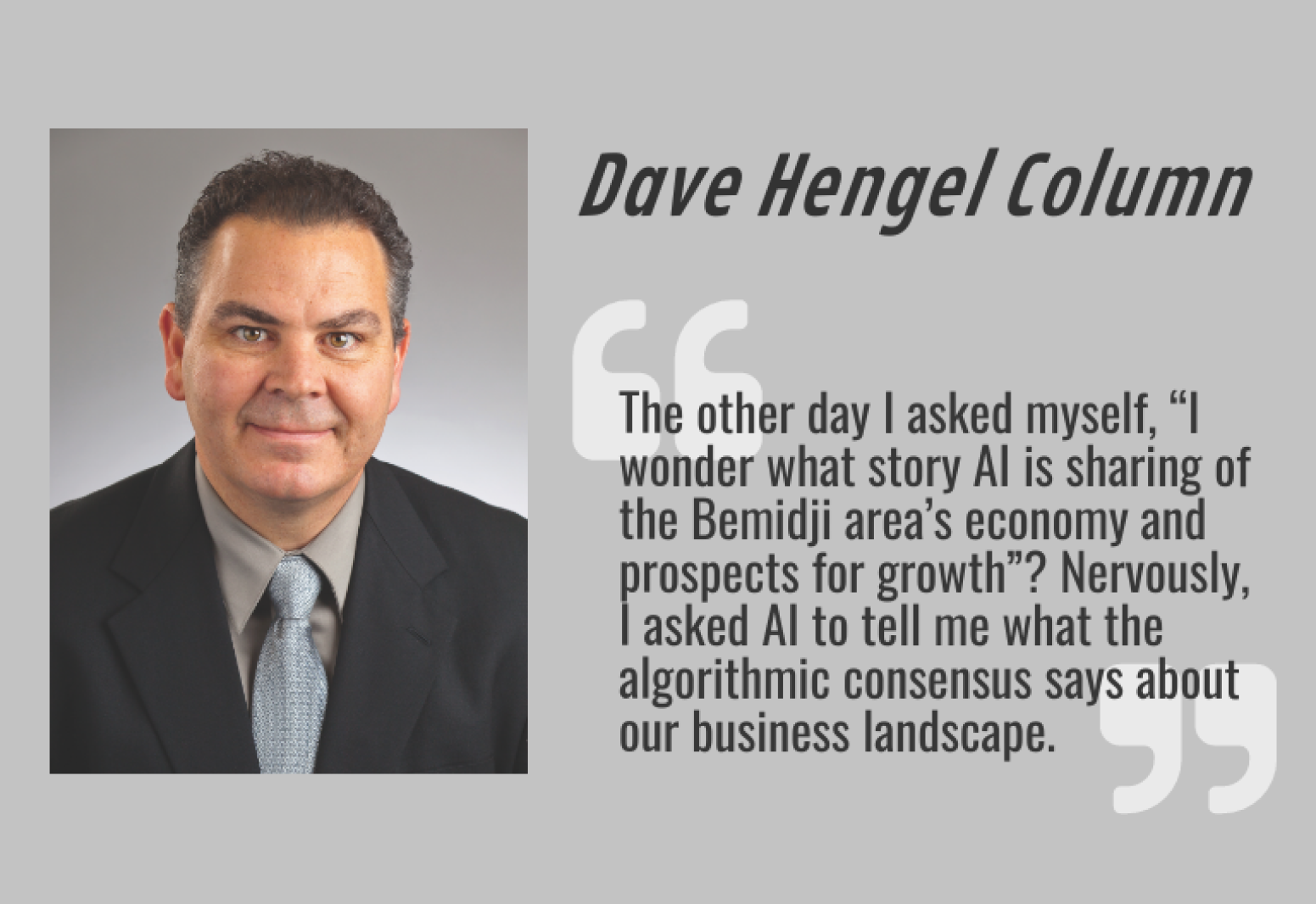
Like every other industry, artificial intelligence (AI) is wreaking havoc on economic development. Some parts are great. When used properly, it can save a lot of time in daily tasks and research. Unfortunately, it also adds a whole new layer of complexity…and worry. An example is shown below.
When a company is looking to grow and is looking for the best place to locate its business, it typically hires a site selection consultant who contacts economic developers like myself to gather information about the community. For me, it’s a great opportunity to provide…yes…accurate data, but to provide it in a way that…well…emphasizes the message I want to see.
Companies and site selectors are now increasingly leveraging AI to obtain unfiltered data and information. AI bypasses “tourist brochures” and dives directly into hard metrics such as labor pools, GDP growth, infrastructure investment, regional attraction, and other economic indicators.
So I asked myself the other day, “What story is AI sharing about the Bemidji region’s economic and growth prospects?” Nervously, I asked the AI to tell me what the algorithmic consensus told me about Bemidji’s business situation.
This is what I told myself and what I tell everyone who asks.
“Bemidji is a prime example of a high-performing micropolitan. Bemidji is an important regional hub that effectively serves a market area of more than 100,000 people. Here’s a breakdown of what the algorithm emphasizes when evaluating a city’s commercial DNA.”
1. Advantages of regional centers
“A data model that tracks geographic economics takes a closer look at how much a city “punch above its weight class.” Bemidji ranks 114th out of 543 small cities nationwide. The algorithm looks at ‘leakage’, such as whether locals are leaving the area to spend money or whether outsiders are traveling in. Bemidji scored very well here. Located as a major medical, retail, and educational center in northwestern Minnesota, it functions economically like a city twice its size. For entrepreneurs and expanding franchises, that means a built-in consumer base that relies on the city as a core destination.
2. Aggressive Infrastructure Tipping Point
“AI algorithms that track local development projects are now warning of major ‘catalytic’ changes in Bemidji. The system points straight to the redevelopment of the railway corridor in the heart of the city. The city and its economic development partners are actively transforming 13 acres of blighted, historic industrial land adjacent to downtown into a $35 million, 60,000-square-foot YMCA wellness center.
“Why does AI see this as a green light for business? Because data shows large civic projects are driving surrounding private investment. This project is projected to act as a catalyst for up to $65 million in adjacent private development, including a boutique hotel, retail space, and mixed-use housing.
3. Global Connectivity: All-Fiber Gigazone
“For today’s high-tech companies, e-commerce giants and remote workers, geography is less important than bandwidth. Algorithms that audit telecommunications infrastructure consistently mark Bemidji as a top-tier digital oasis. As a result of an investment by Paul Bunyan Communications, the City of Bemidji is located on one of the largest all-fiber rural gigabit networks in the United States.
“This infrastructure, called the ‘Gigazone,’ provides symmetrical upload and download speeds of up to 10 Gbps, which is a huge asset when it comes to overhead. We can provide small startups and enterprise-level companies with super-fast, super-reliable data pipelines typically found only in big tech hubs, at a fraction of the real estate costs in big cities.
4. Avoid remote areas via local airports
“A common bottleneck for local economic growth is geographic isolation, but when we look at Bemidji, our AI routing model quickly dispels this concern. Why? Bemidji Regional Airport (BJI). The fourth busiest commercial airport in the state, BJI serves as a huge economic engine, supporting 450 local jobs and driving $58 million in economic activity annually.”
“For companies, daily commercial flights to Minneapolis-St. Paul International (MSP) represent a short 45-minute flight connecting local executives and cargo with other parts of the world. The algorithm recognizes this as an important closing tool for attracting outside companies that need executive mobility without sacrificing their Northwoods location.”
5. A nurtured incubator for startups
“When AI scans an entrepreneur’s vital signs, it looks at the strength of a city’s support network for early-stage companies. Bemidji stands out because we don’t leave startup success to chance. We’re building a programmatic ecosystem dedicated to funding and mentoring startups. The algorithmic model powers LaunchPad, a premier coworking space and entrepreneurial hub specifically designed to accelerate local startups. Shows local champions like.
“Combined with financial support from Greater Bemidji, the Headwaters Regional Development Commission, and the Northwest Minnesota Foundation, the town emulates the incubator infrastructure of major cities. Our data shows that startups in markets with this level of tight, localized support have a much higher survival rate because they have direct access to local capital, low-cost workspace, and immediate cross-industry mentorship without the anonymous, cut-throat competition of larger cities.”
6. Talent pipeline and “218 redeployment” elements
“The algorithm shows that our workforce is competitive. Bemidji’s workforce is younger and more highly educated than nearly any other regional center in the Upper Midwest, and is heavily supported by a steady talent pipeline from Bemidji State University and Northwest Technical College.
“Furthermore, algorithms that analyze regional migration patterns show the success of local talent attraction campaigns like 218 Relocate. Data shows a steady influx of remote workers and professionals bringing diverse skill sets, trading congestion in urban areas for lower costs of living and access to pristine lakefronts.
conclusion
“An algorithm crunches the numbers and predicts a resilient and collaborative economy. With a world-class fiber network, a robust airport, a startup incubator, aggressive downtown revitalization, and a dedicated economic ecosystem that drives a growing industrial tax base, the city is intentionally building its own momentum.”
“For AI data models, the consensus is clear: Bemidji offers a rare combination of small-town agility, reach into major regional markets, and a world-class quality of life. If you’re looking to build, invest, or launch, the algorithm suggests this northern hub is right on the edge of a major tipping point.”
Phew. To that I say, “Amen.” Thank you, AI. You tell the story of Bemidji perfectly. Probably better than this economic developer. I don’t know why I was so nervous.
Dave Hengel is the executive director of Greater Bemidji Economic Development. You can contact him at:
(218) 444-5757
or
dhengel@greaterbemidji.com.


