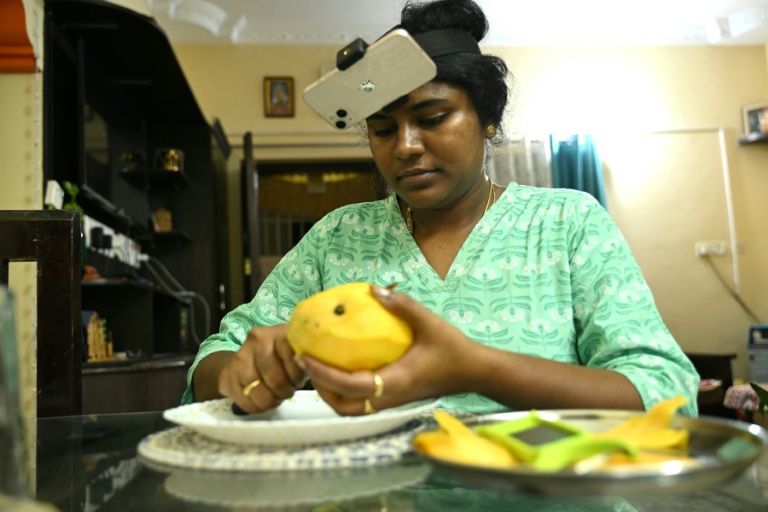
Nagireddy Sriramyachandra, an Indian housewife, straps her smartphone to her head and films herself slicing mangoes to train an AI-powered robot that will one day take on household chores.
Earning just over $2 for an hour of video, her daily recordings are invaluable to global technology companies that teach machines how to move like humans in the real world.
The 25-year-old is one of a growing number of thousands of AI systems trainers in the world’s most populous country.
“Who else would give me 250 rupees an hour just to do housework?” Shramyachandra said from her kitchen in Chennai, in the southern Indian state of Tamil Nadu.
“I might even get a robot myself in the future,” she added.
Artificial intelligence chatbots and image generators process large amounts of digital data, but building systems that navigate real-world environments is even more difficult.
Developers believe that feeding first-person footage, called “egocentric data,” to specialized AI models can help robots imitate humans.
Some AI trainers work from home using video glasses, head-mounted cameras, and motion sensors, while others work in factories or professional studios.
“If you’re not recording properly, you’ll hear a ‘hand not detected’ sound,” says Sriramyachandra, who sends the recordings to AI data company Objectways through a dedicated app.
The company, which has offices in India and the United States, counts Fortune 500 multinational companies among its clients. Works with Amazon SageMaker, a platform for machine learning models.
– “something better” –
The humanoid robot market is booming, with investment bank Morgan Stanley predicting that more than 1 billion robots could be in use by 2050, primarily for industrial and commercial purposes.
“Folding clothes, making coffee… making something very specific, making a sandwich,” said Ravi Shankar, head of Objectways, citing videos requested by customers.
“Some jobs are supposed to be taken over so humans can do a better job.”
In India, the emerging field of spatial AI is creating new jobs so far.
The 50-year-old CEO is based in the United States, but employs workers from the state of Tamil Nadu, where he grew up, one of India’s international technology hubs.
At the Karur textile factory, workers were busy pasting labels on hats and ironing cloth bags, and AFP saw eight employees wearing head cameras and smart glasses provided by Objectways.
India has established itself as a global intermediary for the creation, processing and annotation of AI data.
“We’re probably going to see an increase in these data collection services,” said Aditi Sule, a digital labor expert at the Indian Institute of Human Settlements in Bangalore.
– Non-regular workers –
India is actively working to develop its AI industry, but its leaders recognize that alongside the much-touted benefits of the technology, automation brings risks.
Government think tank NITI Aayog said most of the debate around artificial intelligence and labor has “focused on white-collar professionals and predicts that without urgent action, jobs in this sector will almost certainly be lost.”
“Little, if any, attention has been paid to how AI can serve India’s 490 million undocumented workers, the very backbone of the economy,” the report, released ahead of this year’s World AI Summit in India, said.
The think tank looked at how the technology could impact or harm dozens of jobs, from shoemakers to sewer cleaners, farmers to tea sellers.
For the past 10 years, 55-year-old Pony has been sitting on a roadside in Bengaluru, a city known as India’s Silicon Valley, making garlands.
She, too, is paid to have a cell phone strapped to her forehead.
“The next generation…may have to do the same kind of work that I did, but they will face problems,” Poni said.
~Always have a camera on you~
In Objectways’ studio, AI system trainers film themselves performing chores in a fake, furnished apartment.
After thousands of hours of photography, wallpapers are modified to provide variety to our clients.
“Today I’m sitting here, tomorrow I’ll be standing there,” said engineering graduate Rani N., 21, as she folded her towel again during a break from her photo shoot.
Each video is about four minutes long, and she records about 90 of them a day from almost every spot on her bed.
She says her job is “tolerable,” but she feels like she has cameras on her all the time.
In another room, colleagues arranged pencil sharpeners, water bottles, and crayons in a pattern that was recorded with a depth-sensing camera.
Qanat Consulting Services in Andhra Pradesh, a subcontractor of Objectways, provides records to about a dozen large data companies.
CEO Taslim Pattan said some of the 2,000 contributors work with motion sensor bands on their “wrists, hands, and feet.”
Manish Agarwal of Bangalore-based Humyn Labs, who is not affiliated with Objectways, records conversations as well as videos.
Contributors discuss assigned topics ranging from politics to entertainment for clients who wish to have their voice patterns processed.
Agarwal denies that robots will take jobs, saying he believes networks of humans and robots will one day “work together.”
“Indian welders may be managing welding robots in Prague,” he said.
ash/pjm/kaf/cms