
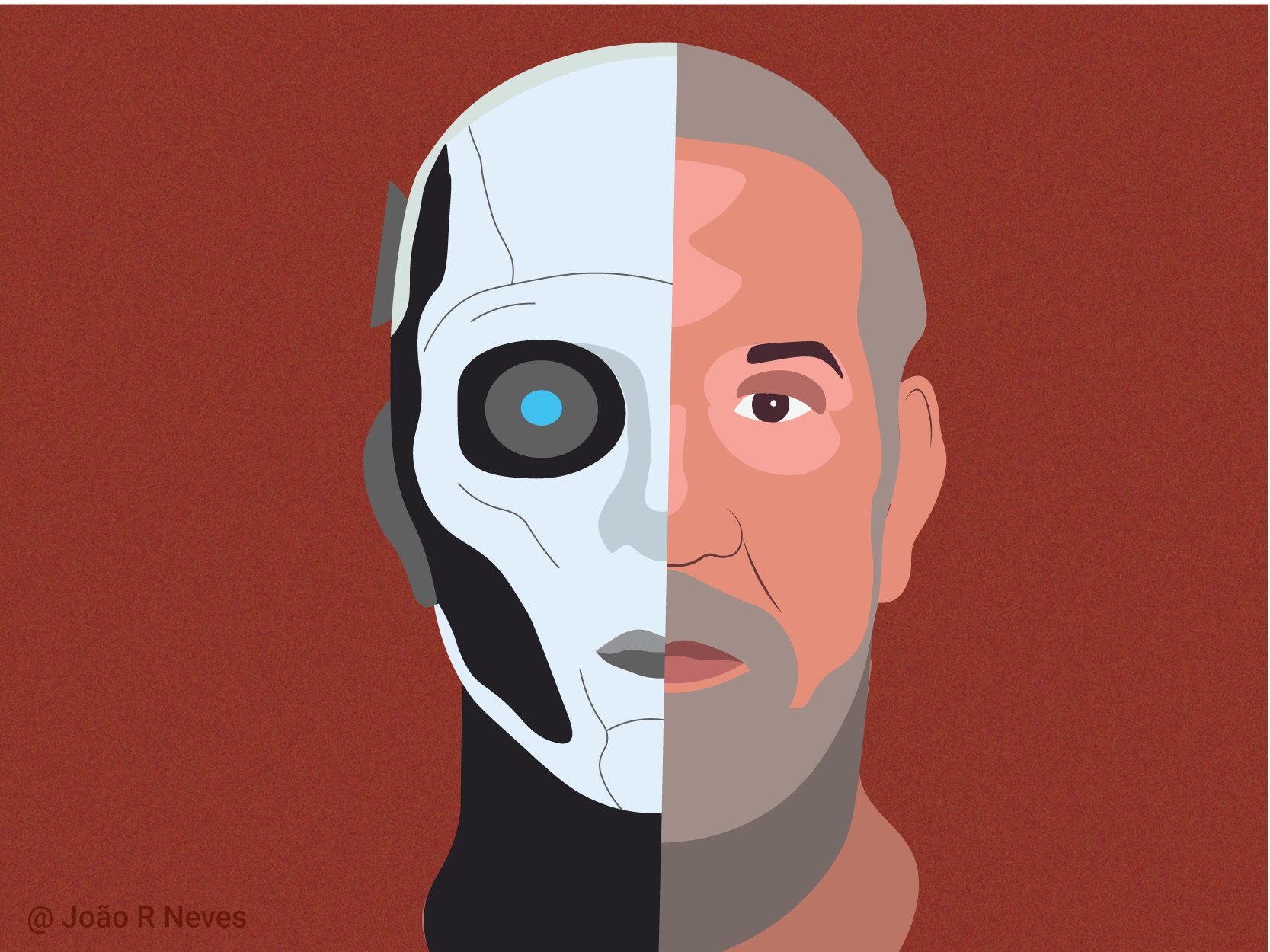
But long before AI became a cultural thing, long before language models entered our phones, offices, and dinner table conversations, Joao Gama was already somewhere in Porto helping to redesign the way machines learn from the world.
What makes Joan Gama’s trajectory particularly impressive is not only the scale of his scientific influence, but also its timing. Many of the problems that are now central to artificial intelligence, adaptation, continuous learning, and real-time decision-making were problems he was already working on decades ago. From his laboratory at the University of Porto, he quietly helped shape a field that has only recently become widely known.
Machine learning wasn’t entirely new to Joanne. “The term machine learning was first used in the 1950s,” he explains, citing researcher Arthur Samuel, who created a checkers program that could improve as you played. “This ability to learn from experience is what we call learning.” What changed over time was not the existence of these ideas, but the scale at which society perceived them.
A scientific ecosystem built in Porto
João Gama’s career is closely linked to the University of Porto, where he began teaching at the Faculty of Economics in the early 1990s. At first glance, it may seem like an unusual place for one of Portugal’s leading artificial intelligence researchers to be born here. However, Joan explains: “The group was founded in economics, because economics was taught by Professor Pavel Brasil,” he says. Brazil has established one of the country’s first internationally relevant machine learning groups within the Faculty of Economics.
Economics and the social sciences were already heavily reliant on large amounts of data and quantitative analysis, so in many ways location shaped perspectives. Traditional econometrics approaches problems through predefined models. Machine learning takes a different approach, allowing systems to learn patterns directly from the data itself. Joan found herself at the exact intersection of computational rigor and real-world complexity.
Over the years, João has contributed to strengthening that ecosystem through teaching, research supervision and building scientific networks far beyond Portugal. He directed the Economics Department’s master’s program in data analysis for more than a decade, mentoring dozens of doctoral and master’s students, many of whom went on to forge their own research careers.
Learn from the moving world
Joan Gama’s observation that the real world is dynamic led to a major shift in machine learning. Traditional models relied on static datasets, but Joanne tackled the problem of data that is constantly evolving and quickly becoming stale. This led us to develop an approach to learning from data streams, where the algorithm continuously adapts in real time. At the heart of this research was the idea of ”concept drift,” the perception that patterns change over time. From consumer behavior and urban transportation to industrial infrastructure and environmental systems, the patterns that shape the real world are constantly evolving.
Joan’s research is born out of this very instability, and addresses a fundamental question that would become central to modern artificial intelligence: how can machines adapt and continue to learn in a changing environment without having to start from scratch again and again?
His research became the foundation of this field. Today, his research on data stream mining and concept drift is among the most cited internationally, with tens of thousands of citations and global influence spanning both academia and industry.
The practical implications of this research became particularly evident through projects developed using real-world infrastructure. One of the most concrete examples came through our collaboration with Metro do Porto, which aimed to proactively detect machine failures.
Responsibilities before superintelligence
Public conversations about artificial intelligence increasingly revolve around fears that machines will surpass humans. Joanne approaches these arguments with a skeptical eye. “At the moment, machines are still very stupid,” he says, almost humorously. For Joan, modern AI systems remain fundamentally limited because they lack consciousness, self-awareness, and a true understanding of what they are doing. They perform tasks with increasing sophistication, but without reflective awareness.
He does not deny the risks of AI. Instead, it focuses on current social realities such as inequality, data misuse, information manipulation, and unequal access to technology. He emphasizes that technology is not neutral. AI will shape opportunities, work structures, and access to information, giving an advantage to those who can work with AI and leaving others behind.
This concern partly explains why he strongly values Europe’s efforts around privacy regulation and responsible AI governance. Joan believes that frameworks like GDPR are not bureaucratic hurdles, but attempts to protect human autonomy in a world where information flows at unprecedented speed and scale.
University as a place of thought
Despite Joan Gama’s international profile, much of her identity remains deeply tied to her education and academic life. He speaks about mentoring students with genuine love and calls dissertation guidance one of the most rewarding aspects of his career. “It’s always good to work with people,” he says.
This perspective also forms his strong defense of the university as a space in which research must be preserved alongside teaching. He believes that universities are not simply institutions that transmit existing knowledge, but have a responsibility to generate new questions, foster critical thinking, and maintain the intellectual freedom necessary for innovation. Research requires not only technical skills, but also mental capacity and the ability to think through which problems are worth pursuing. After becoming Professor Emeritus at the University of Porto, João continues to teach students, lead research projects and remain actively involved in INESC TEC. In reality, little has changed other than the move away from formal education. Research, teaching, and scientific collaboration continue to occupy the center of his daily life. What is particularly impressive is that he talks about this trajectory without thinking of him as an individual protagonist. In her final lecture before retiring from teaching, Joan chose not to focus on achievements, awards or career milestones, but on the people who have accompanied her throughout her decades of work. “I never did anything alone,” he said. “I have to thank my team, but most of all I want to thank my students.”
continue to adapt
As I talked with Joan Gama, it became increasingly clear that adaptation itself is central to both his science and his worldview. His research focused on systems that could continuously learn, as he understood early on that static models would struggle in dynamic reality. But the same idea seems to extend beyond algorithms. Throughout her career, Joan has positioned herself many times in transition, between economics and computer science, theory and application, research and policy, and academia and public debate.
There is a quiet consistency in the fact that one of the world’s leading experts in adaptive systems speaks frequently about responsibility, collaboration, and collective learning. For Joan, intelligence, whether artificial or human, is never purely individual, but is collectively constructed.
After all, the infrastructure that currently underpins artificial intelligence—systems that can continuously adapt to changing realities—exists in part because Joan Gama has spent decades thinking about how to adapt to a world that never stops moving.

