If you’re someone who focuses on what people do rather than what they say, you might want to start paying attention to AI loyalty now. why? That’s because Microsoft CEO Satya Nadella, Nvidia CEO Jensen Huang and others are in a 1990s-like situation with PC upgrade cycles, CPUs, and on-premises infrastructure.
Yes, folks, we have a problem. Tokenomics will (probably) only work for a small number of companies, and the economics won’t make sense unless we take computing out of the cloud for AI inference. It makes me wonder why FOMO-driven money is being spent on AI factories and centralized computing models that may already be outdated.
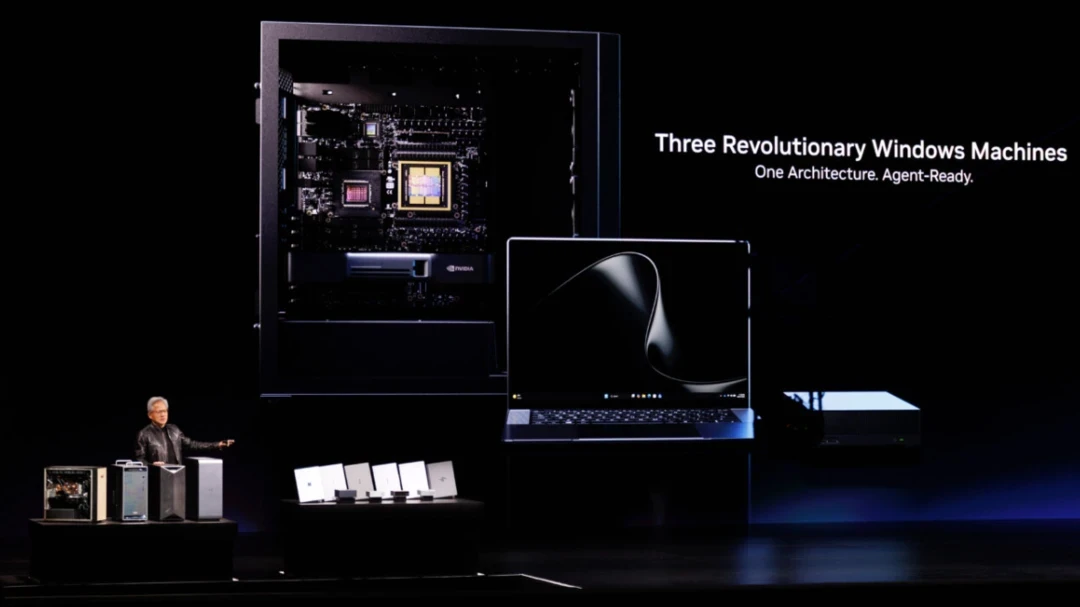
Nvidia’s Huang kicked off his Computex keynote with a focus primarily on CPUs. Nvidia wants to put Vera CPUs inside PCs and workstations. There’s a reason for that. All AI inference is CPU dependent. Huang also showed off several PCs.
Apparently, Nvidia wants to become the next Intel Inside while still dominating GPUs and AI data centers. Nvidia’s move could be considered a good hedge.
Nadella realized:
“When I saw the pictures of Jensen over the weekend and saw all the desktops, I felt like I was back in the ’90s. It was so cool to see the lineup of all the machines I loved, and grew up with new features again. It’s the same form factor, but with incredible new features thanks to onboard AI capabilities.”
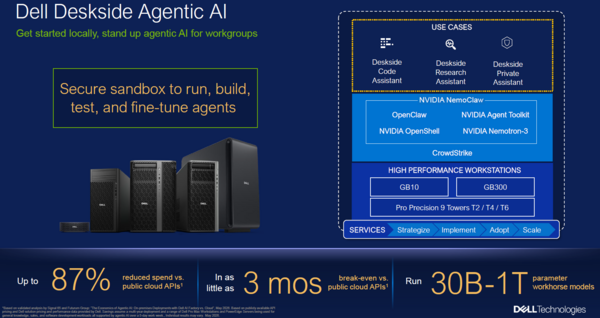
And this excitement in retro infrastructure isn’t just about AI PCs. Did you see Dell Technologies’ explosive quarter? Yes, there was a demand boom for AI infrastructure (and perhaps some of it was brought forward), but traditional servers exploded. HPE followed up with a strong networking and traditional server quarter.
Cisco spoke on Cisco Live about how networks are the foundation of AI (sound familiar to you old heads, right?). Sure, Cisco CEO Chuck Robbins talked a lot about agent AI during his keynote, but it was more about the systems that all work together behind the AI: the traditional AI factory and the new AI factory.
AMD CFO Jean Hu said at the Bank of America 2026 Global Technology Conference that the 1990s vibe is not unexpected. AMD predicted two years ago that CPUs would regain ground, even though everyone was happy with GPUs.
Mr. Hu said:
“From training to inference to AI deployment to experimentation to larger-scale deployments, we’re seeing continued momentum. Agent AI is no longer about answering questions. It’s about orchestration, it’s about database access and running a lot of tools. And all of that requires significant CPU performance. And what we’re seeing is a tremendous increase in demand for CPU platforms.
The economics of AI also continue to change. With token generation rapidly increasing, all customers are seriously focused on performance and TCO, and how they can use different compute to address different applications and workloads. ”
Arthur Lewis, president of Dell Technologies’ Infrastructure Solutions Group, said the new model is cloud and edge. It’s not one or the other.
Lewis said at an investor conference:
“When we started down this artificial intelligence path in early 2022, we wrote down a few different assumptions, and one of them was that there would be a strong gravitational pull on data. And that’s proven to be the case. Today, 83% of data is on-premises for the majority of enterprises around the world, and there is a strong trend to deploy it on-premises for performance, cost, and security reasons.”
That gamble paid off, as Dell was rapidly selling not just PCs but all types of servers. It’s all client server.
Trillions of dollars in FOMO
Looking at the AI infrastructure market, I can’t help but think it’s similar to real estate in 2006 and 2021. In both cases there was a rush for assets. In the first real estate bubble, there was FOMO that the only way to buy a house was to go up. Then came the mortgage crash of 2008.
During the coronavirus pandemic, there has been a rush to buy homes in sunny places. Austin and Florida grew rapidly based on the assumption that we would all never return to the office. Ask people who bought in 2022 how they did.
Since we’re talking about hard assets, AI data center is a bit of a rhyme. There is no moderation in spending as everyone assumes that OpenAI and Anthropic can grow forever and pay trillions of dollars in taxes. Sounds like FOMO.
Alphabet has launched an $85 billion initial public offering to raise funds for investments in AI infrastructure. There is no quarter in which the AI Infrastructure tab does not appear. Goldman Sachs projects that capital spending in computing, data centers, and power will total $7.6 trillion from 2026 to 2031.
Jim Covello, head of research at Goldman Sachs Research, said on a podcast that the economics of artificial intelligence are more questionable now than they were two years ago.
Mr Covelo said:
“There’s a huge amount of FOMO at every level of the supply chain, and that doesn’t mean it’s not justified. I just think we’re spending way ahead of what the economic situation is right now. And I think that’s because everyone is afraid of what will happen if they find a use case for it. And your competitors understand that, you don’t understand that. And I think that’s everything from the enterprise level to the model layer to the enterprise level. ”
big question
All the nostalgia for the 1990s raises a very expensive question: What if the AI infrastructure is already built?
If AI inference is what powers the world of agents, we’re really talking about massive upgrade cycles for CPUs, not massive AI factories with big gaps between announcement, depreciation, and actually turning on the lights. Yes, the cloud is there and the demand will eventually justify the investment, but there is a huge amount of underutilized computing.
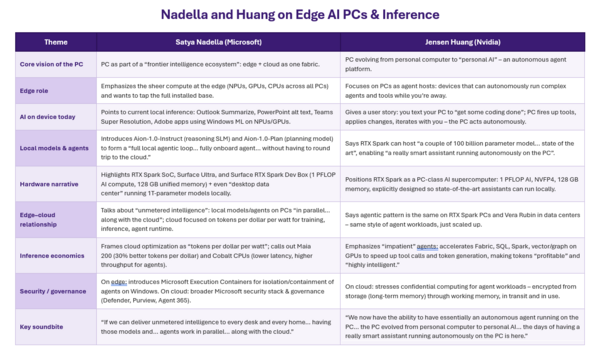
Nadella said, “Let’s start with Windows Edge, because if you take a step back, the amount of computing that exists at the edge is actually amazing. Think about all the NPUs, GPUs, CPUs, even all the PCs. When you kind of aggregate that, that’s a huge amount of computing power. If we can bring pay-as-you-go intelligence to every desk and every home, we’re right back to where we started.”
Is the goal to spend billions in capital investment building AI factories, or to deliver Nadella’s “tokens per dollar per watt”? If it’s the latter, you may need to consider edges further. There will certainly be a handover to the cloud, but it doesn’t make sense to build the next mainframe in the Midwest when more sophisticated architectures may already be in place.
Nadella repeatedly referenced unmeasured intelligence to explain his vision for edge AI working in conjunction with the cloud. “This idea of pay-as-you-go intelligence is about having these models and having the agents that use those models work alongside (at the edge) what they do in conjunction with the cloud,” he said.
In other words, it’s an orchestration idiot. You’ll probably need another Napster to aggregate and optimize the kind of compute where fancy LLM providers actually pay for spare compute.
To expand on this theory a little further, consider all the edge data centers run by telcos. Do those assets play a role in AI inference? Of course they do.
The deeper we go down this AI rabbit hole, the more the 1990s theme starts to make sense. That’s why Huang suddenly became the CPU captain.
Esteban Kolski, an analyst at Constellation Research, said the value of AI is likely to be a combination of servers and the edge. The 1990s model didn’t work perfectly because there was no “glue” between the siled systems between compute, data, storage, and networking. “It’s not just power; it’s how you focus it and how you use it. You need an orchestrator,” Kolsky says.
“The 1995 vibe is true, but many cycles are moving forward. The opportunities are still the same, but the market dynamics are different. We need to imagine the opportunities and possibilities,” Kolsky said.