
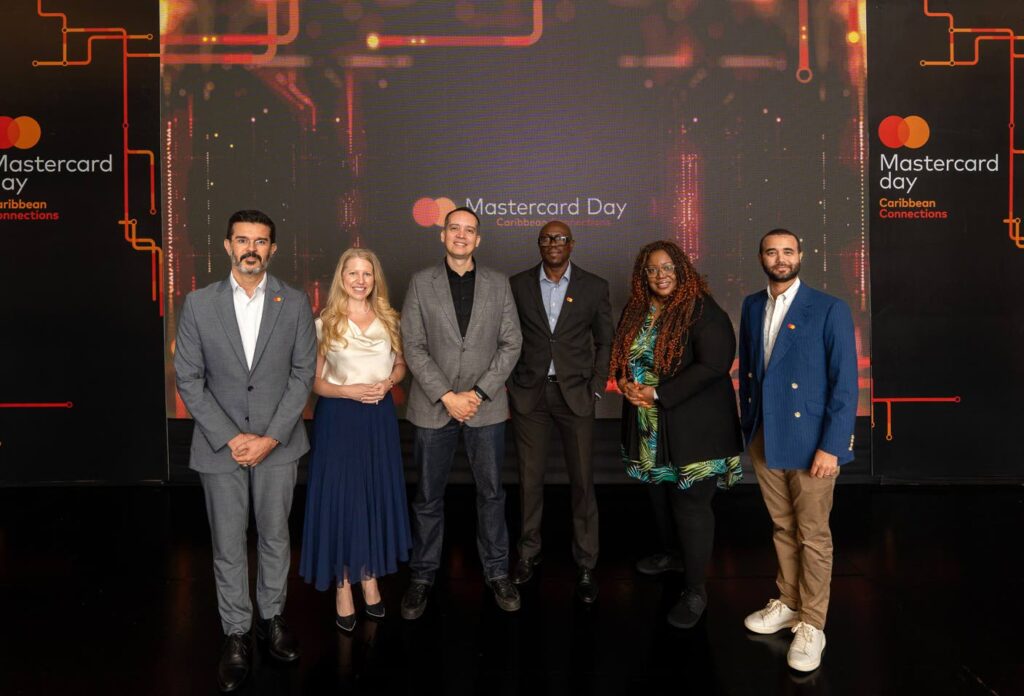
Members of the Mastercard team share a photo op during the annual Matercard Day activities held at the AC Hotel in Kingston. From left: Marcus Carmo, vice president of product marketing for B2B and Latin America and the Caribbean; Lindsay Lehr, Co-Founder and Managing Director of Payments and Commerce Market Intelligence (PCMI). Jose Interiano Senior Vice President, Transfer Solutions, Mastercard LAC. Dalton Fowles, Country Manager for Jamaica, Trinidad and Tobago, Barbados and the Eastern Caribbean; Chantal Ricketts, Vice President of Product Development and Foundry Regional Innovation, Mastercard North America. Michael Capozzi, Vice President of Digital and Agent Commerce;
global Payments company Mastercard is preparing for the next phase of how consumers shop and pay with a new use of agent-based artificial intelligence (AI) technology that will allow AI-powered assistants to make purchases on behalf of customers.
Dalton Fowles, Mastercard’s Caribbean country manager, said the company is already laying the groundwork for what could be the next evolution in digital commerce, developing the rules and security framework needed to support transactions initiated by autonomous AI agents.
“We’ve always leveraged AI, particularly from a network perspective to combat fraud, so it’s already embedded in the way we work. But as the technology continues to evolve, consumers will hear more and more about agent AI. It’s coming, and it’s coming very quickly,” Fowles said at a media roundtable held as part of the recent Mastercard Day activities in Jamaica.
Mastercard’s push into agent commerce comes amid growing acceptance of digital payments in Jamaica, where consumers are becoming more familiar with traditional payment methods such as debit and credit cards, while embracing new digital solutions.
With agenttic AI, consumers can use an AI assistant to not only research products and services, but also complete the purchase after user approval. These digital agents will eventually be able to shop, manage subscriptions, and perform a variety of everyday financial tasks on behalf of consumers.
“Cardholders can, for example, use AI tools to initiate an investigation and instruct an agent to purchase something on their behalf,” Fowles explained. “That’s reflected in the pipeline very quickly.”
While the concept may still seem futuristic, Fowles said agent AI payment capabilities are already being implemented in some international markets.
Earlier this year, Mastercard executed the first authorized agent transaction in Australia through its Agent Pay solution. Initial assessments already suggest that AI-enabled commerce could impact 55% of Australian consumer transactions by 2030, with annual spending reaching up to A$670 billion.
Mastercard said it remains committed to enabling fully recognized and authenticated agent transactions, with the Trusted Agent Framework process introducing AI agents as visible and controlled participants into payment flows, ensuring every transaction is secure, transparent and trustworthy.
To prepare for widespread adoption, Mastercard is currently working with partners around the world to establish secure standards for AI-driven transactions while maintaining strong consumer protections.
The move builds on Mastercard’s long history of leveraging AI across its network. This technology already plays a key role in fraud prevention, helping monitor transaction patterns, identify anomalous spending behavior, and alert you to potential fraud in real-time.
Beyond AI, Mastercard continues to strengthen its partnerships across the fintech ecosystem as digital payment methods evolve.
As the adoption rate of contactless payments in Jamaica rises to 56 per cent, Mastercard executives recently gathered at the AC Hotel in Kingston to discuss how innovation and broader digital acceptance can support a more connected and inclusive economy.
Fowles said that while acceptance of digital products is growing in the local market, there remains a significant opportunity to expand acceptance of digital payments across small business, tourism and transportation, and to help more businesses fully participate in the digital economy.
The results of Mastercard’s latest “Jamaica’s State of Digitalization and Financial Inclusion” study showed that despite a strong foundation for digital payments, merchant acceptance remains a major barrier. The survey found that 92 percent of consumers want more businesses to accept digital payments.
Mastercard said it will continue to proactively collaborate with financial institutions, merchants and government officials to build the seamless digital ecosystem that Jamaicans need and want, building on the findings through a wide range of solutions including contactless, tap-on phone and click-to-pay combined with targeted merchant and consumer education efforts.
“What is needed now is coordinated action to build a network of merchants where Jamaicans can shop every day, while ensuring consumers and businesses have the knowledge and confidence to use digital payment options reliably,” Fowles said.
“As Jamaica moves towards a more digital economy, the future of financial inclusion depends on how easily people can pay for the most important things in their daily lives, wherever they are.”


