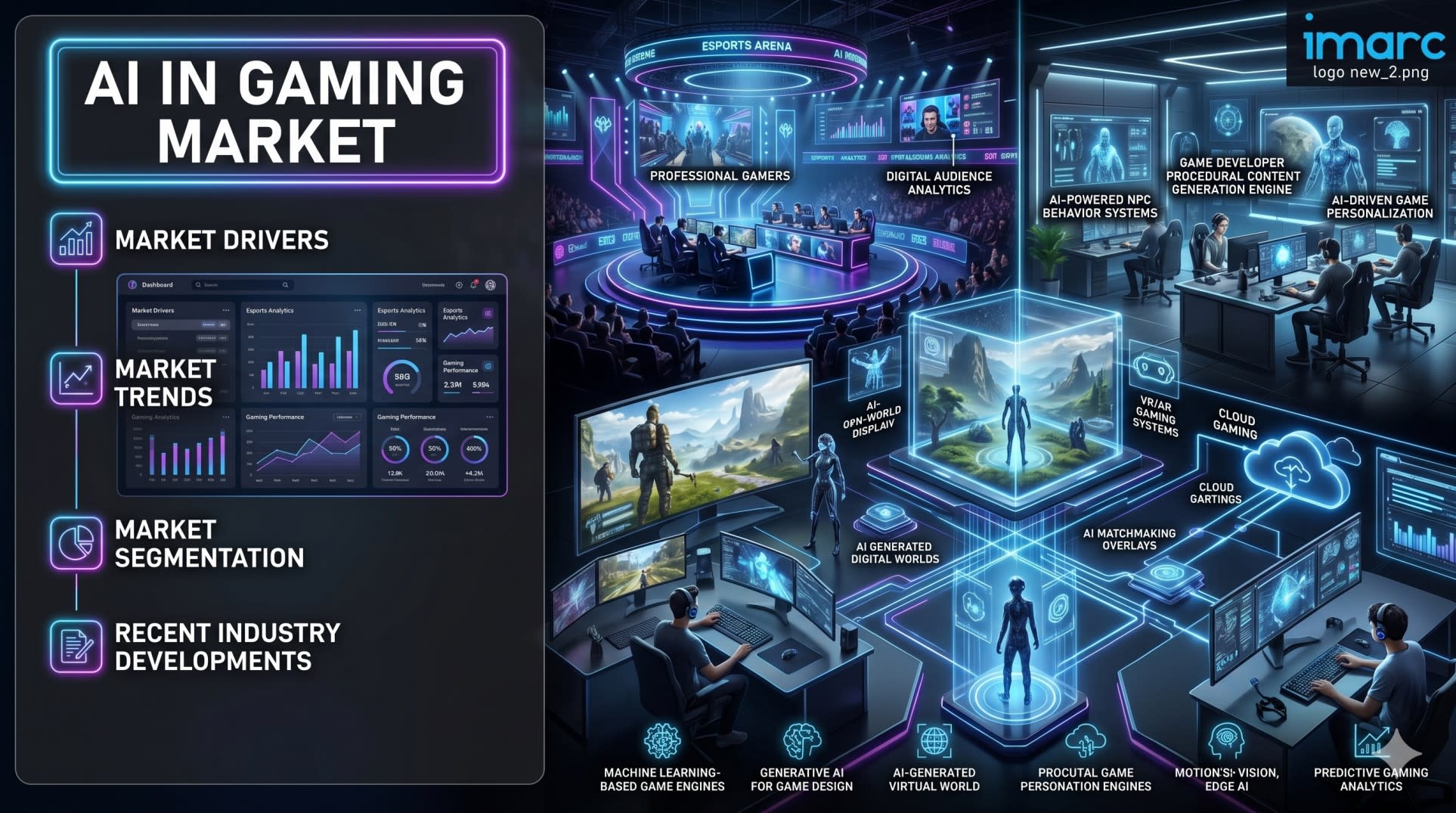
According to IMARC Group’s latest research publication, the global AI in gaming market size is valued at USD 39.4 billion in 2025. The market is projected to reach USD 876.9 billion by 2034, exhibiting a growth rate (CAGR) of 39.91% from 2026 to 2034, demonstrating strong growth momentum driven by advances in machine learning, growing demand for immersive player experiences, and increasing integration of AI. These include the behavior of non-player characters and increased investment in gaming startups and cloud gaming infrastructure.
How AI is reshaping the future of AI in the gaming market
- Integrating generative AI for dynamic content creation: One of the most transformative trends shaping AI in the growth of the gaming market is the adoption of generative AI for dynamic and personalized content generation. Game developers are leveraging large-scale language models and generative algorithms to create unique mission paths based on real-time interaction, adaptive storytelling, and individual player behavior. A study by Google Cloud and The Harris Poll found that 87% of game developers are incorporating AI agents into their development process, and 36% are using AI for creative tasks such as dynamic level design and dialogue writing. This greatly increases replayability and player engagement, allowing for customized experiences not possible with traditional scripting techniques. Additionally, generative AI enables studios of all sizes to compete by automatically creating assets such as textures, levels, and character designs to optimize development workflows, reduce production costs and schedules, and deliver rich, dynamic worlds at scale.
- Personalized gameplay and player behavior prediction: The ability to analyze and respond to player behavior in real time is a key differentiator in today’s gaming landscape, and this capability represents one of the key drivers of AI in gaming market growth. AI systems are now being employed to predict user preferences, skill levels, and emotional states, allowing developers to adjust gameplay difficulty, recommend in-game purchases, and deliver targeted content. AI-powered game personalization has been shown to increase player engagement by up to 35%. AI models analyze real-time telemetry data to identify trends that indicate user frustration or boredom and change game mechanics accordingly. Predictive analytics is also utilized in competitive games to pair players with similar skill levels, ensuring fairer and more enjoyable gameplay that maintains long-term user retention and platform loyalty.
- AI-powered non-player character behavior modeling: Non-player character behavior modeling is a major application of AI in the gaming market. Because developers are deploying machine learning and deep learning systems to create NPCs that dynamically respond to player decisions rather than following a fixed, scripted path. AI-driven NPCs can learn from player interactions over time and adapt their tactics, dialogue, and behavior patterns to create more believable and rewarding in-game enemies and allies. This feature fundamentally changes the depth and longevity of the gaming experience, especially in role-playing games, action and adventure titles, and strategy games, where opponent intelligence directly determines the quality of gameplay and player satisfaction. Studios that integrate adaptive NPC systems report significant improvements in session length and user retention metrics compared to titles that rely on traditional scripted character logic.
Overview of AI in the gaming industry
The convergence of machine learning, generative AI, natural language processing, and computer vision is creating an entirely new paradigm for how games are designed, developed, and experienced, and the global AI in gaming market is undergoing a rapid transformation. The industry is experiencing strong growth momentum, driven by the global expansion of cloud gaming infrastructure, the proliferation of mobile gaming platforms, and the deepening integration of AI at every stage of the game development lifecycle, from concept to post-launch optimization.
North America leads the world in AI in gaming markets, driven by a concentration of major game studios, technology companies, and AI research institutions that are jointly accelerating the development and commercial deployment of gaming AI capabilities. The region benefits from an established cloud infrastructure, high per capita gaming spending, and a competitive environment that fosters continued technology differentiation through AI investments. Asia Pacific represents the fastest growing regional market, driven by a large mobile gaming user base spanning China, Japan, South Korea, and India. AI-powered personalization and engagement tools are essential to competing in a highly saturated app store environment with hundreds of millions of active players.
Download a sample report to see key data and forecasts
AI trends and drivers in the gaming market
The growing demand for immersive and personalized gaming experiences represents a key structural driver of AI in gaming market growth. Modern players increasingly expect games to adapt in real-time to their individual behaviors, skill levels, and preferences, rather than providing the same fixed experience for all users. AI systems that can continuously monitor player telemetry and dynamically adjust difficulty, pacing, narrative branching, and content recommendations directly address this expectation and transform player satisfaction and long-term retention outcomes for studios that effectively onboard players.
Increased investment in gaming startups and cloud gaming infrastructure is simultaneously accelerating the pace of AI adoption across industries. Cloud gaming platforms remove the hardware constraints that previously limited the computational complexity of AI systems that can be deployed within gaming environments, allowing developers to run advanced machine learning models server-side that would be impossible to run on consumer devices. This infrastructure shift is especially important for mobile and streaming gaming platforms, where cloud-based AI can deliver console-quality personalization and NPC intelligence to players on lower-spec devices across emerging markets.
Microsoft Gaming announced Muse in February 2025. Developed in collaboration with Ninja Theory, this is a generative AI model designed to generate gameplay snippets and controller actions in real-time, enhancing the game development process by providing dynamic content creation capabilities. This development reflects an industry-wide shift toward AI tools that enhance the creative capabilities of development teams rather than simply automating back-end operational tasks, positioning generative AI as a core component of future game design workflows across studios of all sizes.
Scopely announced in March 2025 that it would acquire Niantic’s entire video game division for $3.5 billion, giving it control of major titles such as Pokemon GO and Pikmin Bloom. This strategic move aims to strengthen Scopely’s portfolio with Niantic’s expertise in geospatial AI and augmented reality technologies, underscoring the leading gaming company’s emphasis on unique AI and spatial computing capabilities as fundamental competitive assets for next-generation location-based and mixed reality gaming experiences.
A leading global AI company in the game industry
- Electronic Arts Co., Ltd.
- Google LLC (Alphabet Inc.)
- Microsoft Corporation
- NetEase Co., Ltd.
- NVIDIA Corporation
- Sony Interactive Entertainment LLC
- Tencent Holdings Limited
- Ubisoft Entertainment SA
- Unity Technologies
AI in Segmentation of Gaming Market Report
By component:
- hardware
- software
- service
The report offers detailed segmentation and analysis of the market based on components, covering hardware, software, and services across the global AI in Gaming ecosystem.
By game genre:
- action and adventure
- Role-playing games (RPGs)
- strategy game
- simulation
- others
A detailed segmentation and analysis of the market based on game genres including action and adventure, role-playing games, strategy games, simulation, etc. is provided, reflecting the diverse adoption patterns of AI technologies across game content categories.
By platform:
- mobile games
- PC games
- console games
- AR/VR games
- Cloud/Streaming Games
- others
The report provides in-depth segmentation and analysis of the market based on platform, covering the overall global AI in mobile games, PC games, console games, AR/VR games, cloud and streaming games, and other gaming areas.
By technology:
- Machine learning/deep learning
- Generation AI
- NLP
- computer vision
- others
A detailed market segmentation and analysis is provided based on the technologies driving AI capability development across the gaming industry, including machine learning and deep learning, generative AI, natural language processing, and computer vision.
By application:
- Non-player character (NPC) behavior modeling
- Automate game testing and quality assurance
- Procedural content generation
- Voice recognition of commands
- Cheat detection and fraud prevention
- Player behavior prediction and personalization
- others
The report provides detailed segmentation and analysis of the market based on applications, covering NPC behavioral modeling, game testing and quality assurance automation, procedural content generation, voice and speech recognition, cheat detection and fraud prevention, player behavior prediction and personalization, etc.
Regional insights:
- North America (USA, Canada)
- Asia Pacific (China, Japan, India, South Korea, Australia, Indonesia, and others)
- Europe (Germany, France, UK, Italy, Spain, etc.)
- Latin America (Brazil, Mexico, others)
- middle east
- Africa
The report provides a comprehensive analysis of all major regional markets, mapping the key regions and fastest growing regions, enabling stakeholders to identify key country-level opportunities within each region of the global Gaming AI market.
Recent news and developments in AI in the gaming market
- March 2025: Scopely announces it will acquire Niantic’s entire video game division for $3.5 billion, giving it control of major titles such as Pokemon Go and Pikmin Bloom. This strategic move aims to strengthen Scopely’s portfolio with Niantic’s expertise in geospatial AI and augmented reality technologies and establish a major new competitive advantage in location-based and mixed reality games leveraging its unique spatial AI capabilities.
- February 2025: Microsoft Gaming announced Muse, a generative AI model co-developed with Ninja Theory. Muse is designed to generate gameplay snippets and controller actions in real-time, enhancing the game development process by providing dynamic content creation capabilities that augment the creative output of development teams throughout the game design lifecycle.
Note: If you require specific details, data, or insights that are not currently within the scope of this report, we would be happy to accommodate your request. As part of our customization services, we collect and provide any additional information necessary to meet your specific requirements. Please let us know your exact needs. We will ensure that your reports are updated to meet your expectations.