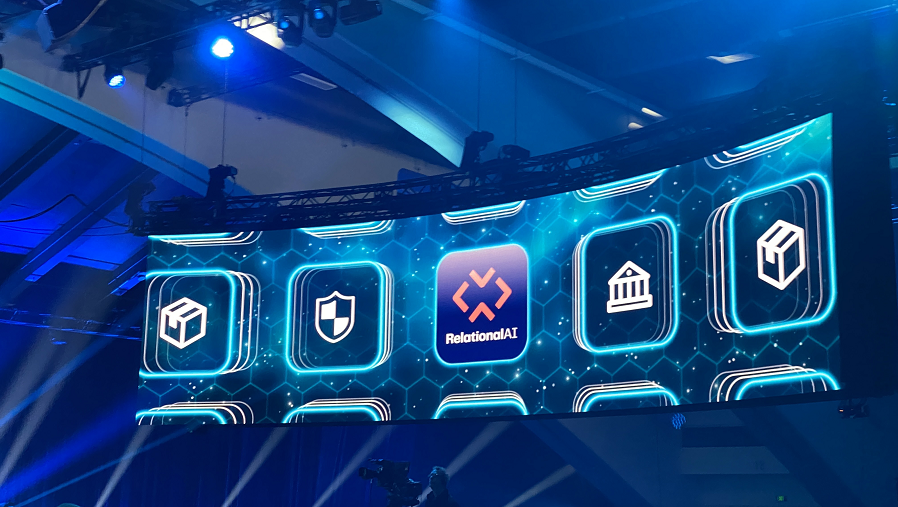
RelationalAI Inc., an enterprise decision intelligence startup, is advancing the capabilities of Snowflake Inc.’s AI data cloud platform.
Today at Snowflake Summit 2026, we announced a series of updates aimed at providing artificial intelligence agents with the context, inference, and post-training they need to make smarter business decisions autonomously.
The company said the goal of today’s update is to close the “AI value gap” where many companies struggle to extend the capabilities of generative AI. The new capabilities in Rel, the company’s flagship agent decision intelligence system, will help Snowflake customers enhance the capabilities of their “decision agents” in areas such as supply chain management, network operations, resource allocation, and pricing strategy.
The highlight of today’s announcement is the launch of the new Rel App. It is a centralized tool for planning a shared and fully managed semantic representation of each customer’s entire business. This app is designed to map everything from business concepts to internal relationships and operating rules.
Rel App allows domain experts to explore their company’s data, follow connections, ask questions in natural language, and make logical decisions. The company says each interaction is based on its data stored within the Snowflake AI Data Cloud.
Additionally, RelationalAI has debuted a key pair of new agent skills called Predictive Reasoning and Prescriptive Reasoning. Available today, this prescriptive reasoning capability is designed to handle multi-domain reasoning and optimization problems. The company says it combines large-scale language model inference and graph computation to improve the accuracy of AI agent inferences while also reducing computational costs.
As for predictive inference capabilities, this is also available starting today. It leverages graph-based neural networks within Snowflake to attempt to predict business outcomes such as asset failure and customer churn. This means agents can more easily move from making predictions to recommending actions and executing them on behalf of customers.
The new service targets key bottlenecks in the broader AI data environment. As TheCUBE Research’s Dave Vellante and George Gilbert pointed out in a recent Breaking Analysis, platforms like Snowflake Horizon are great at organizing governance metadata. It acts as a catalog that defines what the data means and who can access it.
But businesses seeking a true “intelligence system” need more than this. RelationalAI has established itself as a critical part of the enterprise context layer by mapping live, executable business logic and relationships to enterprise ontologies.
“The key difference is between catalogs and intelligence. Catalogs provide definitions. Catalogs tell you what metrics mean, where the data resides, who owns it, and what policies apply. It’s necessary, but it’s not sufficient,” Bellante and Gilbert wrote. “Intelligence systems will evolve further. They will begin to model the business process logic itself, including verbs as well as nouns. As business rules, relationships, and actions become alive, managed, and ultimately actionable, enterprises move from metadata to intelligence.”
To support our position as an intelligence system, RelationalAI has become a launch partner of the new Open Semantic Exchange initiative. This makes it easy for enterprises to port business ontologies from third-party platforms to Snowflake without having to rebuild anything.
In a separate update, the company said its platform powers conversational decision intelligence capabilities within Snowflake CoWork. Snowflake CoWork is a platform aimed at enhancing collaboration between human workers and AI agents. This integration enables humans to ask ad hoc business questions in natural language and receive insights from RelationalAI’s inference systems.
Finally, RelationalAI said it is launching a new “push-button” post-training feature for AI agents in private preview. This allows enterprise users to fine-tune open source LLM with their own Snowflake data and semantic framework. The company said this will support the creation of specialized AI agents that are familiar with the company’s proprietary terminology and business logic.
Molham Aref, founder and CEO of RelationalAI, said AI agents are similar to humans in that they have difficulty making good business decisions without extensive knowledge of the organization. “Running these capabilities natively on Snowflake AI Data Cloud allows customers to close the AI value gap by providing agents with the context, tools, and post-training they need to take the best action in the face of uncertainty,” he said.
Image: RelationalAI
Support our mission of keeping content open and free by joining the theCUBE community. Join theCUBE’s Alumni Trust Networka place where technology leaders connect, share intelligence, and create opportunities.
- over 15 million viewers of theCUBE videospowering conversations across AI, cloud, cybersecurity, and more
- 11.4k+ theCUBE Alumni — Connect with over 11,400 technology and business leaders who are shaping the future through our trusted, unique network.
About SiliconANGLE Media
Founded by technology visionaries John Furrier and Dave Vellante, SiliconANGLE Media has built a dynamic ecosystem of industry-leading digital media brands that reach more than 15 million elite technology professionals. Our new, proprietary theCUBE AI Video Cloud leverages theCUBEai.com neural networks to deliver breakthrough advances in audience interaction, helping technology companies make data-driven decisions and stay at the forefront of industry conversations.