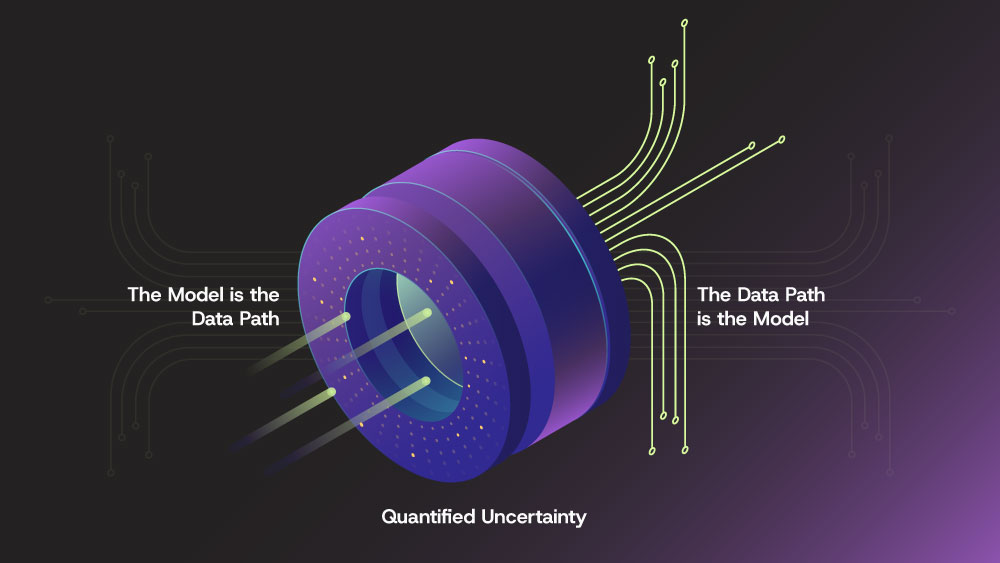
All major AI systems in production today work the same way. Take a dataset, compress it into a set of parameters, and deploy those parameters as a model. Data will be lost. All that remains is the model.
This has been the default architecture for over a decade, and for good reason. it works. Large-scale language models, recommendation engines, and predictive analytics platforms all follow this handbook. But as AI moves deeper into regulated industries and high-stakes commercial decision-making, it becomes harder to ignore the impact of its architectural choices.
When a model makes a decision, it cannot be traced back to specific evidence. If conditions change, the model won’t know it’s wrong. If you need to delete someone’s data, you can’t re-boil the eggs.
What if there is a problem with the architecture itself?
cost of compression
Standard machine learning pipelines treat data as input, the model as the hub of intelligence, and training as a transformation that transforms one into the other. Once trained, the model becomes a product. Data will be archived or destroyed.
This separation creates three structural problems that no amount of scaling can solve.
First, traceability is indirect at best. Decisions emerge from billions of parameters interacting across a high-dimensional space. You can build post-explanation tools, but you cannot point to the specific observations that produced a specific output. In highly regulated industries such as healthcare, finance, and advertising based on privacy laws, this is not an academic concern. It’s a compliance responsibility.
Second, adaptation is temporary. The model’s knowledge is frozen the moment training ends. When the world changes, such as when new competitors enter the market, regulations go into effect, or consumer behavior changes, the model continues to operate based on old assumptions until someone decides to retrain it. During that time, reliability remains high but validity decreases.
Third, generalizations are approximate. The model extrapolates from the compressed representation, which may or may not hold under new conditions. There is no mechanism to evaluate whether the learned relationships are still valid. It’s just assuming that’s the case.
These are not bugs. These are the results of the architecture.
Why does the correlation break down?
Parameter-based systems learn correlations. Given enough data, they approximate statistical relationships between inputs and outputs, often with surprising accuracy. However, correlations have fundamental limitations. It does not encode uncertainty about itself.
A model trained on two years of purchase data shows that consumers who purchase organic baby food are also more likely to purchase premium diapers. What we don’t know is whether that relationship will hold up in subsequent quarters, whether it reflects pure preference or temporary promotion overlap, or how confident we can be in that pattern if the retail environment changes.
As the environment changes, in CPG, advertising, and retail, the environment is constantly changing and correlation-based systems degrade without warning. Their confidence scores remain high even when real-world accuracy breaks down. Anyone who has seen lookalike audiences lose effectiveness after a platform privacy update has experienced this firsthand.
This vulnerability is not due to insufficient training data or model size. This reflects the lack of a mechanism to measure how reliable a relationship is, rather than simply how often it appears.
Learning as measurement
There are alternatives. Rather than defining learning as compressing data into parameters, we define learning as continuously measuring relationships within the data itself.
In this frameworkthe system does not fit the global function. Evaluate how compatible individual observations are with each other. The central quantity is uncertainty, specifically how surprising it is to substitute one observation for another.
Observations are functionally similar if the substitution preserves information. Not that it brings any major surprises.
This changes everything about how the system works. Learning becomes an accumulation of measured relationships rather than an optimization of weights. Inference becomes the process of identifying informative analogs in the data and weighting them by their measured reliability. Generalizations emerge from consistent local structures rather than global approximations.
As a result, there is no distinction between data and model. The dataset itself becomes a model, annotated with relationships and quantified uncertainties. There are no separate training phases, fixed parameter sets, or compression of information into abstract weights.
What does this enable?
When a model is data, several things change at the same time.
All decisions are traceable. Because the information is not irreversibly compressed, any output can be traced back to the specific observation that produced it. This is not an after-the-fact explanation screwed into an opaque system. It’s architecture specific.
Adaptation is continuous. New observations impact relevance immediately, without the need for retraining. The system doesn’t have to wait for the engineering team to schedule a retraining cycle. As new evidence arrives, it is incorporated.
The failure is visible. With increased uncertainty, when a system encounters conditions that it could not adequately measure, it may explicitly exhibit reduced reliability rather than silently producing unreliable outputs. Parametric models can have significant differences in reliability and accuracy. In measurement-based systems, they are structurally linked.
Bias is testable, not built-in. Traditional models have inductive biases embedded in them during training, such as the choice of architecture, loss function, or optimization procedure, which often shape their results in ways that are opaque and impossible to separate a posteriori. Measurement-based systems minimize such implicit constructs. Relationships influence outcomes only to the extent that they reduce uncertainty. When a feature no longer provides information, its impact naturally diminishes.
A different perspective on intelligence
This framework suggests something important about what machine intelligence actually is or can become.
The dominant paradigm treats intelligence as an increasingly sophisticated function approximation. Building larger models and training them with more data will give you better predictions. This has produced impressive results, but it confuses two things: the ability to predict and the ability to know.
A measurement-based approach provides a clearer distinction. Prediction is not the goal. The objective is to assess how well the conclusions are supported by the available evidence. Models do not create knowledge. They approximate it. Systems built on continuous measurement act directly on the knowledge structures that exist within the data.
This is not a theoretical discussion. This is architectural and has practical implications for any area where decisions need to be transparent, auditable, and responsive to change.
where is this going
The success of parameterized models has shaped the trajectory of AI for over a decade. Its trajectory will not reverse. Large-scale language models and deep learning will continue to dominate applications where scale and pattern recognition are paramount.
But the growing variety of problems demands something different. Native transparency, not an afterthought. Continuous adaptation, not temporary. Confidence that reflects actual trustworthiness.
The alternatives to these problems are obvious. Models are not separate artifacts. This is data that is structured, measured, and interrogated in real time.