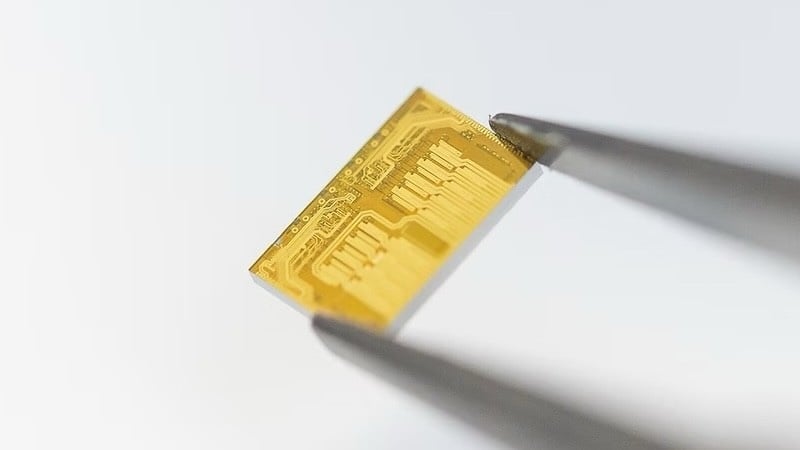
The bottleneck limiting the next generation of artificial intelligence is not computational power, but the wires that connect the chips. French startup Scintil Photonics thinks it has the answer.
For decades, the semiconductor industry operated on the comforting assumption that if chips grew faster, the rest of the system would follow. That assumption is now crumbling, and nowhere is the stress more visible than within an AI data center.
The numbers are staggering. Cloud bandwidth demands effectively double every two years. The size of AI models is growing faster than Moore’s Law can accommodate. Nvidia CEO Jensen Huang captured the magnitude of the challenge at Computex 2025 when he said that NVLink spines, the high-speed interconnect fabric that links Nvidia’s GPU clusters, move more data per second than the entire Internet. What was once a theoretical constraint has become an operational imperative.
Copper has reached its limit
The culprit is copper. Traditional copper SerDes interconnects have served the industry reliably for many years, but they are reaching fundamental physical limits. At the signal speeds demanded by modern AI workloads, copper cables can only extend short distances before signal integrity is compromised.
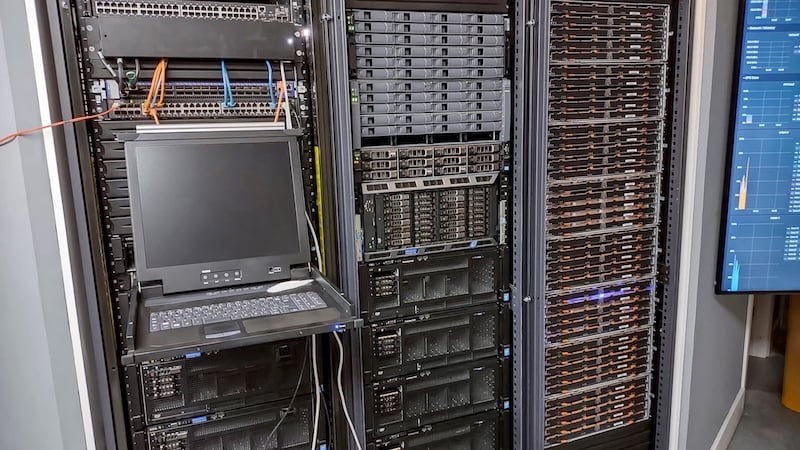
As GPU clusters continue to scale up, copper interconnects struggle to keep up. Image courtesy of Adobe Stock (licensed).
As GPU clusters scale from tens to hundreds to thousands of accelerators and distributed across multiple racks, copper cannot fill the gap. Tomorrow’s AI scale-up networks – dense, high-bandwidth fabrics that can coordinate thousands of GPUs as a single computational entity – will require something fundamentally different.
That something is light. The photonics industry has long supplied optical transceivers to data centers in the form of pluggable modules, discrete components that convert electrical signals to optical signals at the edge of a switch or server. These pluggable solutions work, but they come at a huge cost. Latency is tens to hundreds of nanoseconds, energy consumption is approximately 17 to 18 picojoules per bit, and bandwidth density is approximately 1 to 2 terabits per second per millimeter of chip edge.
These numbers are orders of magnitude insufficient for next-generation AI infrastructure.
Co-packaged optics
A new solution is copackage optics (CPO), which integrates the optical engine directly on the same board in parallel with the computing ASIC or GPU, eliminating long electrical traces between the processor and transceivers. However, not all CPO architectures are the same. The mainstream approach uses CWDM (Coarse Wavelength Division Multiplexing), which packs four optical channels into a fiber at up to 200 Gbps per channel. Pluggable issues have been improved, but they are still half-hearted as a countermeasure.
A more promising architecture, and one that Sintil Photonics is betting the company on, is DWDM CPO (dense wavelength division multiplexing combined with co-packaged integration). The difference in performance between the two is obvious. CWDM CPO provides a delay of 50 to 100 nanoseconds and an energy efficiency of approximately 7 picojoules per bit, whereas DWDM CPO provides a delay of less than 5 nanoseconds and an energy efficiency of less than 3.5 picojoules per bit.
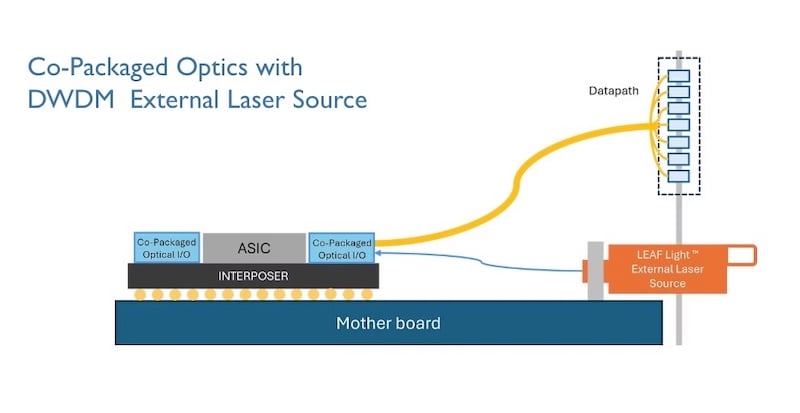
Scintil’s approach is to combine co-packaged integration with DWDense wavelength division multiplexing (DWPM).
Bandwidth density can scale to more than 8 Tbit/s/mm (approximately 8 times more than CWDM CPO), delivering up to 1,600 Gbps over a single fiber. DWDM CPO reduces power consumption by a factor of 6 when measured compared to traditional pluggables.
The problem is that DWDM CPO requires something the photonics industry has never successfully mass-produced: a single-chip, multiwavelength laser source that can be fabricated directly on a standard silicon photonics wafer.
Silicon photonics trade-offs
Silicon photonics is an elegant idea, but it has stubborn limitations. Although silicon is an excellent medium for routing and modulating light, it cannot efficiently generate light. Lasers, the central light source for all optical interconnects, have traditionally been made from III-V semiconductor materials (compounds such as indium phosphide), which are chemically and structurally incompatible with standard silicon manufacturing processes.
The traditional workaround is to build the laser separately and attach it to a silicon photonic chip by gluing a separate die or connecting an external module. This works, but reintroduces the consolidation penalty that CPO was supposed to eliminate. Additional interfaces mean more losses, more power, more failure modes, and significantly higher production costs.
Grenoble-based Scintil Photonics was founded in France to solve this integration problem from first principles. The company’s core innovation is the SHIP process (Scintil Heterogeneous Integrated Photonics). This is a wafer-level manufacturing technology that allows III-V laser materials to be directly integrated into standard silicon photonics platforms.
elegant approach
The approach to this process is elegant. Scintil starts with a standard silicon photonic wafer containing passive and active components (waveguides, modulators, and photodetectors), manufactured using a conventional CMOS-compatible process. The original silicon-on-insulator substrate is then removed by handle replacement, exposing the buried oxide layer.
An unpatterned III-V semiconductor die is bonded precisely to this surface where the laser resides. Importantly, the III-V material is patterned using photolithography at the wafer level, the same manufacturing step that defines the laser wavelength, giving Scintil superior precision in wavelength control that cannot be achieved with discrete assemblies.
The result is a monolithically integrated chip where the laser, waveguide, modulator, and detector coexist on a single piece of silicon and are manufactured in a single fab flow.
Sintil’s Leaf Light
Scintil’s first commercial product, LEAF Light, is the world’s first single-chip DWDM laser light source designed for AI-scale co-packaged optics. It supports 8 or 16 wavelength configurations on a single chip and has the industry’s tightest frequency spacing accuracy of ±10 GHz. Each wavelength carrier provides up to 20 milliwatts of optical power, resulting in wall outlet efficiency of approximately 20% at operating temperatures.
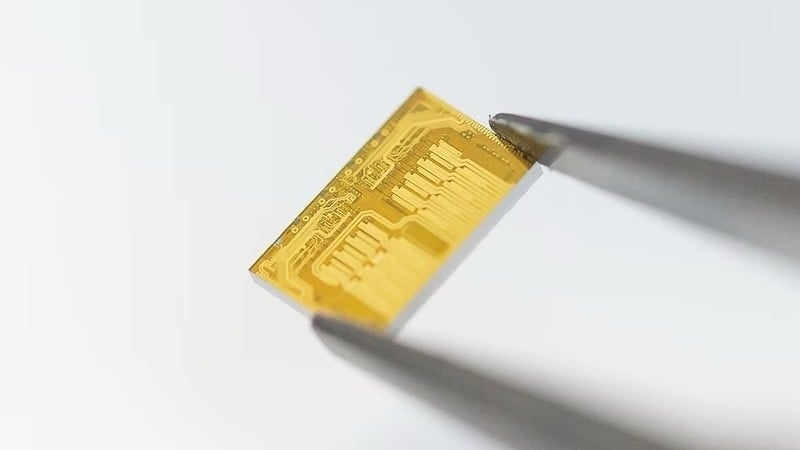
LEAF Light is a single-chip DWDM laser light source designed for AI scale co-packaged optics.
Crucially for data center operators, LEAF Light eliminates the failure modes most commonly associated with high-speed lasers. By eliminating the need for antireflection coatings and avoiding current flow through the grating structure, this architecture achieves stable mode-hop-free operation. This reliability characteristic is critical at the scale of modern AI infrastructures, where the failure of a single optical component can degrade the performance of an entire GPU cluster.
The market opportunity is huge. Scintil estimates the viable market size for LEAF Light in 2030 to be approximately $4.9 billion. This is based on an average connection rate of two DWDM sources per accelerator, with projected XPU shipments of 31 million units by the end of the decade.
financial signals
In September 2025, Sintil completed a Series B funding round, raising $58 million, part of a total of $85 million. The round was co-led by Yotta and Nokia Growth Partners, with participation from Nvidia, and was 100% reinvested from existing backers including Bpifrance, Supernova Invest, Bosch Venture Capital, Applied Ventures, and ITIC-Taiwan. This round was significantly over capacity.
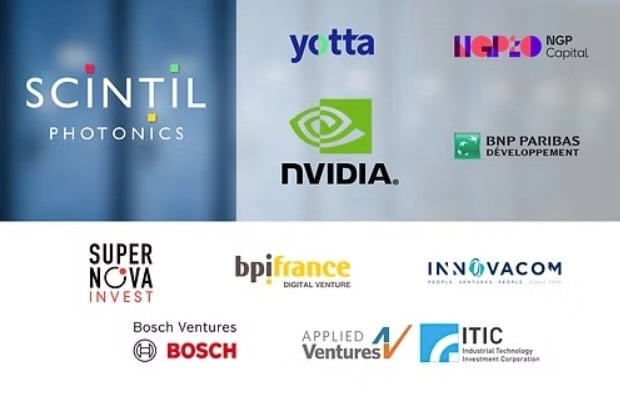
Scintil’s Series A B investment round, led by Yotta Capital Partners and NGP Capital, included significant participation from Nvidia.
Nvidia’s participation is more than just an economic signal. This shows that the world’s leading GPU manufacturers, whose scale-up interconnect fabrics are at the heart of every major AI infrastructure build, see heterogeneous integrated photonics as a reliable path forward.
Scintil’s production roadmap calls for the launch and pilot production of the LEAF Light product this year in 2026, with shipments to early access customers beginning in the same year and volume production ramping up to 2027. The company has a high-volume manufacturing partnership with Tower Semiconductor, one of the leading silicon photonics foundries, providing the fab capacity needed to scale to more than 100 million units.
Not “if” but “when”
The physics are clear. Copper wires cannot handle the bandwidth density demanded by AI infrastructure. The transition to optical interconnects is no longer a question of “if” but rather a question of which architecture, at what cost, and from whom. Sintil’s bet is that the answer starts with a single chip, 16 wavelengths, and a manufacturing process that ultimately makes light unique to silicon.
All images courtesy of Scintil, unless otherwise noted.