
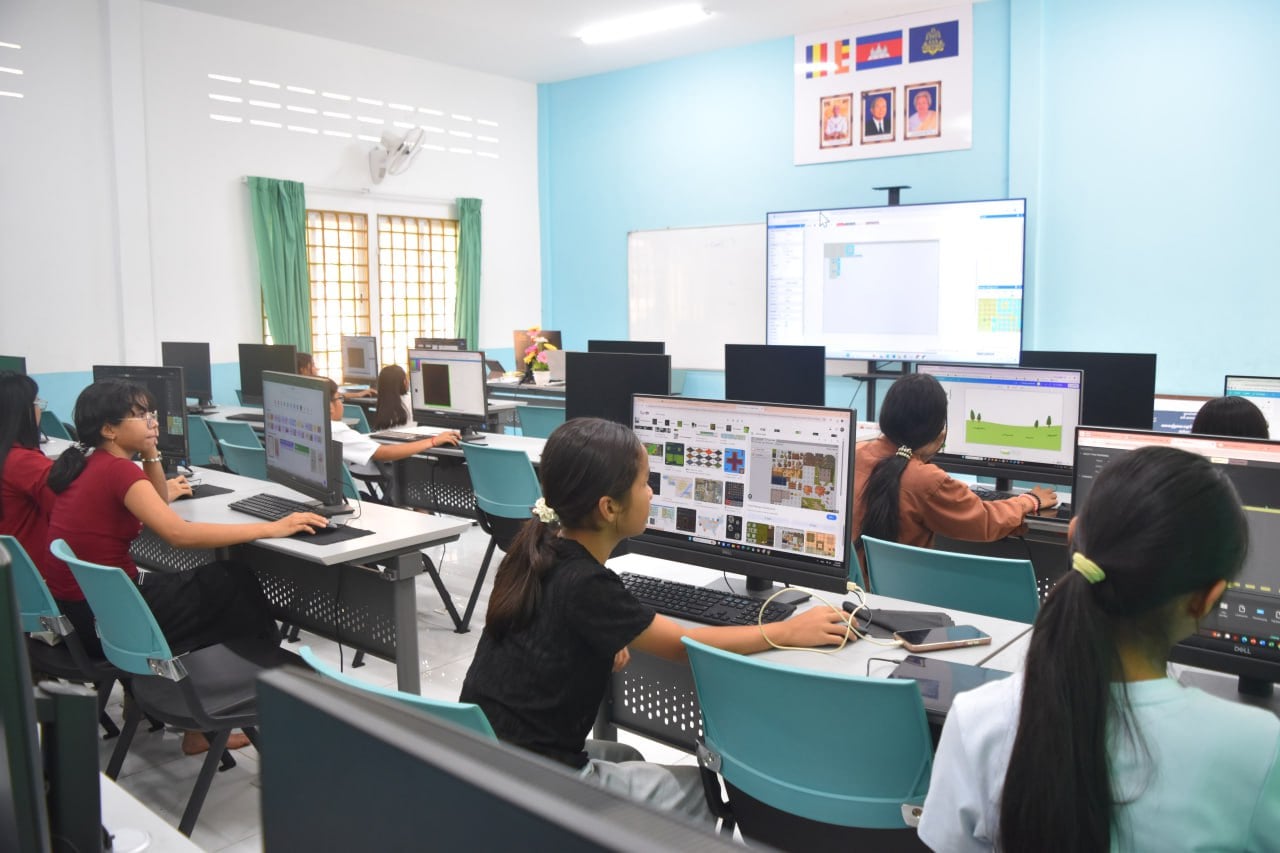
The lack of generative AI guidelines in Cambodian higher education institutions (HEIs) reflects a lack of readiness for a rapidly expanding technology that is perhaps the most disruptive yet potentially transformative tool to introduce into university classrooms.
With the exception of Puti Satra University of Technology (UP), few academic guidelines for the use of AI have been developed in Cambodian universities.
This delay is not unique to Cambodia. Data from a 2025 UNESCO survey of 400 higher education institutions (HEIs) in 90 countries, 15% of them in the Asia-Pacific region, found that just 19% of respondents said their institutions had a formal AI policy, and a further 42% said their AI governance framework was still “in development.”
However, the adoption of generative AI (GenAI) applications such as ChatGPT and Claude has expanded to the point that the majority of professors, students and administrators in higher education institutions in Southeast Asia use these tools on a daily basis, according to another UNESCO report on digital transformation in higher education institutions in the region in 2025.
Teachers and students are using GenAI all the time and are aware of both its benefits and its risks and challenges. However, the lack of formal guidelines risks compromising the quality of education.
To address oversight gaps and potential harmful uses of GenAI, higher education institutions in Cambodia should develop and enforce guidelines based on a growing number of empirical recommendations. Despite persistent systemic challenges such as fragmented management and limited resources, institutions do not have to go far beyond their existing capabilities to implement strategic policy guidelines for the use of AI, which is already ubiquitous in the classroom.
First step: Collaborative development of GenAI guidelines
Faculty, teachers, and students should be involved in the GenAI guidelines development process to ensure that diverse perspectives and experiences are reflected. It is important to foster ongoing dialogue with students, who are the most prominent users of these tools.
It is also important that the guidelines are not too strict and serve as guiding principles.
For example, two major higher education institutions in the region, Chulalongkorn University and Singapore University of Technology, clearly recognize both the potential and limitations of GenAI, including ethical concerns and issues related to academic integrity. These universities are encouraging their staff to use GenAI tools for assessment and teaching materials, balancing the potential risks and benefits.
Chulalongkorn University encourages the use of AI for creative brainstorming, but requires full disclosure of AI prompts to prevent ethical violations by concealing assistance.
These examples suggest that the degree of GenAI integration should be tailored at the faculty level to the specific requirements of each discipline. Once educators understand the core principles of GenAI, they should communicate clear expectations to students through open discussion, collaboratively develop classroom policies, and emphasize the importance of uniqueness in coursework.
Teachers should also require students to disclose their use of GenAI in their assignments, although such oversight will ultimately depend on student honesty and teacher validation.
The use of GenAI in the classroom should be categorized into three levels. The first is grammar correction and readability support. Second, use GenAI for summarizing, summarizing, and brainstorming. The third task, disclosure being the most important, involves drafting the original text, creating a bibliography, and interpreting the data.
Students must declare what level of GenAI use has been incorporated into their work and must be responsible for verifying the legitimacy of all citations and aggregated sources.
Institutionalizing AI disclosure is essential. In fact, data shows that nearly 60% of the world’s top 50 universities already have formal recognition guidelines in place for students.
The consequences of misuse or overuse of GenAI tools must also be clearly established. If the use of GenAI exceeds your institution’s or classroom’s guidelines, students must revise and resubmit their work.
From policy gaps to practical GenAI literacy
According to a 2024 survey, many instructors in Cambodia recognize the benefits of GenAI and argue that it should be allowed for educational purposes rather than banned. The findings suggest that both positive attitudes toward GenAI and students’ practical experience reflect widespread acceptance of the technology within the academic community.
However, only about 20% of Cambodian university students had received prior training in the use of GenAI, clearly demonstrating the urgent need for GenAI training for both students and teachers.
Higher education institutions should develop training curricula in collaboration with expert groups from the private and public sector. GenAI training should emphasize practical application over theory so that participants can immediately apply newly acquired skills in academic settings.
A key element that institutions should integrate throughout their training is a human-centered or “human-involved” approach. This is needed to address the need for users to critically evaluate AI-generated content and overcome what researchers call the “trust gap.” Higher education institutions also need to design training programs tailored to the specific abilities and needs of their staff and students.
Currently, Cambodian universities continue to face challenges in securing human resources. A lack of qualified instructors with master’s or doctoral degrees can limit an institution’s ability to fully understand both the benefits and risks of GenAI in the field being taught.
However, the rapid growth of Cambodia’s higher education institutions presents a unique opportunity to overcome the current policy vacuum. A shift from undeveloped guidelines to collaborative governance could transform GenAI in the classroom from a disruptive force to a pillar of organizational trust.
This transition requires more than just technical upskilling. This requires a cultural shift that engages students, faculty, and stakeholders as co-creators of ethical standards.
As Cambodia pursues education reform through the Education Strategic Plan 2024-2028, mastering GenAI will act as a catalyst for a more resilient digital economy, ensuring that the next generation of learners and educators do not just use technology, but help shape its responsible development and application.
Vuthy Khorn is a junior researcher at Future Forum, a public policy think tank based in Phnom Penh. This article was written as part of the Future Forum’s Inclusive Policy Fellowship, an initiative supported by the Australian Government through the Asia Foundation’s Ponlok Chomnes II: Data and Dialogue for Cambodia’s Development.


