
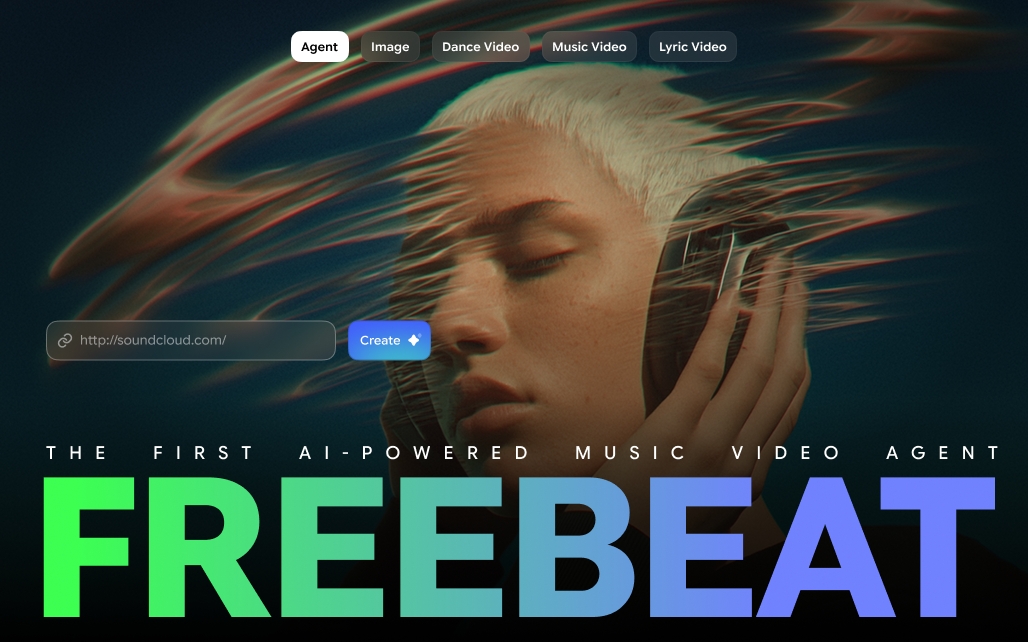
In 2021, my co-founder and I began developing the music vision foundation model that would become Freebeat. As engineers and lifelong music lovers, the question that drove us was simple. Why do all AI video tools ignore music?
We’ve seen the first wave of text-to-video generators arrive. Impressive technology, really exciting. But when musicians tried to use them for music video production, the workflow broke down. These tools generate short clips from text prompts without using any audio input. Creating something resembling a music video requires generating dozens of individual scenes, manually assembling them, and syncing them to a track in a separate editor. Music was not part of the creative process. AI has never actually heard of it.
We built Freebeat as a purpose-built AI music video generator because there is a gap between what exists and what musicians need.
The problem we are trying to solve: Generating visuals for music
Producing a professional music video can cost anywhere from $5,000 to $50,000 and take several weeks. For independent musicians and artists who use tools like Suno or Udio to create songs, distribute them through DistroKid, and publish them weekly to TikTok or YouTube, that model doesn’t scale. But the alternatives weren’t much better. While existing AI tools can produce beautiful, independent clips, video generators for music cannot produce consistent music videos from start to finish. We didn’t have the tools to understand that the verse needed a different visual pace than the chorus, that the bridge needed a change of mood, that the characters introduced in the opening still needed to be recognizable in the final shot.
Musicians don’t think in clips. They think in song. I needed to build a system that could convert songs to videos in the same way.
What does “music first” actually mean?
When creators upload their tracks to Freebeat, the music itself dictates the creative direction. Our system starts with multidimensional music analysis: BPM detection, onset mapping, energy curves, spectral characteristics, and section boundary identification (verse, chorus, bridge, drop). Based on that analysis, it autonomously generates a storyboard, chooses a visual style, and assembles a fully beat-synced video. Although creators can also use text prompts to control visual style, characters, and scene details, audio always forms the structural backbone of a video. We call this agent-based AI music video generation because the AI doesn’t react to audio peaks. The creator guides the aesthetic, directing a visual narrative shaped by the song’s emotional arc.
The technical differences are important. Most music video tools on the market sync the visuals to the volume. Loud moments trigger transitions, quiet moments hold static frames. That approach can’t tell the difference between a powerful chorus and a loud snare hit. Our 5-stage beat quantization system maps scene changes to transitions in musical phrasing and structure, widening the visual pace during reflective passages and accelerating through high-energy sections. The result is a beat-synced video that follows the story of the song, not just the waveform. This is something you can’t achieve with music visualizers or standard image conversion tools.

The most difficult problem: character consistency
Anyone who has worked with AI video generation knows the consistency problem. If you generate 10 shots of the same character in a row, by shot 6 you’ll have a different face, different clothing, and possibly a different number of fingers. In the case of a music video, this is a deal-breaker because one character could appear in 30, 50, or 80 shots throughout the four-minute track.
This is why character consistency was one of our deepest technical investments. Our character locking system supports dual characters in duet and narrative formats, maintaining recognizable characters across 80+ shots in a single video. Combined with around 90% lip-sync accuracy in over 100 languages, this means creators can create videos where characters actually sing, rather than just standing close to the music.
I would like to speak frankly about the current state of the market. Runway produces the best raw visual quality in its AI videos, but it doesn’t accept audio input during production, so every cut must be adjusted manually. Neural Frames provides superior fine-grained audio response control with 8-stem extraction, but produces abstract music visualizer output. Kaiber creates stylized animated visuals with beat-triggered transitions, but the volume-based responsiveness doesn’t distinguish between a song’s structural sections.
These are great tools to solve a variety of problems. What we currently offer is an AI music video generator that handles automated production from full songs to finished videos while maintaining consistency in character, and that’s a specific feature we’ve built for Freebeat to deliver. When creators upload their songs, a complete music video of up to 6 minutes in 1080p is generated in as little as 5 minutes, with no editing required.
What it means for creators
Since its launch, Freebeat has generated over 1 billion seconds of music video content for over 1 million creators in over 200 countries. We joined the Yamaha Creator Pass program earlier this year, and USA Today reported on how Gen Z musicians are embracing the platform. Our core users are independent musicians, producers with AI-generated songs from platforms like Suno and Udio, and content creators who need a reliable app for music video production across social platforms. One of the fastest growing use cases is for creators to create music videos for Suno songs, take AI-generated tracks, and create complete visual narratives in minutes instead of weeks.
We’re not trying to replace professional music video production. A director with a staff and a budget will always produce something that AI cannot. What we’re trying to do is give all musicians, especially those who can’t afford videography, a way to turn their songs into videos and expose their music in a visible way. That’s been our mission since we started building the technology in 2021, and reaching 1 billion seconds of content shows it’s resonating.
Bruce Chen is the CEO and co-founder of Freebeat (freebeat.ai), an AI music video generation platform founded in 2024 by Stanford University alumni. Freebeat is an official partner of Yamaha Creator Pass.
Source link


