

The conversation around enterprise AI video generation in 2026 has been dominated by leaderboard scores: which models have the highest Elo, which models produce the most realistic faces, and which models produce the longest clips. That conversation misses a more important change. The real story is that the input side of these models is converging to be multimodal, and ByteDance’s Seedance 2.0, launched in February 2026 and widely deployed through CapCut on March 26, is the clearest product example of what that looks like.
For companies building content operations around AI video, a multimodal pivot is more important than the next 50 Elo points in a benchmark. That changes which vendor decisions are reversible and which are not.
What Seedance 2.0 actually accepts
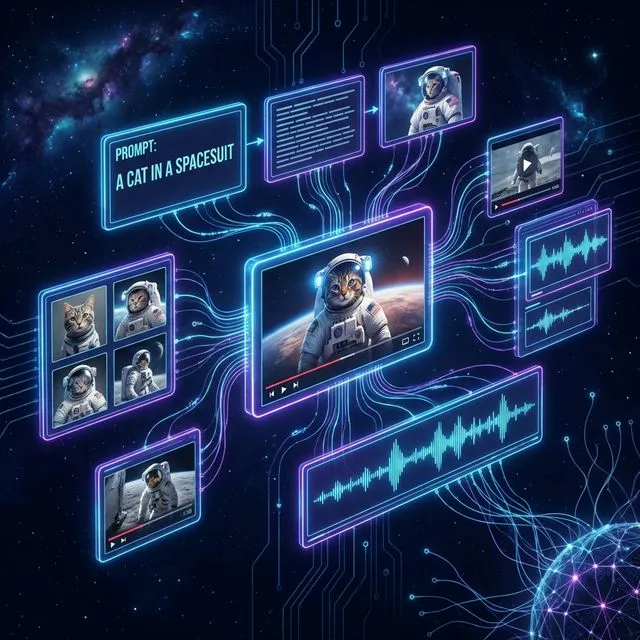
Seedance 2.0 uses an integrated multimodal audio and video co-generation architecture. Single-generation calls can take text, images, audio, and reference video as input, and ByteDance’s interface for models, Dreamina, accepts up to nine images, three videos, and three audio files per project, and outputs 2K video with synchronized native audio in a single pass. Duration is 4-15 seconds in all standard aspect ratios from 9:16 vertical to 21:9 horizontal.
An interesting technical detail is audio and video synchronization. Seedance 2.0 generates dialogue, sound effects, ambient noise, and music in the same forward pass as the video itself, with millisecond-accurate coordination between visual events and sonic layers. Previous generations of video models, including Seedance 1.x, handled audio as a separate step after generation. The architectural shift to co-generation of audio and video allows models to infer cause and effect across both modalities. The reason the cup hit the table and the sound was in the correct frame is because they both come from the same prediction.
For enterprise content teams, the multimodal input side is a more significant change. Marketing teams producing product videos were chaining together three or four separate tools: image generation for the starting frame, image-to-video conversion for motion, audio generation for narration, and a video editor to stitch it together. With Seedance 2.0, your brief generates a complete clip in one call, including product reference images, branded voiceover samples, and 30-second text prompts.
This is not a standalone release
Seedance 2.0 is currently ranked second in the Artificial Analysis Video Arena (Text to Video with Audio, Elo 1212) behind HappyHorse-1.0 at Elo 1213. Rankings change every month. A more obvious pattern is the one below the leaderboard. Three of the top five video models released in the past six months, Seedance 2.0, Kling 3.0 Omni, and Google’s Gemini Omni (announced at I/O on May 19, 2026) share a multimodal input architecture. The text-only input paradigm that defined AI video in 2024-2025 is being phased out by model labs themselves.
This is a tectonic shift for companies that have built their workflows around a text-to-video paradigm, including most of the purpose-built AI video tools currently on the market. The competitive challenge for AI video vendors in mid-2026 will no longer be about how good the text-to-video output is, but what range of inputs the system can accept and make inferences about. Platforms that don’t make this transition will look obsolete by Q4.
Worth reporting for enterprise teams running multimodal video pilots this quarter. LoraAI currently offers the following services 20% off HappyHorse This is a practical way to put the real Video Arena #1 in front of existing vendors without committing to list price during comparisons.
Strategic implications for enterprise content operations
There are two effects from multimodal pivots.
The first is that the boundaries between AI video generation and AI editing are disappearing. A model that accepts video as input, applies prompts or references, and outputs the edited video is not really a generator, but an editor that also happens to generate. Enterprise content operations that used to maintain separate procurement tracks for production and post-production are increasingly working with the same vendors on both sides, impacting budget allocation and team ownership that most content leaders have grappled with.
Second, standardization of a single model is no longer defensible. If the top 4-5 video models all accept similar inputs, all produce comparable lengths and resolutions, and all fall within 120 Elo of each other in blind testing, the risk of vendor lock-in is greater than choosing the “wrong” model. Companies that were deeply committed to a single AI video vendor in 2025 are spending the second quarter of 2026 untangling those decisions. The right attitude in 2026 is to treat the frontier model layer as a commodity to be exchanged, rather than as a strategic standardization decision.
Layer below the model to be actually composited
What hasn’t changed, and what won’t change no matter which model is launched in 2026, is that these frontier video and image models have no idea what a company’s specific products, people, or visual identity looks like. They draw plausible versions of something similar. That’s fine for the one-and-done generation. When producing thousands of brand-consistent assets across campaigns, the gaps can keep content programs stuck in revision cycles.
LoRA training fills that gap. The technique originates from a 2021 paper by Edward Hu et al. (arXiv:2106.09685), which demonstrated that low-rank adaptation can reduce trainable parameters by a factor of 10,000 compared to full fine-tuning without sacrificing quality. When applied to a diffusion-based image and video model, content teams can take a carefully selected set of references (15-30 images per character, 30-50 per style, 20-40 per object) and create small adapter files in hours that lock all subsequent generations to a specific identity.
The mistakes that derail a company’s LoRA program are operational, not technical. Dataset curation is more important than dataset size. 20 well-chosen references are always better than 200 mediocre references. Base model lock-in will surprise the team later on, as Flux LoRA will not work with Wan and 2024-era Flux LoRA will need to be retrained for Flux 2. Version control (update cycles associated with rebranding, package redesign, and talent rotation) requires an explicit owner. Organizations that handle them well treat their LoRA portfolios as design system assets and apply the same governance disciplines to fonts, color tokens, and component libraries.
Hopefully, the value of the LoRA layer will increase regardless of which Frontier model is at the top of the leaderboard this quarter. The model will be replaced. The LoRA library is not, as long as the underlying model decisions are made with portability in mind.
What does this stack actually look like?
According to McKinsey Q1 2026 AI data, 65% of organizations are now using generative AI in at least one business function, double the number 10 months ago. A May 2026 Gartner survey of marketing leaders found that automation of marketing tasks with AI is expected to increase from 16% in 2026 to 36% by 2028. The volume curve moves in one direction in every industry that produces visual content at scale.
A platform that makes sense in this diagram is one that treats image generation, video generation, and LoRA training as one workflow under one credit balance, rather than three separate procurement decisions. LoraAI is one of them. Run Seedance 2.0 in parallel with Gemini Omni, Veo 3.1, Kling V3, Wan, and HappyHorse., The video side includes PixVerse, and the image side includes GPT Image 2, Nano Banana Pro, Seedream 5.0, Flux 2, and Qwen Image. LoRA training on Flux, Kontext, Wan, and Nano Banana-based models exists within the same interface, and the trained LoRA appears directly in the generation UI without an export step.
Image side of the same pilot window: GPT images 2 are currently not restricted by LoraAIThis makes it cost-effective to evaluate closed-source image readers against existing image vendors in the same easy volume.
You can evaluate Lola AI Get 50 free credits when you sign up. No card required.



