

With the advent of the artificial intelligence (AI) era, the talent recruitment market is rapidly being reshaped. The number of AI job openings has more than doubled in five years, with increased demand for entry-level positions and in non-metropolitan areas, demonstrating that the demand for AI talent is widespread across the country and across all occupations.
HR tech company Job Korea on Thursday announced related data to commemorate the 1st anniversary of the opening of its recruitment channel “AI Job” specializing in AI jobs. AI Jobs is the domestic platform’s first specialized recruitment channel launched by JobKorea to meet the recruitment demand related to AI transformation (AX).
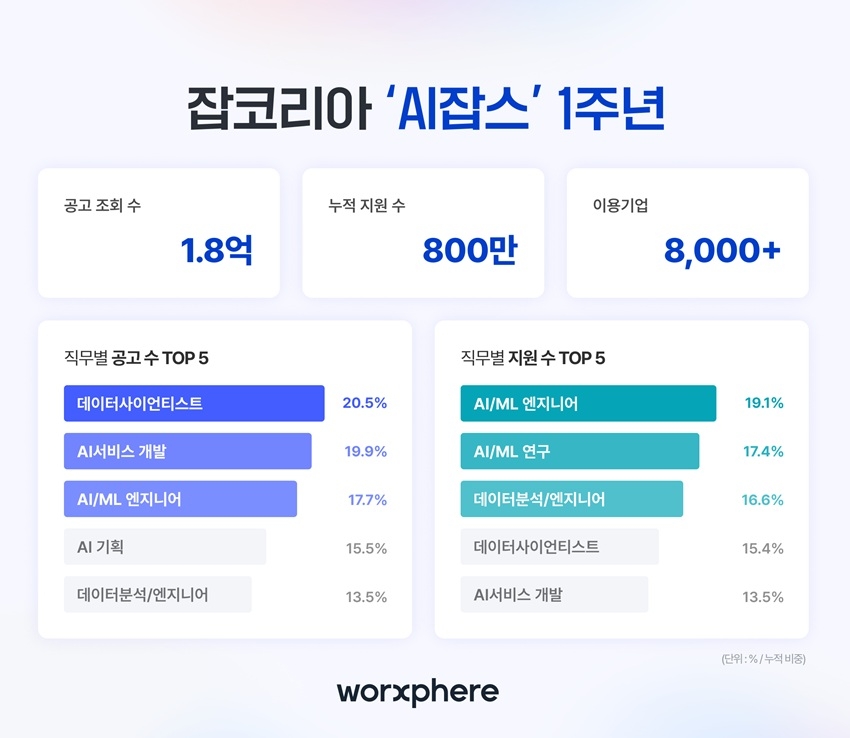
Within a year of its launch, AI Jobs garnered a strong response from both employers and job seekers. In the past year, the platform has secured approximately 100,000 job listings and 8,000 corporate users. The total number of applications has reached 8 million, and the number of job information views has reached 180 million. March coincided with recruitment season, and applications submitted through AI Jobs increased by 36% month-over-month.
In the first quarter of this year, the number of posts containing the keyword “AI” on Job Korea increased by 112% compared to five years ago. Entry-level job openings increased by 162%, and job openings outside metropolitan areas increased by 232%, showing sharp expansion. This trend reflects the demand for AI talent, which was once limited to specific research and development (R&D) departments, but has spread across all job roles following the introduction of generative AI.
Data scientist was the most sought after position by companies at 20.5%, followed by AI service development (19.9%), AI/machine learning (ML) engineer (17.7%), AI planning (15.5%), and data analyst/engineer (13.9%).
The job category most job seekers applied for was “AI/ML engineer” at 19.1%, followed by AI/ML researcher (17.4%), data analyst/engineer (16.6%), data scientist (15.4%), and AI service developer (13.5%), revealing a subtle gap between demand and supply.
A JobKorea official said, “AI has become a basic function in every industry, and changes in the human resources recruitment market can be confirmed from data.” “By building an integrated AI ecosystem that includes industry and job vertical platforms, AI-based recommendations and agents, we will transform the hiring paradigm with faster and more accurate job matching.”


