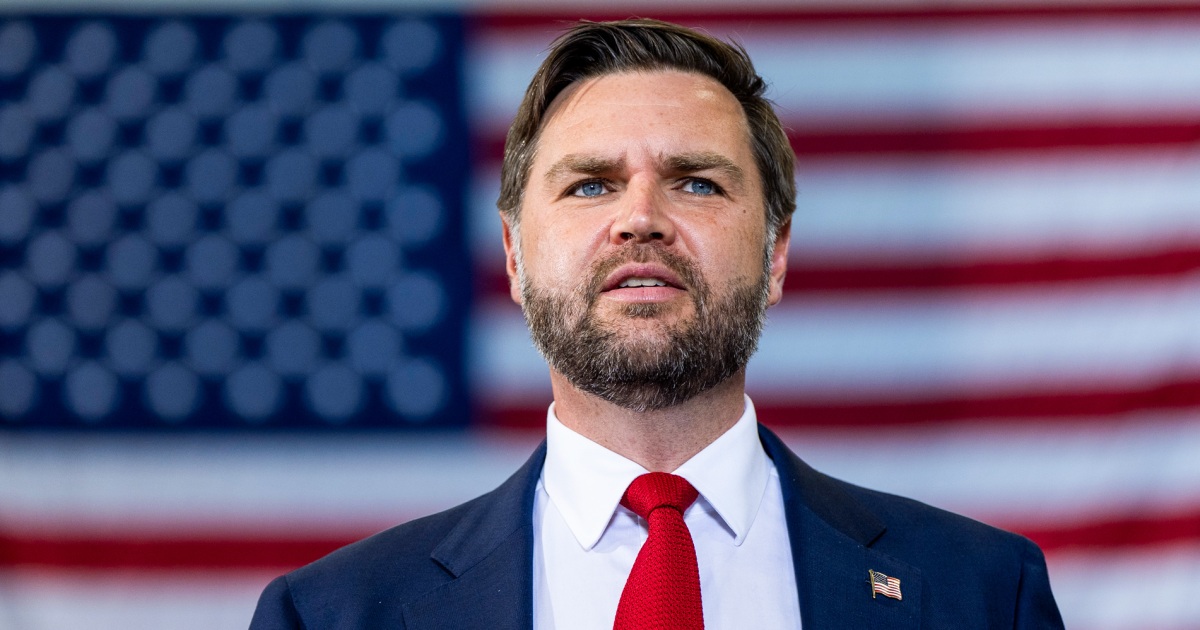
Vice President J.D. Vance on Tuesday praised Pope Leo XIV for releasing a new theological document filled with warnings about the unending advances in AI.
Subscribe to read this story without ads
Get unlimited access to ad-free articles and exclusive content.

The document, Leo’s first encyclical since he became pope last year, does not stop progress, but rather urges restraint that serves as “an exercise in responsible care for the human family.”
Vance, a Catholic and supporter of AI technology, said in a phone interview with NBC News that he has not yet read the encyclical in its entirety, but has read “fragments” and summaries of it.
“I think what I read is very profound and the kind of content that you would expect and expect from a church leader,” he said. “The important thing about morality is that the principles never change, but the way we apply them does change, because the world changes, right?”
“With new technology and warfare, we need to update the ‘just war’ doctrine,” Vance added. “New ways for humanity to relate to each other. We need to rethink the whole Catholic social teaching in light of the new world we live in. And I think that’s what the Pope is trying to do. So I’m glad he’s doing that.”
Leo presented the encyclical with Christopher Olah, one of Anthropic’s co-founders. The artificial intelligence giant’s involvement was seen as a potential flashpoint between the Vatican and President Donald Trump, whose administration ordered all government agencies to stop using Anthropic after the company denied the U.S. military unrestricted access to its technology.

Vance’s interview Tuesday was the first to preview his upcoming book, “Communion,” which will be released June 16 by HarperCollins. The book follows Vance’s journey of faith, including his Protestant upbringing, his drift toward atheism, and his recent conversion to Catholicism.
In an interview, Vance confirmed Semaphore’s report last month that he deleted X from his phone during Lent, the Christian season of prayer and sacrifice leading up to Easter. Lent ended on April 2, but Vance, whose propensity to directly participate in social media discourse and debate is well-documented, revealed that he has not yet reinstalled the app, although he plans to do so at some point.
“I think not having distractions has made me more productive,” Vance said. “If I have five minutes, I’m not scrolling all the time. I can actually read something as opposed to scrolling and being distracted by X.”
Vance said his social media accounts remain active and he still writes and publishes many posts on his behalf. He also confessed that he missed the “in-person interaction” with other users, including critics.
“I live in such a crazy bubble,” Vance said. “I travel with the Secret Service all the time. If you think about how many unscheduled interactions I have in a week, it’s close to zero, because I live in such a bubble. And I think one of the good things about social media is being exposed to real, unfiltered opinions. That’s one of the things I have to hear as a political leader. So I’ll definitely be reinstalling it, but I’m enjoying a break from social media for a little while.”
Social media wasn’t the only sacrifice Vance made during Lent. The vice president said he is committed to the “crazy diet” recommended by Secretary of Health and Human Services Robert F. Kennedy Jr., which means “a lot of protein” and “a lot of fermented foods — lots of yogurt, cheese, things like that.”
“I think it definitely made me feel healthier, and that’s something I continue to do,” Vance added. “One of the great things about Lent is the realization that sometimes we do these things as sacrificial acts, and it can be very good not to indulge ourselves.”
Vance, who was baptized in 2019, has often framed his vice presidency around his faith. Vance is the second Catholic to hold the job, after Joe Biden, and Vance’s staff emphasizes that he is the first convert to Catholicism to hold the position. Vance was one of the last people to meet Pope Francis before his death last year, and he returned to the Vatican a few weeks later for the inauguration of Leo, the first American-born pope.

forsubscriber
The pervasive threat of AI in security – what’s at stake?
04:49
Vance said on Tuesday that he was “really happy that the pope took the name Leo XIV. I think it’s a great homage to Leo XIII, who of course became pope at the beginning of the industrial era.” “I think Leo XIV is about to become pope at the beginning of the AI era, and I think if we get through this successfully it will be largely because the pope and the church can provide us with the moral leadership we need.”
Vance’s positions on AI, largely supportive of its advances and wary of government regulation, are informed in part by his background in Silicon Valley venture capital and the close relationships he has built with some of the biggest names in Big Tech around the country. His views are also influenced by his faith. Vance recently approached the issue with more public skepticism after polls showed voters were concerned about the rise of AI. He emphasized, for example, the need for new AI models to ensure that businesses and consumers are protected from cybersecurity vulnerabilities.
“Technology, and I talked a little bit about it in this book, is raising very serious questions about how we interact with each other, what skills we need in our workforce, the kinds of wars we’re going to fight and how we’re going to fight them,” Vance said Tuesday. “I think we really need moral leadership to think through these issues, and that’s the best kind of leadership for the church to have.”