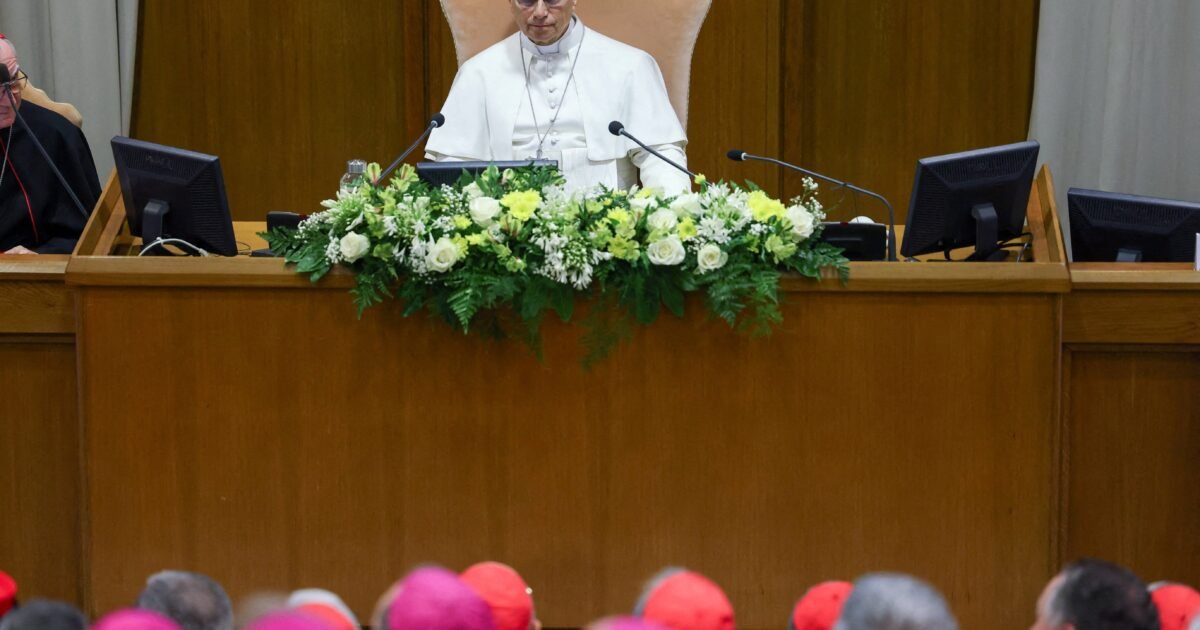
Vatican City (CNS) – Pope Leo
With its authoritative teachings, the 82-page encyclical Magnifica Humanitas significantly positions the Catholic Church as an active voice in debates over artificial intelligence, autonomous weapons, labor, human dignity, and the concentration of technological power among a small number of corporations.
“It’s not just the absence of war, it’s peace working as justice,” Pope Leo said on May 25 in a presentation to unveil the document to an audience packed with members of the Holy See, journalists and special guests in the Vatican’s Synod Hall. “But when technology weakens our critical senses, peace itself is at risk.”
The pope said he wrote the encyclical after hearing from scientists, engineers, political leaders, parents and teachers about the opportunities and dangers posed by artificial intelligence. While some are enthusiastic about the technology, others have expressed concerns about future generations and increasingly autonomous weapons systems, he said.
While acknowledging the benefits of AI, Pope Leo made it clear that this developing technology requires further scrutiny.
“Artificial intelligence needs to be disarmed,” the Pope said. “I know this is a strong word, but it was chosen intentionally because this moment requires words that can capture attention, awaken conscience, and point humanity in the path it should take.”
Pope Leo has frequently warned from the beginning of his pontificate against the unchecked development of AI, warning that the technology risks weakening human discernment, distorting reality and replacing real human relationships with simulations of human relationships.
The pope delivered a theme for the church’s annual World Communication Day, saying artificial intelligence is increasingly simulating “human voices and faces” while raising deeper questions about consciousness, responsibility, friendship and truth.
“We do not have the technical answers and we will not replace those who have the expertise,” the Pope said in his May 25 address. “But we bring human wisdom that our time desperately needs. Every person is unique and irreplaceable.”
The Holy See’s relationship with big technology companies dates back nearly a decade through a dialogue known as the Minerva Dialogue, which brought together church leaders and executives from Silicon Valley companies such as Google and LinkedIn.
That’s one reason why one of the most anticipated speakers at the presentation was Chris Oler, co-founder of artificial intelligence research company Anthropic, who praised the pope’s willingness to engage directly with industry.
Ola acknowledged that computer scientists alone cannot determine the ethical boundaries of AI, as developers themselves are influenced by “incentives” such as ambition, competition and economic pressure.
“We need informed critics to let the lab know when we’re failing,” Oler said. “We need a moral voice that cannot be bent by incentives.”
He said the church could help shape the debate around the fair distribution of the economic benefits of AI, the technology’s impact on children and jobs, and broader issues of human flourishing.
Ola also described aspects of advanced AI systems as “mysterious, even disturbing,” and said researchers continue to discover behaviors within models that they don’t fully understand.
Other participants who spoke at the presentation highlighted themes throughout the encyclical, including economic inequality, labor exploitation, and the concentration of technological power.
Anna Rowlands, professor of political theology and Catholic social doctrine at Durham University in the UK, also participated in a panel discussion with the pope. She said the encyclical “brings a gospel vision to the culture of AI.”
He said the document challenges the idea that artificial intelligence itself can “save” humanity, while questioning whether the impact on modern life is too much in the hands of a few technology companies.
“How can we resist such a perverse concentration of power in the hands of a few people in the interest of the common good?” Rowlands asked.
Another panelist, Leokadi Rushombo, professor of theological ethics at Santa Clara University’s Jesuit School of Theology, pointed to the encyclical’s criticism of the mining industry in the Global South, which supplies minerals used in AI infrastructure and data centers.
“Yes, AI can easily be colonized,” Rushombo said. “It is likely to further violate the rights of the Global South.”
Cardinal Michael Czerny, head of the Diplomatic Agency for the Promotion of Integrated Human Development, said that while the speed of progress in this new technology is unparalleled, the stakes are even deeper when it comes to “the essence of human coexistence.”
He went on to say that the most original contribution of the Christian faith to the debate about AI is “the belief that humans are always more than the sum of their accomplishments, their data profiles, and all their technological simulations, because they are called to a full life in which they find truth in their relationships and find their fulfillment in their constant and honest gifts to themselves.”
Cardinal Victor Manuel Fernández, Prefect of the Holy See for Faith, said the document insists that despite advances in technology, humanity must not lose sight of its dignity.
Cardinal Fernández said: “This is because every human being has infinite dignity and will never lose the sublime capacity for love that God gave to humanity when he created it.”
He also emphasized one of the central claims of the encyclical: that artificial intelligence cannot reproduce humanity’s ability to suffer, grow, and love.
Pope Leo’s encyclical said that human beings carry within themselves “lessons etched like scars, memories of journeys taken between freedom and fall, dreams and disappointments.”