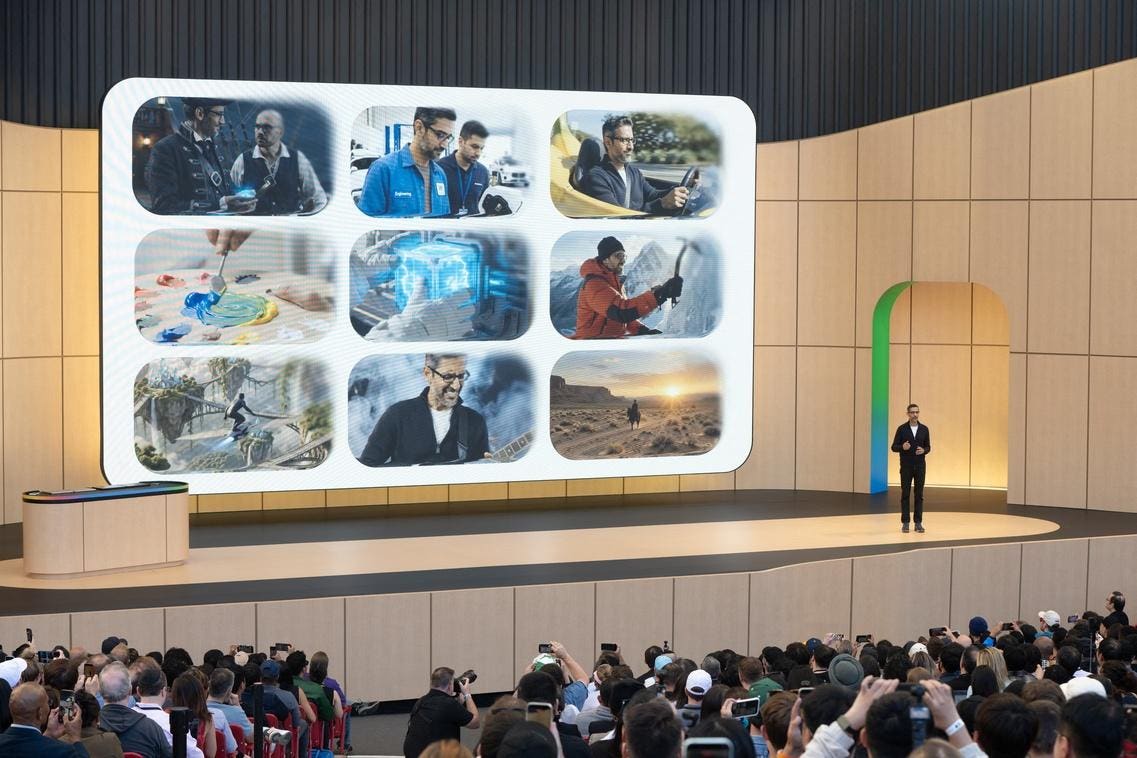

Google CEO Sundar Pichai speaks at the 2026 Google I/O Technology Developers Conference in Mountain View, California on May 19, 2026. (Photo: Karl Mondon/AFP via Getty Images)
AFP (via Getty Images)
Google this week leveraged the latest I/O events to introduce Gemini Omni Flash, a new AI model that can take text, photos, video, and audio as input and generate short video clips with audio. This is being launched through the Gemini app, Google Flow, and YouTube Shorts, with current clips up to 10 seconds, with longer formats planned. Google’s latest video announcement shows that the industry is focused on more than just text-to-video demos. AI is becoming more integrated into the video creation process.
Early AI video tools worked like most other prompt output generators. Fill in the prompts to get your clips. If you don’t like it, try again. Gemini Omni Flash is closer to a video assistant. You can provide them with existing media, ask them to change it, and use the conversation to drive results. Google says the Omni family is designed around creating “anything from any input,” with video as the first major format. According to a report from Google I/O 2026, Gemini Omni Flash will be released through the Gemini app, Google Flow, and YouTube Shorts. The Verge also reported that current clips are a maximum of 10 seconds long, with longer formats being planned.
Broad range of Google AI video options
Google is adding to its already somewhat overwhelming lineup of video-oriented AI models. Google already has a dedicated AI video model, Veo. Veo 3.1 is built for high-fidelity video generation with native audio, powerful prompt following, cinematic controls, and output options including 720p, 1080p, and 4K via Gemini API. Veo 3.1 Lite is a lower cost version for large developer and enterprise use. Flow is Google’s AI video production workspace, Google Vids is a workspace tool for business video, Gemini provides a consumer entry point for casual video creation, and Vertex AI and the Gemini API give developers programmatic access to Veo.
Gemini Omni Flash has different applicability. Gemini Omni Flash is an extensive multimodal model for creating and editing videos from text, images, audio, and video through conversation. Since it’s part of Gemini, it’s more focused on multimodal creation than a standalone video engine. You can use text, photos, videos, and audio as starting material. Omni Flash also benefits from Gemini’s extensive training and knowledge of the world, potentially making it better at interpreting context than video models that only respond to prompts.
Together, these options allow Google to offer a broader video AI stack for consumers, creators, businesses, and developers, but the number of overlapping names and entry points can make it difficult for users to understand the product story. However, this combination is powerful. A basic AI video tool might turn a single prompt into a clip. A more convenient system could use all these inputs to create several short videos, modify them through chat, and format them for shorts.
Because of the potential for the generated video output to be used maliciously and harmfully, Google places safety markers around the output. Google’s AI-generated video content will include SynthID watermarks and content verification tools.
Transition from production to production
Creators, marketers, agencies, studios, and software platforms are recognizing that AI can create high-quality video output clips. The harder question is whether AI can take a product image, a brand guide, a voice memo, three customer reviews, a half-baked storyboard, and yesterday’s top-performing ad and turn it all into a usable video asset that can be modified, tested, localized, approved, and shipped.
Google says Gemini Omni Flash can create videos from text, images, audio, and video, and the larger Gemini Omni family is built on the idea of creating “anything from anything.” Google also says the model integrates Gemini’s inference with media generation and editing.
While Veo remains a Google-only video model, and Veo 3.1 focuses on video quality, native audio, realism, and creative control, Gemini Omni Flash aims for broader use. It can use a variety of media inputs, generate videos with audio, and support conversational editing. This means that rather than being an output-oriented tool, it is a visual editor with memory, similar to how agent coding tools like Claude Code and OpenAI’s Codex move from one-time output to managing the entire process.
Gemini Omni allows marketers to request three YouTube shorts based on product photos and customer quotes. Founders can input their rough iPhone clips and request a clean version that maintains the same energy. Retailers can request 20 variations of the same seasonal promotion, each tailored to a different buyer segment. This machine doesn’t just generate pixels, it also helps manage the complex creative process between the idea and the publish button.
The increasingly crowded video processing field
Other vendors are building workspaces around AI video, increasing competition in the market and potentially causing confusion with customers. Higgsfield offers an AI video generator and studio that allows users to access several leading models in one place, including Kling 3.0, Veo 3.1, Sora 2, Seedance 2.0, Wan 2.7, and more, compare outputs, control camera movement, and manage motion and shape styles without leaving the platform.
Magnific (formerly Freepik) takes a related route from the creative assets side. The renamed platform combines AI image and video generation, 4K video with audio, upscaling, enhancement tools, collaboration, 3D and virtual scene tools, AI assistants, training, and a library of over 250 million creative assets. As such, Magnific is more of a complete creative production suite than a pure video modeling company. The advantage is that you start with a huge base of stock images, design assets, and creative users and layer AI generation and editing on top of that.
Runway, Luma, and similar tools also focus on process and flow by offering a wide selection of models, repeatable styles, character consistency, camera control, brand assets, collaboration, templates, approvals, and output quality. ByteDance and Kuaishou’s China model is adding further pressure with Seedance and Kling pushing features such as multimodal input, multi-shot generation, native audio, lip sync, and faster short-form video creation.
より広範な市場は 2 つの陣営に分かれています。 Google and OpenAI have focused on frontier models and direct product surfaces. OpenAI has promoted Sora 2 as its flagship video and audio generation model with synchronized dialog and sound effects, but OpenAI’s own page now states that the Sora product is no longer available, and its developer documentation states that the Sora 2 video model and video API are deprecated and will be shut down on September 24, 2026.
Impact on the creative economy
As more production and creative processes move upstream, concerns from the creative economy are increasingly being voiced. Many people wonder if AI video will replace filmmakers and production staff.
AI video has now reached the proof-of-concept stage for feature films. Hell Grind, a 95-minute AI-generated sci-fi action film by Higgsfield AI, was screened around Cannes in May 2026. The Wall Street Journal reports that the film took about two weeks to make and cost about $500,000, of which $400,000 was spent on AI calculations. The production still required a team of 15 people and extensive human direction, and reportedly required more than 16,000 initial generations for the first 25 minutes alone, which was later cut down to 253 shots in the end. Hell Grind doesn’t prove that a studio can type in “make an AI movie” and receive a finished product, but it does show that if people provide detailed prompts, creative judgment, editing discipline, and enough computing power, AI video can support feature-length production.
The cause for concern is real, as much of the work in video production is expensive and repetitive. They often exist across multiple applications, conversation threads, editing timelines, asset folders, and approval queues. As studios and production companies increase their use of AI, there is no doubt that they will leverage more production-focused tools.
Of course, human creativity remains important. Creative style, judgment, timing, narrative instinct, sense of risk, legal caution, and audience knowledge make you rare and valuable. The machine can generate 10 choices, but it needs to know which ones feel cheap, which ones feel creepy, which ones violate the brief, and which ones will actually sell.
On the risk side, the more accurate these tools become, the easier it will be to create convincing synthetic personas, fake endorsements, unauthorized likenesses, and risky media for your brand. Difficult questions still remain, such as what data trained the model. What image rights are protected? Can output be tracked? Can companies prove what was produced, who approved it, and which assets made it into the final cut? Can workflows stop fraudulent campaigns before they reach customers?
So while AI-generated videos have captured everyone’s attention with their beautiful clips, the real future lies in controlled production.