
The race to build AI factories is impacting hyperscalers, operators, and enterprises alike, with long lead times and power access concerns.
Jeff Wabik, CTO of digital infrastructure provider DC Blox, said in a fireside chat at Fiber Connect 2026 in Orlando that hyperscalers are investing heavily in capacity and infrastructure to scale AI, but they don’t necessarily know what will happen in the next few years.
“I see them planning and executing very diligently. What if we need more fiber, more conduit, more power, more splices, more interconnects?” Wabik said. “It’s beautiful madness.”
Companies like AWS, Google, and Meta are currently spending hundreds of billions of dollars on large, centralized data centers focused on GPU-intensive model training. But as AI use cases mature with the accompanying real-time inference, there is a need to move toward distributed edge architectures that are closer to the data source and can process, analyze, and respond to data within 10 milliseconds, Peter Crese, president of consulting firm Entropy, said during a panel discussion on data center innovation.
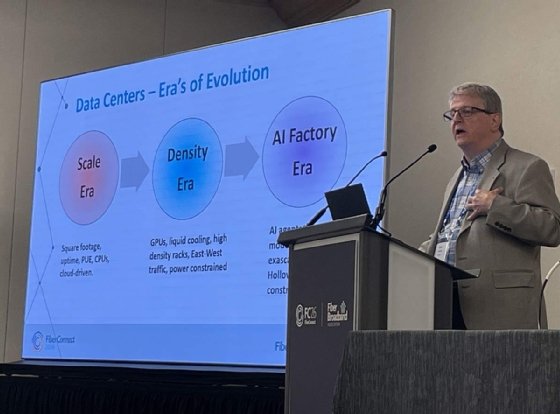
Brent Legg, executive vice president of government affairs at Connected Nation and IXP.US, which builds physical carrier-neutral data centers across the United States, said the existing Internet ecosystem simply cannot support that scale right now, and he predicted that the ecosystem, which routes data traffic through centralized hubs in large cities, will fail within 24 to 36 months.
“As we move from large-scale language model training to latency-sensitive inference-based applications, we will need more places for networks to interconnect and exchange traffic regionally, not just in large cities like New York or Atlanta,” Legg said. “No such evolution is occurring.”
All this led to building and purchasing Robin Olds, senior sales business development manager at Cisco, said the frenzy among hyperscalers and carriers is creating lead times for equipment purchases the industry hasn’t seen since the COVID-19 pandemic.
“At Cisco, we’ve had problems with hyperscalers who buy more than they need. They know what’s going to happen,” Olds said in a chat with Wabik. “They’re aggressively buying as much GPU, computing, electronics and optical equipment as they can.”
Another complicating factor is the fact that these AI factories are power hungry. In various sessions, panelists repeatedly mentioned the challenge of generating adequate energy to support these AI facilities. “Whoever wins the power race will win the AI race,” said Sachin Gupta, vice president of business and technology strategy at Oklahoma-based ISP Centranet, during a panel discussion on expanding AI.

At the level of computing that occurs in these data centers, hyperscalers require hundreds of gigawatts of energy, and they don’t have access to that energy, said Jason Eichenholtz, founder and CEO of Relativity Networks, a fiber optic provider specializing in hollow-core fiber. For example, the lead time for transformers is five to eight years, he added.
The industry is considering alternative energy options such as solar energy and small modular reactors for nuclear power. SMRs are more compact, provide more stable power, and have lower carbon emissions. However, commercial data centers that utilize SMR are unlikely to materialize for several more years. Additionally, most hyperscalers have enough challenges with jurisdictional conflicts and permitting delays, not to mention community concerns about nuclear power, DC Blocks’ Wabik said.
As a result, the AI buildout is a bit like throwing sprinkles in the air, watching them fall, and plotting a course based on the results, he added.
“That’s where the inference nodes are going. Wherever you can find dirt, wherever you can find a political ecosystem that won’t block you, wherever you can find natural gas mains that can actually give you the power to make it work,” Wabik said.
What this means for businesses
Companies aren’t building AI factories at hyperscalar levels. But they can still mimic hyperscalers’ strategies and plan accordingly. Centralized data centers will no longer be able to support AI workloads that occur in multiple locations. Distributed architectures are essential to enable AI inference at the edge, such as on factory floors, healthcare facilities, retail stores, and self-driving cars.
It’s also important to proactively plan and purchase data center equipment years in advance, knowing that it may take months or more to arrive. “If you want to buy something for your data center, whether it’s electronics or fiber optics, order it now,” Cisco’s Olds said.
During that planning process, companies also need to audit current power capacity, identify constraints, and assess power availability.
Jennifer English is Editorial Director in TechTarget’s AI & Emerging Tech group.


