In a recent AI podcast episode, Jure Leskovec, co-founder and principal scientist at Kumo and professor at Stanford University, discussed the transformative potential of relational foundational models for enterprise data. These models represent a major advance in applying deep learning to structured and relational data, beyond the typical unstructured text and image realm that has dominated recent AI advances.
Visual TL;DR. Jure Leskovec develops a relational foundation model. Enterprise data challenges are solved with a relational foundation model. A relational foundation model enables the possibility of transformation. Graph neural networks are built on a relational foundation model. The relational foundation model has important features. Key competencies provide transformative potential. Transformative potential includes future applications.
Jure Leskovec: AI researcher, Stanford University professor, Kumo co-founder
Enterprise data challenges: Complex structured data beyond text/images
Relational Foundation Model: New AI for Structured Relational Data
Graph neural networks: Leskovec’s expertise in large-scale data analysis
Key features: Understand complex relationships in your data
Transformational potential: Revolutionizing the understanding and application of enterprise data
Applications of the future: The road ahead for advanced enterprise AI
Visual TL;DR
Who is Jule Leskovec?
Jure Leskovec is a prominent researcher in the field of machine learning and artificial intelligence. His work at Stanford University, as co-founder of Kumo, focuses on developing new AI models and applying them to complex real-world problems. Leskovec is particularly known for his contributions to graph neural networks, recommender systems, and the analysis of large-scale data, including social networks and, more recently, enterprise data.
The full discussion can be found at: TwimurYouTube channel.
Relational Foundation Model for Enterprise Data [Jure Leskovec] – 768 — from TWIML
Relational Foundation Model for Enterprise Data
Leskovec introduced relational foundation models as a new class of models designed to understand and reason about the inherently structured and relational nature of enterprise data. Unlike traditional machine learning models that can require extensive feature engineering or task-specific training, these foundational models aim to learn general representations of entities and their relationships directly from raw data. This approach allows it to be applied to a wide range of downstream tasks without requiring significant adaptation.
The core idea behind these models is to treat enterprise data as a large interconnected graph. Entities such as customers, products, and transactions are represented as nodes, and relationships between them (purchases, interactions, dependencies, etc.) are represented as edges. Leskovec explained that the model is trained using self-supervised learning objectives, similar to masked language modeling in natural language processing. Specifically, the model learns to predict masked entities and relationships in the data graph, allowing it to capture the underlying structure and semantics of enterprise data.
Main features and applications
Leskovec highlighted several important features of the relational foundation model.
Understand complex relationships: This model can capture complex multi-hop relationships in your data, which are important for understanding complex business processes and customer behavior.
Generalizability: By learning common representations, these models can be fine-tuned for a variety of downstream tasks, such as fraud detection, customer churn prediction, recommendation systems, and even scientific discovery in areas such as drug development.
Scalability: Although challenging, this research aims to extend these models to handle the vast amounts of relational data present in large enterprises.
He detailed how these models can be applied to real-world scenarios. For example, you can identify fraudulent transactions by understanding the complex web of suspicious relationships between entities, or predict customer behavior by analyzing interactions and relationships with products and services.
The road ahead
Leskovec emphasized that while the potential is enormous, scaling these models to match the complexity and volume of enterprise data remains a key research and engineering challenge. However, the ability of relational foundation models to learn from raw structured data and generalize across a variety of tasks represents a promising direction for unlocking the value hidden in enterprise information.

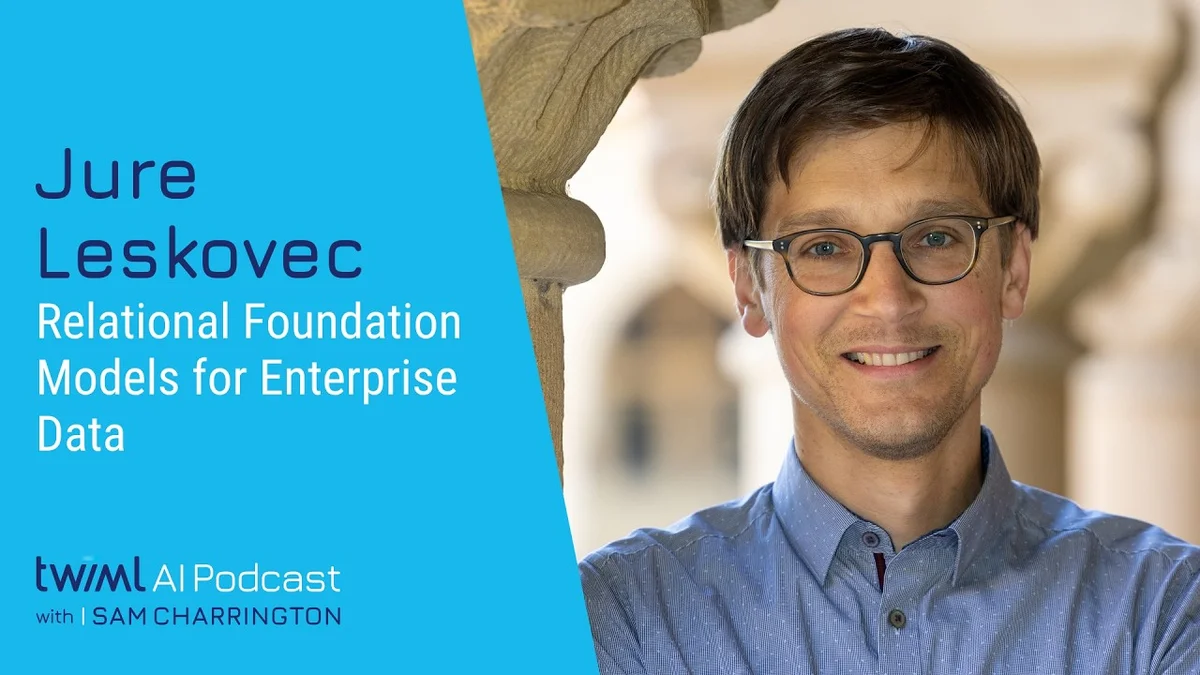
![Relational Foundation Model for Enterprise Data [Jure Leskovec] - 768 - Twimul](https://img.youtube.com/vi/khSSuUyvqno/maxresdefault.jpg)