
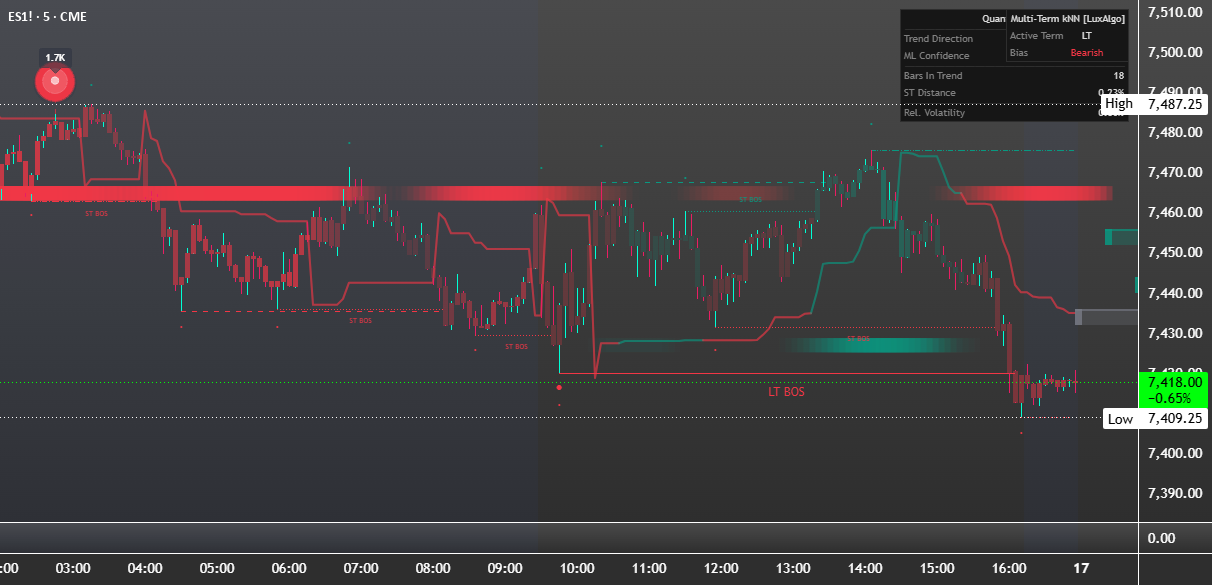
How to trade the QuantFlow Super Trend Indicator
This indicator is designed to do more than the standard Supertrend. Rather than relying solely on ATR-based trend changes, we apply machine learning models to assess whether current market conditions resemble historical bullish or bearish conditions. This is useful for traders who want to combine trend indicators, machine learning indicators, and price action confirmation tools into one script.
The core of this indicator is to help traders stay in line with prevailing movements while highlighting points where price may be rejecting major trend levels. This makes it suitable for trend following strategies, pullback entries, and momentum confirmations.
Trend direction and market bias
The main trend signals arise from the interaction between the KNN engine and the Supertrend baseline. Machine learning models examine RSI and ATR-related volatility across historical search windows and classify the most likely trend conditions based on similar historical market movements.
When the machine learning output matches the direction of the supertrend, the indicator will display a colored horizontal line on the chart. This allows traders to quickly read biases.
A bullish horizon suggests that buyers are in control and the price is trading in a more probable uptrend environment.
A bearish horizon suggests that sellers are in control and price is trading in a more probable downtrend environment.
Weak or unconvincing visual conditions may suggest trend fatigue, indecision, or that the market is entering consolidation.
This structure makes this tool useful as both a trend-confirming indicator and a market regime filter.
3D Denial Orb for entrance and exit clues
One of the distinguishing features of this trading indicator is the 3D rejection orb that appears when the price reacts sharply around a supertrend level, leaving a meaningful wick. These signals are designed to highlight moments when the market refuses to continue in one direction and reacts strongly at the trend baseline.
The size of each orb changes dynamically based on its relative volume.
A label attached to the orb will display the exact amount of Rejection Candle.
These signals can help traders identify potential pullback entries, defensive exits, or localized areas of depletion.
In a bullish situation, traders may interpret a rejection orb near support as a sign for buyers to pull back. In a bearish situation, a rejection orb close to resistance could signal renewed selling pressure. These signals are not intended to be used alone, but are powerful when combined with broader trend direction and market structure.
Candle coloring based on confidence
This indicator also includes a liquid smooth gradient candle color to visualize the reliability of machine learning. This is more than just cosmetics. You can instantly read whether there is strong conviction in a current trend or if it is starting to lose momentum.
Brighter, more vibrant colors indicate stronger confidence from the ML engine.
A more subdued tone may indicate weakening momentum or a less reliable trend phase.
Smooth transitions help traders avoid overreacting to small changes in market noise.
This feature is especially useful for traders who want a more intuitive reading of whether there is still strength behind a trend.
Why this machine learning trading indicator stands out
Unlike standard supertrend indicators, Quant Flow uses historical pattern recognition to filter trend signals. Traditional indicators can react too quickly in unstable situations or lag during critical transitions. By adding a KNN classifier, this script attempts to distinguish between meaningful directional movements and weaker, lower-quality fluctuations.
As such, it is valuable for traders looking for:
Machine learning trading strategy framework
Trend tracking indicators with added intelligence
A tool that combines volatility analysis, RSI movements, and price rejection signals
A visual system for reading trend strength, market bias, and potential reversal reactions
structure
The machine learning component scans the current market using RSI and ATR-based volatility as its main features. It then compares the current state to the previous bar in the selected search window and uses the selected number of K neighbors to find the closest past match.
From there, the indicator estimates whether the current situation closely resembles previous bullish or bearish settings. This output is then filtered through a confidence buffer, allowing only stronger directional probabilities to influence the trend state.
By requiring both machine learning confirmation and supertrend adjustment, the indicator reduces weak flips and improves chart readability. In practice, this helps traders avoid some of the noise that affects standalone trend indicators.
Main features available to traders
Machine learning trend classification
The KNN engine provides adaptive behavior to the script by evaluating whether the current settings are similar to historical bullish or bearish conditions. This adds a statistical layer to your trend analysis, allowing you to make better decisions when the market isn’t moving cleanly.
Structure based on supertrends
The supertrend component serves as the structural backbone of the indicator. This creates a trend baseline for price to interact with and helps define where rejection signals and directional corrections are most important.
Rejection signal considering volume
The 3D Rejection Orb is designed to alert you to candlesticks that exhibit strong rejection behavior near trend levels. Orb size is tied to relative volume, so reactions of interest stand out more clearly on the chart.
Confidence gradient
Smooth candlestick and horizontal line gradients help traders determine the strength of the current movement at a glance. This helps you manage your trades, avoid low-conviction environments, and read the quality of breakouts and pullbacks.
real-time dashboard
A built-in dashboard provides traders with a compact overview of current market conditions, including direction, machine learning confidence, and relative volatility. This is useful for quickly analyzing charts and checking whether your setup fits into your broader environment.
Indicator settings description
setting
Machine learning settings
K Neighborhoods: Sets the number of historical neighbors that the KNN algorithm uses to classify the current trend direction. Lower values may make the model more responsive, while higher values may smooth the output and focus on broader similarities.
Search window: Defines the number of past bars that are scanned to find similar past conditions. A larger search window provides more pattern history, and a smaller search window focuses the model on more recent behavior.
super trend setting
ATR Length: Controls the lookback period for the Average True Range calculation. This affects how Supertrends adapt to market volatility.
Factor: Set the ATR multiplier used to place the supertrend line above or below the price. In general, higher values create a broader, slower trending baseline, while lower values are more responsive.
Noise filter settings
Smooth price entry: Apply HMA smoothing to the price source used in machine learning functions. This reduces market noise and creates a clearer classification.
ML Confidence Buffer (%): Defines how far above or below the midpoint probability the ML signal must move before a change in trend is accepted. This helps prevent choppy signal inversions.
Rejection signal settings
Show 3D Rejection Orb: Turns the volume-based rejection bubble on or off.
Minimum Wick-to-Body Multiplier: Sets the minimum wick-to-body ratio required for a candle to qualify as a reject signal.
Min Bubble Gap: Defines the minimum gap between consecutive reject orb signals in bars to reduce clutter.
Visual and dashboard settings
Liquid Smoothness: Controls the EMA smoothing applied to the machine learning reliability of candlestick and horizon slopes.
Vibrancy: Adjusts the intensity of the visual gradient for traders who require more or less pronounced colors.
Show Dashboard: Toggle the statistics panel on the chart showing trend direction, ML confidence, and relative volatility.
The best way to use this trading strategy indicator
Check trend following
Traders can use the horizon direction and confidence color coding to see if a trend is strong enough to trade. This is especially useful for filtering out breakout trades or staying in a trending position for too long.
pullback entry
When price retreats towards supertrend levels and forms a rejection orb, traders are likely to use that area as a potential continuation setup. This approach is effective when broader trends are intact and machine learning reliability is maintained.
trade management
The color of the candlestick gradient helps traders determine whether trend confidence is strengthening or weakening. This can support decisions about retaining an outage, scaling out, or hardening an outage.
Sideways market filtering
The reliability of machine learning can weaken in indecisive situations, so this indicator also helps traders avoid low-quality environments where standard trend indicators are frequently chopped.
Is Quant Flow Supertrend a trend indicator or a trading strategy?
Can be used as both. Although it is basically a trend indicator, many traders can build a complete trading strategy around it by combining trend direction, rejection orb signals, and confidence gradients with their own entry and risk rules.
What is the 3D Rejection Orb used for?
3D Rejection Orb highlights candlesticks that reject supertrend areas with meaningful wick structure and relative volume. Traders can use these as potential cues for pullback entries, exits, or exhaustion points.
Who is this indicator best for?
This trading indicator is useful for trend traders, swing traders, and active chart users who want more than basic supertrends. This is especially attractive for traders interested in machine learning indicators, trend strength analysis, and volume-based rejection signals.
.


