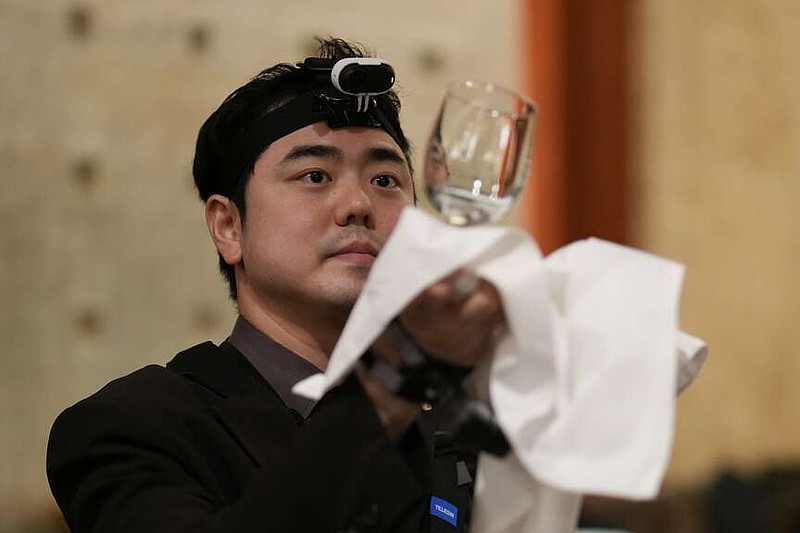
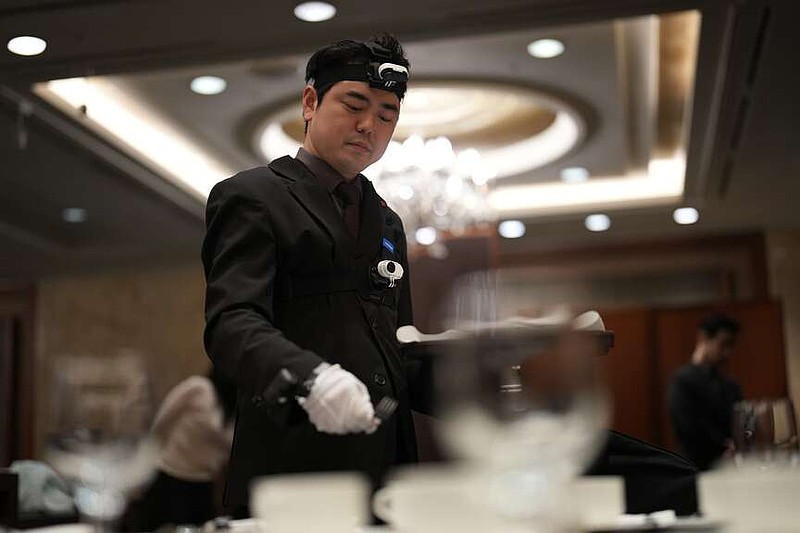
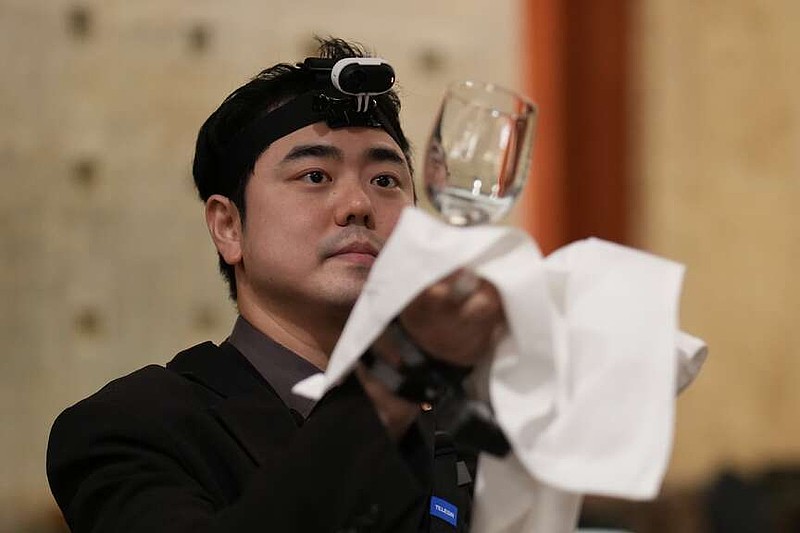
SEOUL, South Korea — Wearing body cameras on his head, chest and hands, David Park deftly folded his banquet napkins the way he had done thousands of times during his nine years at the five-star Lotte Hotel Seoul. Each of his movements is entered into a database that will one day teach a robot to do the same.
The hotel chain is one of many companies that South Korean artificial intelligence startup RLWRLD (pronounced “real world”) is collaborating with to create an extensive library of human expertise gleaned from skilled workers across a variety of industries to develop AI brains for robots that could be deployed in industrial settings and homes.
We collect similar data from CJ’s logistics employees, recording how they grab, lift, and handle items in the warehouse. We also track staff at Japanese convenience store chain Lawson to see how they organize their food displays.
The goal is to build an AI software layer that can run on robots in a variety of factories and other workplaces over the next few years, before enabling deployment to homes. RLWRLD engineers say replicating human manual dexterity is a key priority, reflecting their view that human-like machines, or humanoids, will drive the field.
“I do this about once a month,” said Park, one of about 10 members of Lotte Hotel’s food and beverage team.
After folding the napkins into tightly layered squares, Ms. Park wiped down wine glasses, knives, and forks in a corner of the banquet hall while her colleagues prepared for the actual service nearby. He lightly complained to the engineer that the camera was too tight in his hand.
RLWRLD is one of a wave of Korean tech companies and manufacturers competing in the unproven but fiercely competitive global market for “physical AI.” The term goes beyond traditional factory robots designed for repetitive tasks and refers to machines equipped with AI and sensors that can perceive, make decisions, and act on real-world environments with some degree of autonomy.
It remains unclear whether these machines will fully live up to the promise of industrial transformation, but they are central to South Korea’s ambitions to leverage its strengths in semiconductors and manufacturing to become an AI powerhouse. Competition is stiff, with US tech giants like Tesla and many Chinese companies pouring billions into humanoid and other AI robots.
Just as chatbots like ChatGPT and Gemini use vast amounts of internet text to learn, AI robots similarly need extensive data about human behavior to handle advanced physical tasks. While South Koreans may struggle to compete in the chatbot space, where proficiency in English gives American companies a big advantage, they see a better chance in physical AI, given the rich base of skilled workers in manufacturing and other fields that could help train robotic systems.
Last month, the government announced a $33 million project to capture the “instinctual know-how and skills” of “skilled engineers” into a database of AI-powered manufacturing, with the hope that robots will boost productivity and offset an aging and shrinking workforce.
RLWRLD, which announced its Robotics Foundation Model, an AI system for robots, earlier this month, expects industrial AI robots to be introduced on a large scale around 2028, a timeline shared by major companies.
Hyundai Motor plans to introduce humanoids made by its robotics division, Boston Dynamics, to factories around the world over the next few years, starting with its Georgia plant in 2028. Semiconductor giant Samsung Electronics plans to transform all manufacturing sites into “AI-driven factories” by 2030, and to introduce humanoids and task-specific robots across production lines.
“South Korea has a highly developed manufacturing industry, with a focus on humanoids specifically made for these industries,” said Billy Choi, a professor at Korea University’s Human-Directed AI Research Center.
South Korea’s push for AI has upset labor groups, who worry that robots will take jobs and hollow out the skilled workforce long seen as the nation’s competitive edge, the very asset they are now counting on from the transition.
After Hyundai Motor’s union warned in January that robots could cause an “employment shock,” CEO Lee Jae-myung issued an unusual rebuke, describing AI as an unstoppable “giant cart” and calling on union members to adapt to changes that are “coming sooner than expected.”
“Skill acquisition is ultimately a human achievement. Even if AI can reproduce existing abilities, the continued development of crafts will remain fundamentally human,” said Kim Seok, director of policy at the Korea Democratic Labor Union Confederation. He said the widespread introduction of robots risks “cutting off the pipeline” of skilled workers, and called on governments and employers to engage with workers over AI to gain buy-in and alleviate employment concerns.
make the bot work
A humanoid developed by an American and Chinese company has demonstrated amazing physical abilities even when it comes to long-distance running. However, Haemin Cho, head of business strategy at RLWRLD, said the ability to use hands to perform delicate tasks will determine whether humanoids can be used in various industrial environments and at home.
“Capturing motion data in a real-world setting is very important, and the quality of that data is very important,” she said.
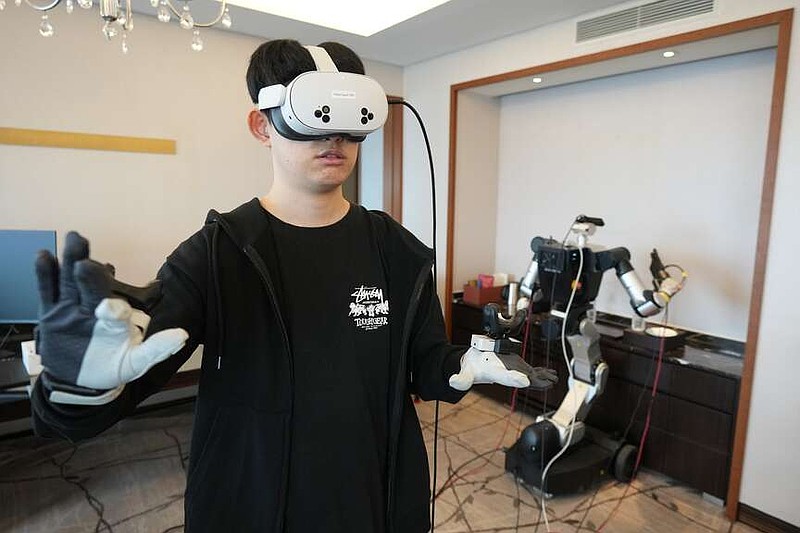
After converting worker footage into machine-readable data, RLWRLD engineers add another layer by repeating these tasks while wearing cameras, VR headsets, and motion-tracking gloves. That data is used to train test robots, often guided by RLWRLD “pilots” using wearable devices. The process records details such as joint angles and the amount of force applied, said Hyun-ji Son from the company’s robotics team.
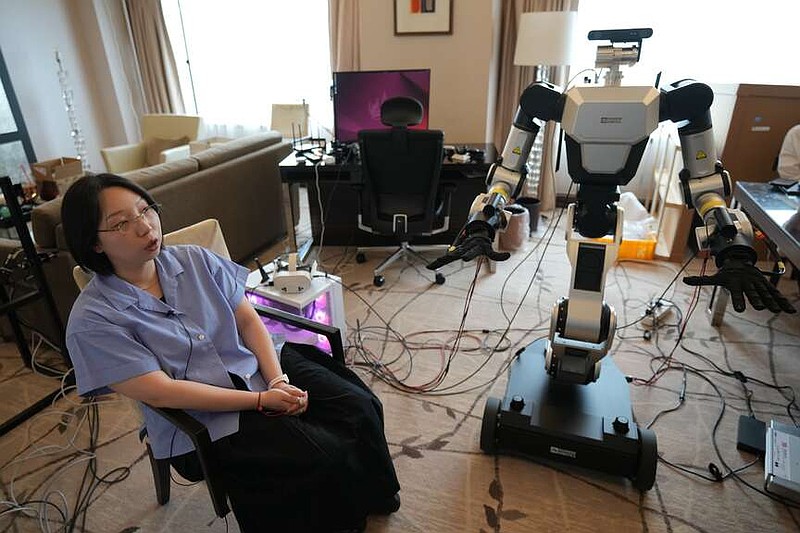
One of RLWRLD’s laboratories is located in a cluttered suite on the 34th floor of the Lotte Hotel. Damaged carpets are buried under tangled wires and computing equipment. A pole with an infrared laser reader stands in the corner.
Beneath a chandelier, a remnant of a once-luxury room, a wheeled robot with black, human-like metal hands moves back and forth with a low mechanical hum.
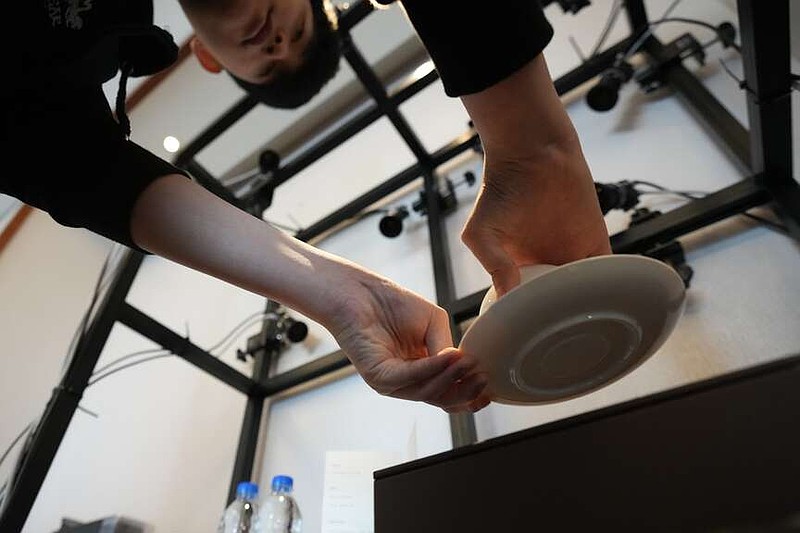
During a recent demonstration, the robot, guided by an engineer, carefully picked up a cup and placed it on a minibar, at one point overturning a plate.
The company’s latest test footage shows a more advanced system. A humanoid robot carefully opens the box, places a computer mouse inside, closes the box, and places it on a conveyor belt.
Most robots, including Boston Dynamics’ Atlas, use task-specific hands, such as two- or three-finger “grippers.” RLWRLD is one of a small group of companies developing five-fingered hand AI that mimics human touch.
While the five-fingered design may not necessarily suit the needs of factories, it could be important as robots enter homes and require close interaction with humans, Choi said.
Hospitality workers provide valuable training data for machines to learn precise and nuanced tasks, and this skill has the potential to expand its use in industrial settings, Cho said.
Lotte Hotel hopes that by 2029, robots will be able to handle cleaning and other behind-the-scenes tasks, whereas current humanoids take several hours to clean guest rooms, which a human would do in about 40 minutes. The company also plans to offer robot rental services for hospitality and other service industries, with the possibility of expanding into homes.
“If you look at the entire preparation process for a backyard event, we think humanoid robots might be able to take on about 30% to 40% of that workload,” Park said. “It’s going to be hard to replace the remaining 50%, 60%, 70%. Those parts involve actual human-to-human interaction.”