
image:
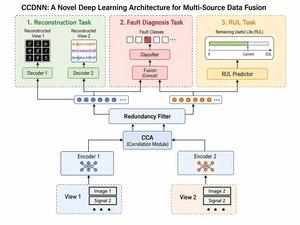
This new method leverages standard correlation-induced deep neural network-based technology for effective data fusion. Experimental results demonstrate excellent performance across benchmark tasks and highlight potential applications in intelligent control, automation, and data-driven engineering systems.
view more
Credit: Professor Zhiwen Chen, Central South University, China
Recent years have seen the unprecedented development of Industrial 4.0 and the Industrial Internet of Things. These two technologies have greatly facilitated the collection of data from various sources for numerous tasks such as reconfiguration, classification, and prediction in next-generation applications. However, effective fusion and interpretation of these multi-source datasets remains challenging and remains an active area of research.
Currently, canonical correlation analysis (CCA) is considered a fundamental data fusion technique that preserves the essence of information within the correlation representation. Its extended kernel CCA (KCCA) enables learning nonlinear representations. However, performance degrades significantly when the dataset becomes large. To address these shortcomings, scientists proposed deep CCA (DCCA) as a flexible alternative that leverages the superior representation learning capabilities of deep neural networks (DNNs). However, all three CCA-based methods incorporate correlations into the optimization formulation itself, which can impede focus on the task. In this respect, the use of canonical correlation as an optimization constraint is promising.
Based on this idea, a team of Chinese researchers led by Professor Zhiwen Chen of Central South University proposed an innovative deep learning architecture called canonical correlation-induced deep neural network (CCDNN) to learn correlation representations for multi-source data fusion. Professor Weihua Gui, Professor Zhaohui Jiang, and Professor Chunhua Yang from Central South University also participated in this joint research. Professor Steven X. Ding, University of Duisburg-Essen, Germany; Siwen Mo, a student from Central South University, and Haobin Ke from Hong Kong Polytechnic University (Hong Kong, China). Their new discovery is IEEE/CAA Journal of Automatica Sinica April 1, 2026.
Professor Chen highlighted the most important contribution of their research, saying: “Unlike linear CCA, KCCA, and DCCA, in our proposed method, the optimization formulation is not limited to maximizing the correlation. Instead, we constrain the canonical correlation, preserve the learning ability of the correlation representation, and focus on the engineering tasks given by the optimization formulation, such as reconstruction, classification, and prediction. Furthermore, a redundant filter with a learning parameter of zero is designed to reduce the redundancy caused by the correlation.”
The team demonstrates CCDNN’s data fusion capabilities through correlated representation learning and its superior performance across a variety of engineering tasks. The proposed method showed promising performance when compared with existing methods. Furthermore, this technique showed better reconstruction performance than DCCA and deep canonical correlation autoencoder in terms of mean squared error (MSE) and mean absolute error (MAE) in experiments on the MNIST dataset. Specifically, compared to DCCA, the MSE and MAE values were reduced by 0.43 and 0.42, respectively. Furthermore, when applying CCDNN to industrial fault diagnosis and remaining service life cases for classification and prediction tasks, superior performance was obtained compared to existing methods.
“CCDNNs can achieve effective data fusion by learning correlated representations through DNNs. Therefore, how to select a suitable DNN for a particular engineering task is worth studying. Moreover, both views of the data are also flexible, allowing CCDNNs to handle multi-source heterogeneous data structures in various industrial applications, such as engineering tasks in fault diagnosis where one view is obtained from the images and the other view is given by the time series.” Professor Chen concluded by highlighting the promising potential of their latest innovation.
***
reference
Doi: 10.1109/JAS.2025.125411
About Central South University, ChinaCentral South University (CSU) is located in the historical and cultural city of Changsha, Hunan Province, China, with an area of 3.17 million square meters, making it an ideal place to pursue your studies. The university is comprised of 33 secondary schools, boasts three large Class A tertiary general hospitals, and is affiliated with six non-directly affiliated hospitals. CSU has a rich history as an educational institution spanning more than 100 years and is committed to the philosophy of “creating knowledge and serving society.” We pursue “virtue, truth, perfection, and inclusiveness.” CSU has 104 undergraduate programs, 89 of which are admitted, and 72 of which are nationally ranked programs. The university boasts 115 nationally top undergraduate courses. It has received 39 National Educational Achievement Awards, 4 National Model Programs in Curriculum-Based Ideological and Political Education, and 5 Grand Prizes in National Education Competitions. CSU is committed to aligning its efforts with the key demands of the country and society.
Website: https://en.csu.edu.cn/
About Professor Zhiwen Chen of Central South University, China
Dr. Zhiwen Chen is a professor in the Department of Automation, Central South University. Professor Chen received his bachelor’s and master’s degrees from Central South University in 2008 and 2012, respectively, and his PhD in electrical engineering and information technology from the University of Duisburg-Essen, Germany, in 2016. He is currently a member of the Institute of Electrical and Electronics Engineers (IEEE), among other prominent associations. His research interests include model-based and data-driven fault diagnosis and health monitoring, and data analysis. He has published more than 70 academic papers in reputed national and international journals. Dr. Chen has received the Hunan Provincial Outstanding Young Talent Award, the Innovation-Leading Talent Award from Central South University, the Hunan Provincial Science and Technology Innovation Team Award, the Hunan Provincial Natural Science Award, the Hunan Provincial Postdoctoral Innovation and Entrepreneurship Award, and the Higher Education Teaching Achievement Award from the China Nonferrous Metals Association. He holds more than 10 national invention patents and registered 5 software copyrights.
About IEEE/CAA Journal of Automatica Sinica
IEEE/CAA Journal of Automatica Sinica Journal of IEEE and CAA, Automatic Control, Artificial Intelligence and Intelligent Control, Systems Theory and Engineering, Pattern Recognition and Intelligent Systems, Automation Engineering and Applications, Information Processing and Information Systems, Network-based Automation, Robotics, Computer-Assisted Technologies for Automation Systems, Sensing and Measurement, Navigation, Guidance and Control, Smart Cities, Smart Grids, Big Data and Data We publish high-quality papers in English on original theoretical and experimental research and development in all areas of automation, including mining, the Internet of Things, and cyber-physical. Cloud computing, mechatronics for systems, blockchain, automation.
Website: https://www.ieee-jas.net/indexen.htm
Funding information
This research was partially supported by the National Natural Science Foundation of China (62173349), the Natural Science Foundation of Hunan Province (2025JJ10007), the Science and Technology Innovation Program of Hunan Province (2022RC1090), and the Natural Science Foundation of Hunan Province (2022JJ20076).
journal
IEEE/CAA Journal of Automatica Sinica
Research method
Computational simulation/modeling
Research theme
not applicable
Article title
CCDNN: A new deep learning architecture for multi-source data fusion
Article publication date
April 1, 2026


