
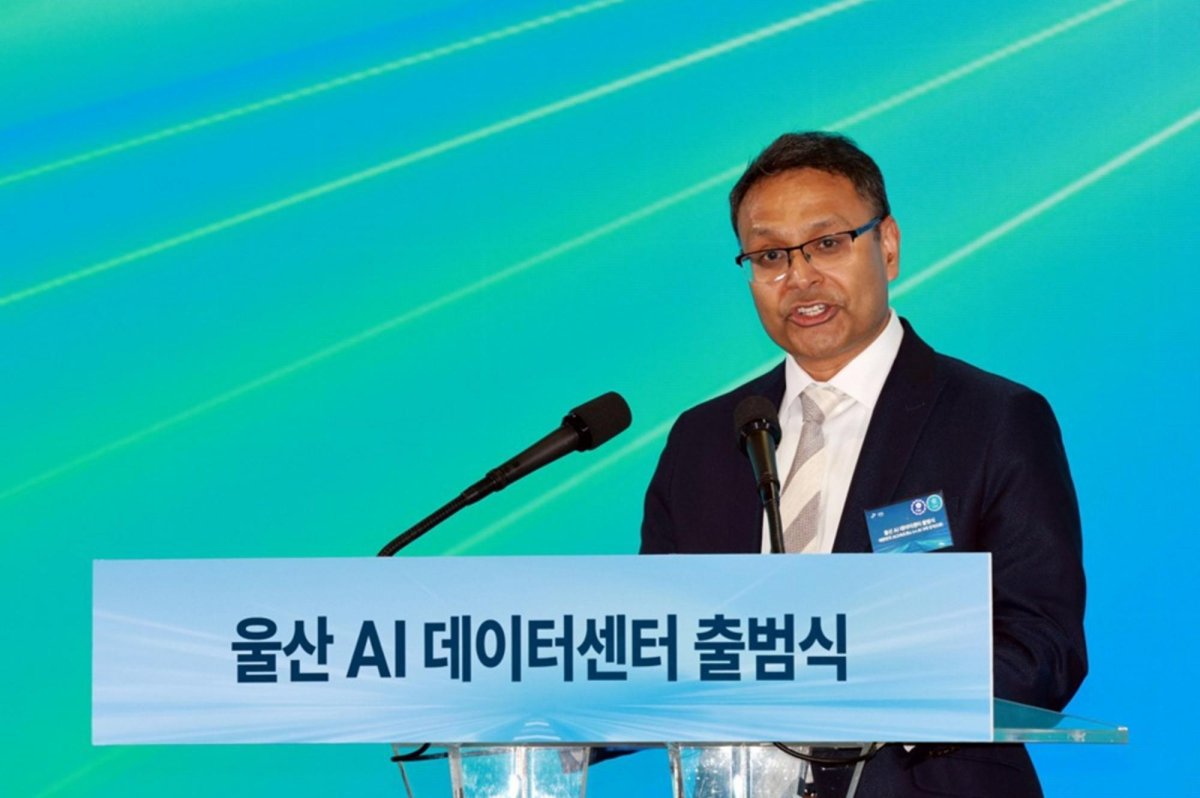
Prasad Kalyanaraman, vice president of infrastructure services at Amazon Web Services (AWS), spoke at a ceremony at the Exhibition and Convention Center in Ulsan, South Korea, to launch an artificial intelligence (AI) data center construction project jointly built by SK Group and Amazon Web Services. Mr. Lee vowed to fully support the AI industry, aiming to position it as South Korea’s next major economic growth engine. Photo provided by Yong Hap/EPA
May 10th (Asia Today) — South Korea’s efforts to expand regional artificial intelligence infrastructure are expected to accelerate after the National Assembly passed a special law designating AI data centers as national strategic facilities. But questions about long-term power supply remain looming, as lawmakers left out a key provision that would have allowed direct liquefied natural gas power purchase agreements.
The “AI Data Center Industry Promotion Special Act,” which was passed by the National Diet plenary session on Wednesday, will go into effect in February after a nine-month grace period following a Cabinet decision.
The law is aimed at simplifying the construction process for AI data centers, especially outside the Seoul metropolitan area, as the government moves forward with its “five mega-regions and three special zones” development strategy aimed at strengthening regional AI competitiveness.
Under the new law, AI data center projects designated as national strategic facilities will undergo comprehensive approval procedures after deliberation by the National AI Strategy Committee. The measure also exempts certain AI data center projects outside of major cities from grid impact assessments when building, expanding, or converting facilities below a specified size.
Industry officials and researchers said the legislation could significantly accelerate the construction of local AI infrastructure by reducing regulatory barriers and speeding approval timelines.
Science, Information and Communications Minister Bae Kyung-hoon welcomed the bill, saying it lays the foundation for what he described as an “AI highway” that can attract large-scale foreign investment as global competition in artificial intelligence intensifies.
One of the hottest provisions during the legislative process, the special exemption clause for LNG-based direct power purchase agreements (PPAs), was ultimately removed from the bill.
The Ministry of Science, Information and Communications and the Ministry of Climate and Energy have reportedly concluded that the current national electricity supply system is sufficient to meet the demand for AI data centers for the next five years. The two ministries also plan to sign a memorandum of understanding to strengthen cooperation regarding measures for stable electricity supply.
Experts said the exclusion of LNG PPA provisions reflects broader concerns about power market stability and national power allocation priorities.
Choi Kyung-jin, a law professor at Gachon University, said the decision was “unfortunate but reasonable” considering the country’s overall electricity supply situation.
“The government appears to have considered the potential price distortions in the electricity market and the importance of LNG in powering the broader population,” Choi said.
He added that renewable and environmentally friendly energy sources are likely to become increasingly important as regional AI data centers expand.
“Local governments with strong renewable energy infrastructure and related technology expertise will have a competitive advantage in attracting and operating AI data centers,” he said.
— Asia Today reported. Translation by UPI
© Asia Today. Unauthorized reproduction and redistribution is prohibited.
Korea original report: https://www.asiatoday.co.kr/kn/view.php?key=20260510010002156


