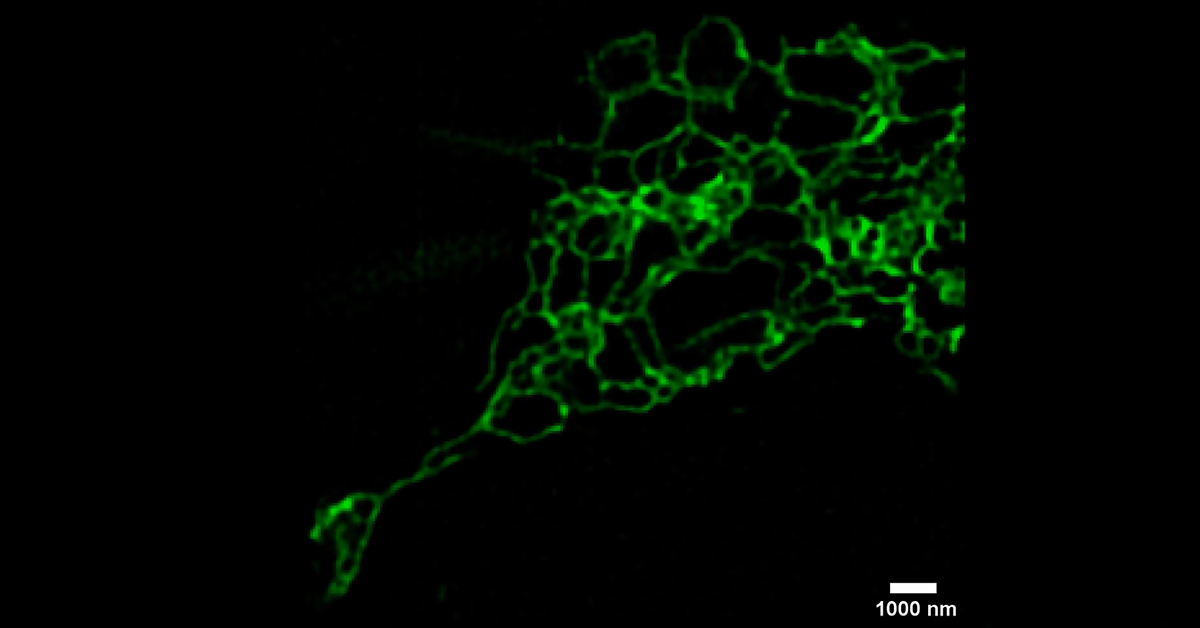
To overcome these challenges, a team led by Zhaowei Liu, a professor in the Department of Electrical and Computer Engineering at the University of California San Diego Jacobs School of Engineering, has developed an upgraded version of the technology called Unrolled Blind SIM (UBSIM). By integrating artificial intelligence into the image reconstruction process, UBSIM produces high-quality images hundreds to thousands of times faster while maintaining simpler hardware. This means scientists can view detailed images taken rather than waiting for processing to complete.
Because the technique is built on the physics of how images are formed, it also avoids the risk of introducing misleading details that are sometimes seen with traditional AI-based approaches.
“One of the most exciting advances with this algorithm is the removal of artifacts and hallucinations,” said study co-lead author Zachary Burns, a PhD in electrical and computer engineering. A graduate of Liu’s lab. “Currently, many neural network-based models can imagine spurious structures when applied to new data. This is a major problem for scientists using these AI models. Scientists need to trust that the structures inside cells they are observing are real. By integrating photophysics, our model removes these problems and builds confidence that it can be used accurately.”
In tests with live cells, UBSIM produced high-resolution video at up to 50 frames per second. This video reveals rapid changes in structures such as the endoplasmic reticulum in real time.
“UBSIM allows super-resolution images to be reconstructed and displayed in real-time without supervision, making super-resolution microscopy as convenient as traditional optical microscopy,” said Liu. “This greatly improves the user experience and greatly increases the effectiveness of discoveries using super-resolution microscopy.”
The researchers say future work will focus on further improving resolution.
Detailed study: “Fast Blind Structured Illumination Microscopy with Unsupervised Algorithm Deployment”. Co-authors include Zachary Burns*, Junxiang Zhao*, Ayse Z. Sahan, and Jin Zhang. Both are from the University of California, San Diego.
*These authors contributed equally
This research was supported by the National Science Foundation (CBET-2348536 to ZL) and the National Institutes of Health (R35 CA197622).
For more information about research and education at the University of California, San Diego, please visit:
artificial intelligence