
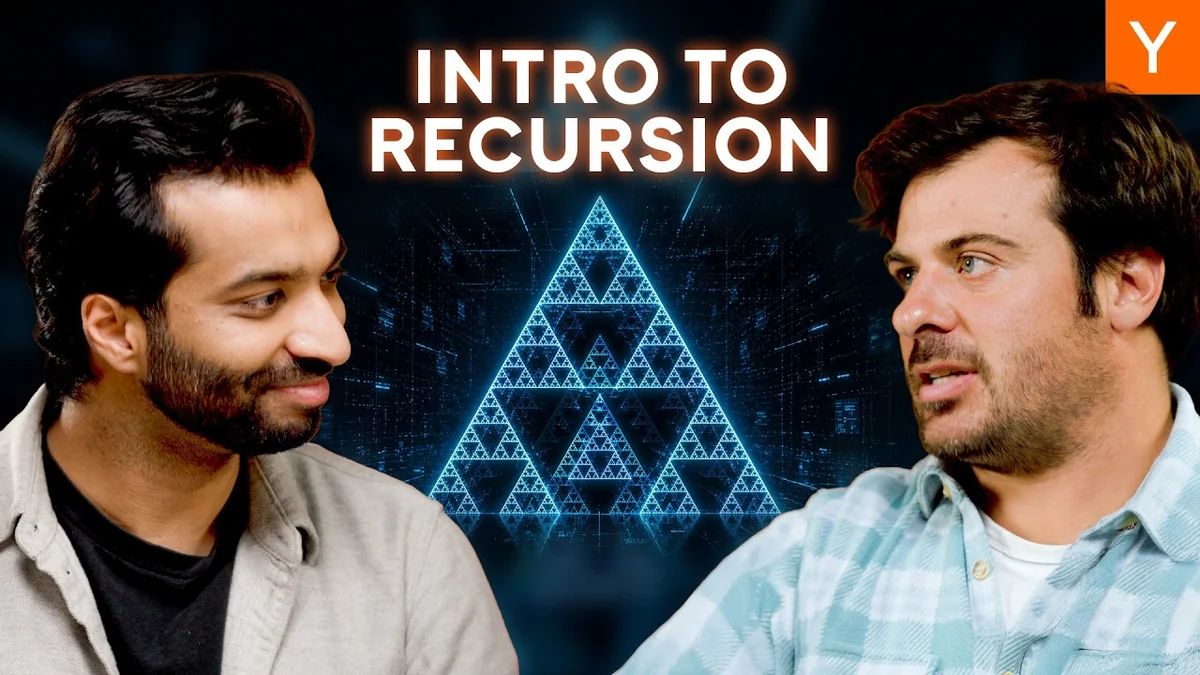
In a recent episode of Y Combinator Decoded, General Partner Ankit Gupta and Visiting Group Partner Francois Chaubard explored the fascinating world of recursive reasoning models in AI. They detail how these models, inspired by the complex workings of the human brain, provide a powerful alternative to traditional monolithic AI architectures. In this conversation, we focused on two important papers that showcase the potential of these recursive approaches, especially in tackling complex reasoning tasks more efficiently.
understand the speaker
Ankit Gupta, general partner at Y Combinator, has extensive experience in identifying and nurturing promising startups. His role includes guiding early stage companies through accelerator programs, providing strategic advice and connecting them with critical resources. Francois Chaubard, Visiting Group Partner at Y Combinator, has a similar passion for advancing AI research and development. His expertise in areas such as neural networks and machine learning, particularly sequence modeling, makes him a valuable voice in this discussion.
The full discussion can be found at: YCYouTube channel.
The power of recursion in AI
The core theme of the discussion revolved around how the inference capabilities of AI models can be improved by adopting a recursive approach. Unlike standard models, which process information in a single large step, recursive models break down complex problems into smaller, more manageable subproblems. These subproblems are processed iteratively, with the output of one stage being fed back to the next stage. This approach is particularly useful for tasks involving long data sequences that are often difficult with traditional models, such as natural language processing and time series analysis.
Chaubard explained the basic concept: “Recursion in AI is essentially a model that can call itself or parts of it repeatedly. This allows AI to handle complex dependencies and build inference capabilities over multiple steps.” He contrasted this with traditional models, noting that while these models may be powerful, they often require large parameter counts, struggle to capture long-range dependencies, and lead to problems such as vanishing gradients and exploding.
The papers discussed provided concrete examples of how this recursive paradigm can be implemented. One paper investigated a model that uses a fixed number of recursive steps to process input and gradually refine its understanding. The other focuses on a more dynamic approach, where the model determines the number of recursion steps needed for a given problem. This flexibility allows the model to adapt to different levels of complexity, increasing efficiency.
Key studies and models investigated
The conversation delved into two specific research papers that exemplify this reflexive approach. The first paper introduced a model that exploits multiple recursive layers, each layer potentially operating at a different temporal frequency. This is similar to how different parts of the human brain process information at different speeds, allowing for both rapid pattern recognition and deeper, more nuanced analysis. This model uses a concept called “deep recursion” where the same weight is applied across different recursion steps, significantly reducing the number of required parameters compared to traditional deep networks.
The second paper discussed presented a more sophisticated approach called the “Tiny Recursive Model” (TRM). Although the model was small, it showed good performance on tasks that typically require large amounts of computational resources. Highlighting its efficiency, Chaubard said, “What is remarkable about TRM is that it can achieve state-of-the-art results with a fraction of the parameters and computational cost of comparable models.” In this paper, we have emphasized the importance of carefully designing “latent states” and “carry” mechanisms. This allows information to be passed between recursive steps, allowing the model to maintain context and build complex inference chains.
Tackling the limits of traditional models
Much of the discussion focused on how these recursive models address the limitations inherent in traditional architectures, especially transformers. Transformer revolutionized NLP, but quadratic complexity with respect to sequence length makes very long inputs computationally expensive. Recursive models may be able to process much longer sequences more efficiently by processing information iteratively. Chaubard elaborated, “The problem with standard Transformers is that to understand a long sequence, you have to process it all, and it has to scale quadratically. Recursive models can scale more linearly by decomposing it, which is a big advantage for very long inputs.”
The researchers also noted that these models may be easier to interpret. Observing the activations and information flow at each recursion step helps you understand how the model reaches decisions. This is an important step toward building more reliable and transparent AI systems.
The future of recursive AI
Mr. Gupta and Mr. Chaubard agreed that this area of AI research has great potential. The ability of recursive models to achieve high performance with fewer parameters and less computational effort has the potential to democratize access to powerful AI capabilities. This could enable the development of more efficient AI agents that can reason and learn in complex and dynamic environments. Chaubard concluded, “We’re seeing a shift from just making models bigger to making them smarter and more efficient. Recursive models are an important part of that evolution, and I’m excited to see where this research leads.”
The discussion highlighted continued innovation in AI that is moving beyond brute-force scaling and toward more elegant, biologically-inspired solutions. Exploring recursive reasoning models provides a compelling glimpse into the future of artificial intelligence, where efficiency and sophisticated reasoning go hand in hand.

