The global video surveillance market is entering a decade of transformation due to rising security concerns, rapid urbanization, and proliferation of artificial intelligence (AI)-driven analytics. Once limited to basic CCTV systems, video surveillance has evolved into an intelligent ecosystem capable of real-time monitoring, predictive threat detection, and data-driven decision-making.
According to Renab Research, The video surveillance market is projected to grow from USD 90.23 billion in 2025 to USD 246.82 billion by 2034, expanding at a compound annual growth rate (CAGR) of 11.83% from 2026 to 2034.
This impressive growth highlights the increasing reliance on surveillance technology across commercial, residential, industrial, and government sectors around the world.
Understanding Video Surveillance: Beyond Cameras and Recording
Today’s video surveillance goes far beyond passive video recording. This includes a wide range of technologies such as:
- Closed circuit television (CCTV)
- Internet Protocol (IP) Camera
- Network video recorder (NVR)
- cloud-based video management system
- AI-powered video analysis
These systems are designed to monitor, record, and analyze activity in real time or retrospectively. They play important roles in the following areas:
- Crime prevention and investigation
- traffic management
- Strengthening security
- Improving operational efficiency in business
The integration of AI has transformed surveillance from reactive monitoring to proactive intelligence, enabling features such as facial recognition, behavioral analysis, and automated alerts.
Market Growth Drivers: What’s Driving Expansion?
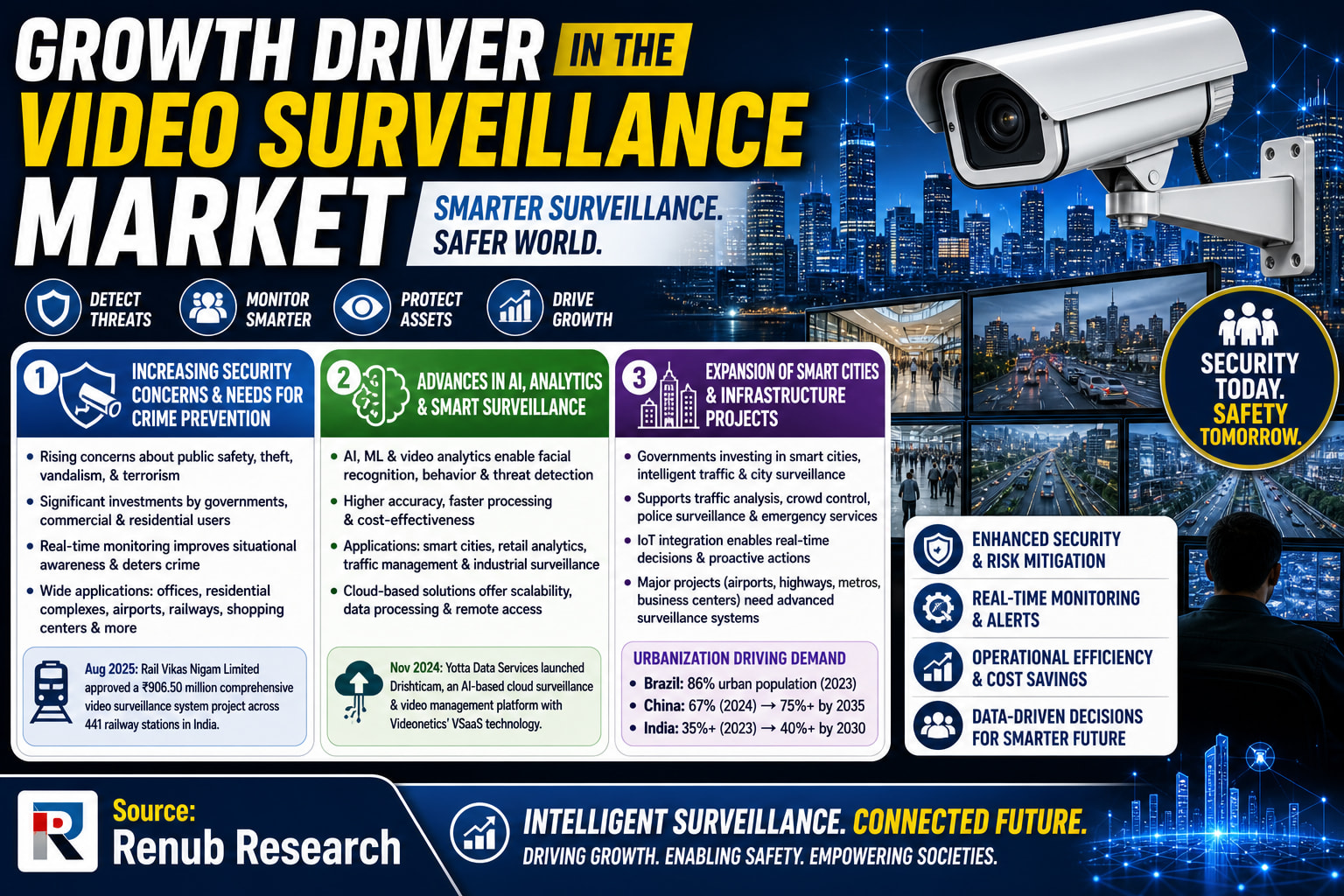
1. Rising security concerns and crime prevention needs
One of the most important drivers of the video surveillance market is the growing concern for public safety and asset protection. Governments, businesses, and homeowners are increasingly investing in surveillance systems to reduce risks associated with:
- theft and vandalism
- Terrorism and public threats
- unauthorized access
Urbanization and population growth have further increased the need for continuous monitoring, especially in high-density areas such as airports, train stations, shopping centers, and office complexes.
A notable example is India’s efforts to modernize its railway security. In August 2025, Rail Vikas Nigam Limited approved a Rs 906.5 million project to roll out a comprehensive surveillance system at 441 railway stations. This highlights the scale of investment in public safety infrastructure.
2. Advances in AI, machine learning, and analytics
Technology is at the heart of this market’s rapid evolution. AI and machine learning enable surveillance systems to:
- Automatically identify faces and objects
- Detect suspicious behavior in real time
- Efficiently analyze large amounts of video data
These features significantly reduce human intervention and improve accuracy and response time.
For example, AI-powered platforms such as cloud-based monitoring services are redefining how organizations manage security. Solutions such as Yotta Data Services’ ‘Drishticam’ leverage scalable cloud infrastructure and intelligent analytics to provide cost-effective and efficient monitoring systems.
3. Expansion of smart cities and infrastructure development
The global push towards smart cities is also a major driver. Governments around the world are investing heavily in:
- intelligent traffic management system
- Smart policing and emergency response
- Integrated city surveillance network
Video surveillance plays a central role in these efforts by enabling real-time monitoring and decision-making.
Urbanization trends are further fueling this growth. While countries such as Brazil and China already have a high proportion of urban populations, India’s urban population is expected to exceed 40% by 2030. This change will significantly increase the demand for advanced surveillance systems in public infrastructure.
Market challenges: Barriers to growth
1. Privacy concerns and regulatory compliance
Despite its benefits, video surveillance faces increased scrutiny over privacy issues. The following are widely used:
- face recognition
- continuous monitoring
- data storage system
Concerns have been raised about abuse, unauthorized surveillance, and violations of individual rights.
Many countries have implemented strict data protection laws governing the collection, storage, and use of surveillance data. Although necessary, these regulations complicate an organization’s operations and increase compliance costs.
2. High implementation costs and cybersecurity risks
The initial investment required for advanced surveillance systems can be significant, especially for small and medium-sized businesses. Costs include:
- Hardware (cameras, sensors, storage systems)
- Software and analytics platform
- network infrastructure
Additionally, as surveillance systems become more connected, they become increasingly vulnerable to cyber threats such as hacking and data breaches. This requires continued investment in cybersecurity measures, increasing overall costs.
Segment Insights: A closer look at market dynamics
video surveillance software market
Software is becoming the backbone of modern surveillance systems. Key components include:
- Video management software (VMS)
- AI-based analytics platform
- cloud-based monitoring tools
These solutions enable remote access, intelligent alerting, and efficient data storage. The move to cloud and edge computing is particularly evident, offering scalability and lower infrastructure costs.
video surveillance services market
Organizations are increasingly choosing service-based models such as:
- Installation and integration
- Maintenance and upgrades
- managed security services
This trend is especially evident among small and medium-sized businesses that prefer outsourcing to reduce capital expenditures and operational complexity.
Hybrid video surveillance market
Hybrid systems combine analog and IP-based technologies to enable organizations to:
- Upgrade your existing infrastructure in stages
- Reduce costs associated with replacing entire systems
- Maintaining operational continuity
These systems are widely used in sectors such as retail, education, and transportation during the digital transition.
IP surveillance market
IP-based monitoring is rapidly replacing traditional analog systems for the following reasons:
- higher video quality
- Advanced analysis features
- remote accessibility
This segment is expected to dominate the market as organizations prioritize intelligent and scalable solutions.
Application-based insights
Residential segment
The housing market is experiencing strong growth due to the following factors:
- Increasing security awareness
- Adopting smart home technology
- Availability of affordable DIY monitoring solutions
Products such as smart cameras and video doorbells are becoming popular because they offer convenience and remote monitoring via smartphones.
commercial segment
Companies use surveillance systems not only for security, but also to improve operational efficiency. Main uses include:
- customer behavior analysis
- inventory monitoring
- Anti-theft
Retailers in particular are deploying video analytics to optimize store performance and improve customer experience.
military/defense sector
In defense applications, surveillance systems are important for:
- border security
- battlefield surveillance
- Information gathering
Advanced technologies such as thermal imaging, UAV integrated surveillance, and AI-based threat detection are driving growth in this sector.
Regional analysis: Key markets driving growth
US
The US remains one of the most mature markets and is characterized by:
- Advanced deployment of IP and cloud-based systems
- Integration of advanced technologies such as facial recognition
- Strong demand across commercial and residential sectors
Innovations such as remote video surveillance solutions are further enhancing market capabilities.
England
The UK has long been a pioneer in CCTV implementation. The market continues to evolve as follows:
- Transition from analog to IP systems
- Greater focus on data privacy and compliance
- Introducing intelligent analytics
Technological advances such as image authenticity verification tools are addressing new challenges in digital surveillance.
China
China leads the world market in terms of size and growth. Factors contributing to its superiority include:
- Broad smart city initiatives
- large government investment
- Popularization of surveillance using AI
However, regulatory concerns and data privacy issues are becoming increasingly important in shaping the market.
Brazil
The Brazilian market is expanding due to the following reasons:
- Rising crime rate
- urbanization
- Increased public and private sector investment
Although growth is strong, infrastructure and financial constraints remain a challenge.
United Arab Emirates (UAE)
The UAE is emerging as a major player in advanced surveillance technology, supported by:
- Smart city initiatives
- high investment ability
- Focus on security and innovation
With the introduction of AI-based surveillance systems, the country has established itself as a leader in the Middle East region.
Competitive environment: Key players shaping the market
The global video surveillance market is highly competitive, with key players focusing on innovation, strategic partnerships, and product development. Major companies include:
- Honeywell International Co., Ltd.
- Hangzhou Hikvision Digital Technology Co., Ltd.
- bosch
- Schneider Electric SE
- Panasonic Holdings Co., Ltd.
- Cisco Systems Corporation
- TKH Group NV
- Motorola Solutions Corporation
These companies are investing heavily in AI, cloud computing, and cybersecurity to stay competitive.
Looking ahead: What lies ahead?
The future of the video surveillance market will be determined by technology convergence and innovation. Key trends to watch include:
- AI-driven predictive monitoring: moving from detection to prevention
- Cloud-native platforms: enable scalable and flexible deployments
- Edge computing: Reduce latency and improve real-time processing
- Integrating with the IoT ecosystem: building a smart, interconnected environment
As digital transformation accelerates globally, surveillance systems will play an increasingly important role in ensuring safety, efficiency, and operational intelligence.
final thoughts
The video surveillance market is no longer just about security, it’s about intelligence, efficiency, and proactive decision-making. As cities become smarter and businesses become more data-driven, surveillance systems will continue to evolve into powerful tools that go far beyond traditional surveillance.
However, it will be important to balance advances in technology with privacy and ethical considerations. Stakeholders must carefully navigate this complex landscape to ensure sustainable and responsible growth.
Fueled by AI innovation, smart infrastructure, and rising security demands, the global video surveillance market is poised for a dynamic and transformative decade.