
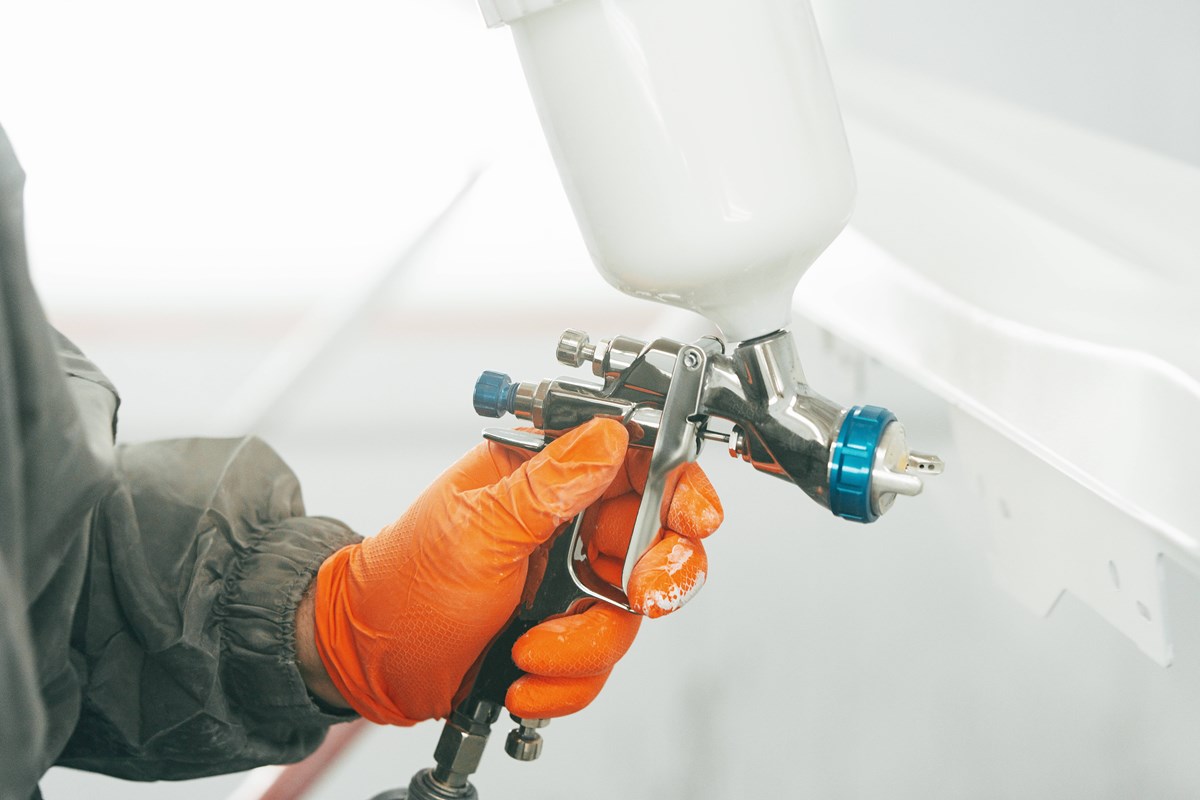

Source | Getty Images
question: As artificial intelligence (AI) and machine learning (ML) become more prevalent, what are your biggest concerns about AI/ML as a control technology?
There are two main concerns: consistency and hallucinations. Did you know there are over 50 ways to measure and record viscosity? And most of them (>86%) use a drain cup.
It was first introduced in 1831 by textile industrialist Charles Dolphus during the First Industrial Revolution.1The drain cup has a fixed orifice (hole) at the bottom and a defined volume from which fluid exits by gravity. Fill the cup with liquid and measure the time it takes for the liquid to drain. Although it may seem simple, this is a manual measurement using a stopwatch. Accuracy is highly dependent on the operator, especially when it comes to motor adjustment and attention to detail. There are many factors that can change the results of a test.
There are over 44 different cups, each created for a different purpose, liquid, viscosity range, etc. If you choose the wrong cup, your measurements will not yield the desired process results, regardless of the operator’s diligence.
Cleanliness is also essential. Any buildup, especially in the orifice (which can be just 2 to 4 millimeters in diameter), will change the outflow time.
Then there is the question: “What is sky?” The film of liquid on the walls of the cup moves more slowly than the liquid in the center of the cup due to friction with the walls of the cup. Metric standards require that the clock be stopped when the stream is interrupted, but where? ISO 2431:2019 specifically states: “The method described in this document is limited to testing materials where a breakpoint for flow from the orifice of the flow cup can be set. decided surely2”
Read “IIoT, Industry 4.0, and AI for coating operations”
But even this is troublesome. When the fluid is released from the orifice’s confines, it elongates with acceleration in the transition to free fall. This means that the further away from the cup the operator is observing, the sooner the breakpoint will occur. This results in high day-to-day and operator-to-operator variability. Is it 1 inch? 2 inches? 4 inches? 12 inches?
This lack of standardization makes process control difficult. A pressure gauge may have both psi and bar scales, and a thermometer may have both °F and °C scales, but the reading on either gauge is accurate because both scales are accurate mathematical conversions. This is not the case with viscosity, which makes data correlation and analysis nearly impossible. This is a critical issue for AI, which may retrieve data from a variety of sources on the web.
real time data
These measurements are time-consuming and are taken infrequently, sometimes hourly, but more often once or twice a day. But successful process control requires real-time data that can be leveraged to create actionable intelligence.
Figure 1, provided by PPG Automotive Coatings’ AiMSmartPaintline system.3 A comparison between manual and real-time measurements is shown. The bottom two traces show manual measurements recorded for temperature (green) and viscosity (red). In addition to the long measurement interval, it is also clear that the measurements are not taken at the same time interval. Over the weekend (February 8-9), no measurements were recorded. This makes it virtually impossible to determine whether there is an interaction between these variables with respect to humans or AI agents (and we know that there is).

Figure 1. Manual and automatic viscosity measurements3. Source | PPG Automotive Coating
The two traces above are from an automatic viscometer installed in the same process. Viscosity (light blue) and temperature (dark blue) data are recorded on the same time basis without operator intervention, resulting in hundreds of readings per hour instead of two per shift. This level of resolution allows automated systems to easily see phenomena such as the inverse relationship between temperature and viscosity, such as viscosity decreasing as temperature increases and viscosity decreasing as temperature increases. It is equally easy to attribute viscosity-based defects such as color, shine, orange peel, mottling, running, and sagging to viscosity variations if they are tracked and recorded over the same time horizon.

Figure 2. AI hallucination rate4. Source | Electronics360 New Desk
hallucination
And there are hallucinations. According to Electronics360 News Desk, “ [AI] The platform delivers meaningless or inaccurate output. This is considered an AI illusion4”
If you are trying to produce a product with a First Pass Yield (FPY) greater than 99%, and for products with tight margins this goal can exceed 99.99%, it is critical to understand the frequency of hallucinations. Electronics360 News Desk lists the top 15 AI models with the lowest hallucination rates in Figure 2.
This data means we have to accept an error rate of 1.3-3.0%. These errors can be due to encoding and decoding, model complexity, and other factors (such as incorrect viscosity data). This is simply not sufficient for manufacturing control.
Modern manufacturers implementing AI cannot afford to use outdated methods and tools to control their processes. Viscosity is a prime example of fluid-centric applications such as painting and coatings. Imagine trying to implement AI/ML process control in your paint job using manual viscosity and temperature data instead of automated data. The resulting problems can easily derail an AI project.
source of information
- Bilot, V. (May 27, 2025). “A Short History of Viscometry and Rheometry. Industriologie”, rheonis.com/en/industrialology-2-short-history-of-viscometry-and-rheometry.
- ISO 2431:2019 “Paints and varnishes — Determination of flow times using flow cups”, iso.org/standard/73851.html#:~:text=Abstract,:%202024%2D02.
- Image courtesy of PPG Automotive Coatings for AiMSmartPaintline System.
- Electronics360 New Desk, (February 15, 2025), “Hallucination rates for AI models”, Retrieved March 6, 2025, from electronics360.globalspec.com/article/21877/hallucination-rates-for-ai-models
About the author

Michael Bonner
Michael Bonner is vice president of engineering and technology for Saint Clair Systems Inc., a supplier of process viscosity and temperature control equipment for industrial fluid dispensing systems. Contact: viscosity.com


