

Residents of Tokyo have expressed deep concern that AI-generated disinformation will be used to incite hostility between nations, after a recent report in the Japanese newspaper Asahi Shimbun exposed a plan to flood Japan’s social media landscape with mass-produced videos centered on anti-China messages.
Following the revelations, people of all ages expressed concern about the spread of misinformation and its potential to cause unnecessary political tension.
“The fact that Japanese people commissioned a company to make an AI video about China in a negative way is truly incredible and amazing. When my friends and I, as Japanese students, watch this video, we might believe in it because AI is something so unbelievable and real. In fact, not only us, but older people may also believe this. By doing so, there is a possibility that troubles that should not occur in the country may occur,” said Miyuka Tsuchiya, a junior high school student.
“I think this kind of stuff appears without people noticing. Personally, I don’t really like watching that kind of content in the first place. I go to China often and I have Chinese friends, so I don’t think it’s really worth looking at that kind of information. People who watch Tube may come across such content unexpectedly.For people who don’t know anything about China or other countries, I think that for people who only have that much information, they might end up feeling scared of that country,” Seiya says. My name is Koyama and I currently live there.
“Perhaps these videos weren’t created solely out of anti-China sentiment. They may have been created because there was a demand for that kind of content. Even though the percentage of people requesting that kind of content isn’t high enough, there’s enough of it to make it a profitable business. As for why there has been such an increase, it is true that there is strong anti-China sentiment and anti-China prejudice among the older generation.However, there is not much of an anti-China atmosphere among young people, as there are a large number of Chinese students in universities and colleges.”
According to a two-part investigative report in the Asahi Shimbun, creators at Crowdworks, a Japanese online staffing company, were invited to create a fictional story featuring Chinese characters who engage in subversive behavior.
A former civil servant told the Asahi Shimbun that he had been making anti-China videos to make money. The man also admitted that he had never been to China or interacted with Chinese people. Another part-time creator told the newspaper that he initially produced videos promoting positive stories about Japan, but gradually noticed a significant increase in orders for negative stories about China.
Experts say the phenomenon reflects a structural problem with the attention economy: The more negative emotions a video stirs, the more revenue it generates.
Other experts warn that using AI to mass produce misleading anti-China videos shows how technology can be manipulated to systematically disparage other countries. Such misinformation campaigns could undermine Japanese society’s understanding of China and further limit the possibility of improving bilateral relations.

Tokyo residents warn against inciting hostility with AI disinformation
A wild Asian elephant wandered into a makeshift border crossing in southwestern China’s Yunnan province early Friday morning, prompting police and support staff to evacuate it to safety and the animal quietly leaving without causing any harm.
The elephant approached a checkpoint in Pu’er Jiangcheng Hani Yi Autonomous Prefecture, avoided fences and cones, and eventually quietly walked away.
The officers followed established procedures and evacuated to a safe location to ensure that the elephants, staff and facilities were not disturbed.
This province, located on the border of China, Laos and Vietnam, is an important habitat for wild Asian elephants. Elephants often “drop in” at local checkpoints, and police officers have established a routine response to such encounters.
If an alert is received or elephant activity is detected, officers are required to immediately leave the area, close the access route, monitor the animal until the elephant departs, and then promptly restore order.
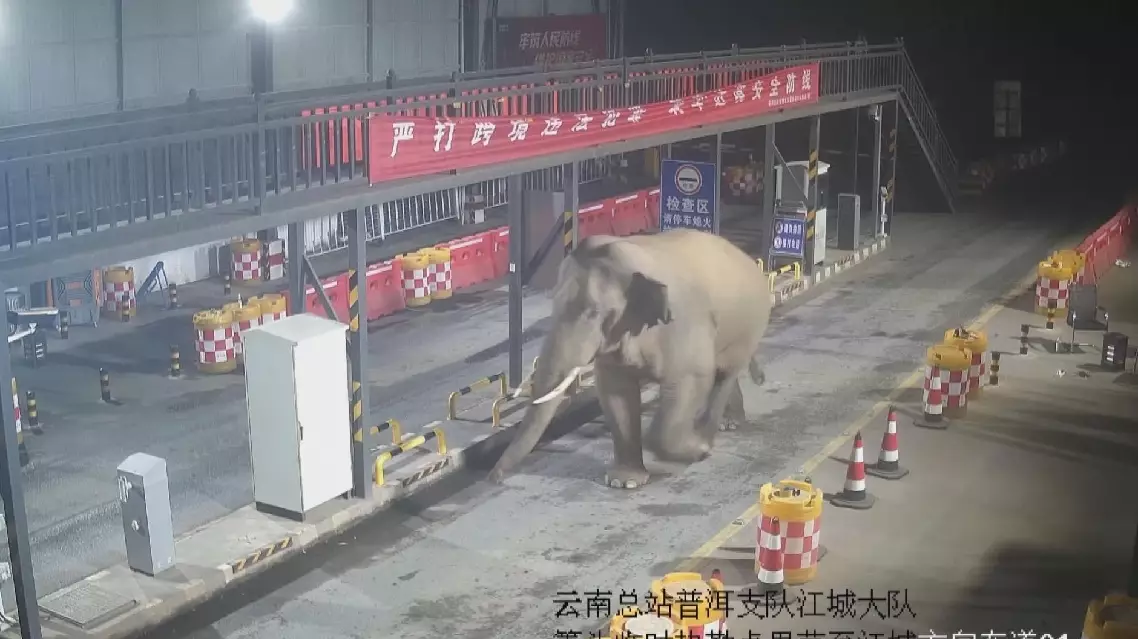
Wild Asian elephants take a walk at Yunnan border checkpoint


