Today’s artificial intelligence performs tasks that once required expert intuition, such as diagnosing satellite failures, allocating radio spectrum, creating entire business plans, and even interpreting complex human emotions. We are witnessing an acceleration of capabilities unlike any previous technological era. Paradoxically, however, the more powerful these systems become, the more urgent the simple truth becomes that an inhuman intelligence has no direction.
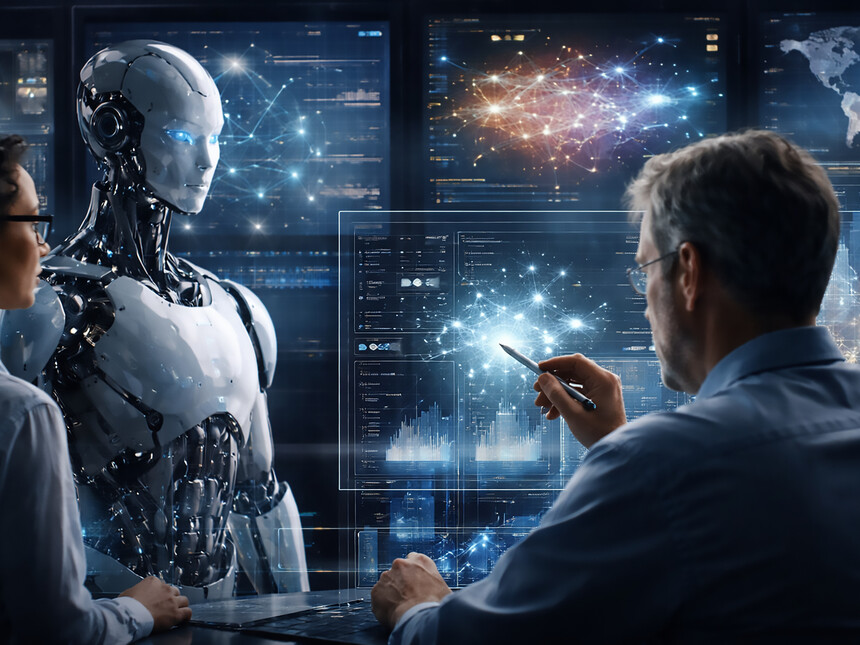
This is the essence of human-in-the-loop (HITL) AI, a model where human judgment, ethics, and situational understanding are incorporated into every stage of an intelligent system’s lifecycle. In an era dominated by automation narratives, HITL is more than a nostalgic obsession with the past. It’s a design philosophy for a more stable and responsible future.
Why humans are still needed in intelligent systems
Contrary to popular belief, AI does not “understand” the world the way we do. Algorithms recognize correlations, patterns, and probabilities, but not meaning. They lack lived experience, emotional nuance, and moral intuition.
Today, even the most advanced AI models suffer from three persistent limitations. While AI excels when the rules are stable, context sensitivity remains a challenge because human reality is full of exceptions, including subtle cultural cues, ethical gray areas, and evolving risks that datasets cannot fully encode. Rare events also cause problems. AI learns from past data, but in critical systems such as space missions, medicine, and finance, the most dangerous events are precisely those with the least precedent. Finally, the interpretation of the value remains open. AI can optimize metrics, but it cannot define values. Whether the result is simply optimal is a human question, not a mathematical one. A human-involved framework recognizes this gap not as a flaw, but as a natural division of labor between machine computation and human interpretation.
The true meaning of human in the loop
This phrase is often misused. A human participant does not mean a human pressing the “confirm” button after the AI makes a recommendation. It is a continuum of collaborative intelligence that spans multiple layers.
At the data level, we label, manage, and modify datasets, especially for sensitive tasks such as satellite image classification, medical diagnosis, and emotional interpretation. Without this human foundation, AI will inevitably learn the wrong lessons. At the model level, experts interact with the AI during the learning process, adjusting parameters, guiding the exploration, and defining what “good performance” means. Models don’t improve by chance. Improve through negotiation. At the decision-making level, humans have the final authority and AI acts as an advisor rather than a decision maker. This is especially important in safety-critical environments such as aviation, autonomous vehicles, orbital flight, and emergency response systems. Finally, and often overlooked, at the governance level, humans define policies, ethical boundaries, escalation paths, transparency requirements, and acceptable risk thresholds. By definition, the loop repeats, and in HITL systems the feedback is continuous rather than terminal.
Where AI excels and where humans need to intervene
Modern AI has great processing scale, processing millions of data points, thousands of variables, and instantaneous inferences. However, it has no discernible ability.
AI performs best in situations involving real-time anomaly detection, pattern discovery across large datasets, predictive modeling under stable conditions, iterative or labor-intensive analysis, and rapid simulation across multiple scenarios. Humans must take the lead when ethical trade-offs are involved, when the environment is uncertain, when low-probability but high-impact events occur, when human stakeholders are involved in conflict resolution, or when decisions have political, social, or cultural consequences. Synthetic intelligence is powerful, but human wisdom remains irreplaceable.
A more human purpose for AI
Industries from aerospace to education are under increasing pressure to automate everything. However, complete automation, especially automation of decisions, is neither realistic nor desirable. The real question is not whether AI should replace humans, but how it amplifies human capabilities.
Human-involved models contribute in three important ways. Trust increases because people are more likely to rely on systems they understand and can influence. Opaque decision-making justified by algorithmic authority is not a viable social infrastructure. Accountability is ensured because responsibility cannot be delegated to an algorithm when the outcome impacts public safety or human dignity. Finally, stay adaptable. Human systems evolve, but AI models remain static until retrained, and human oversight ensures resilience amid political, regulatory, and operational changes.
Space and communication perspective
Human involvement is especially important in space systems, an area that is rapidly changing with satellite constellations, onboard autonomy, and automated mission planning. Orbital conditions can change unexpectedly, space weather phenomena can disrupt even the most reliable predictions, and frequency interference issues involve regulatory and geopolitical aspects. Deep space missions also raise ethical questions about scientific priorities and risk tolerance. Fully autonomous systems may be fast, but they are rarely wise.
Human oversight will be essential in areas such as onboard fault protection logic, constellation alignment, interpretation of Earth observation anomalies, approval of deep space orbit corrections, planetary protection decisions, and arbitration of spectral disputes. Many successful missions reflect a careful symbiosis between algorithmic precision and human judgment.
Hidden risk: Over-relying on automation
The paradox is that as AI becomes more sophisticated, users tend to trust it more even though they understand it less. This can lead to over-reliance on predictive models in ambiguous situations, reduced scrutiny of automated decision-making, propagation of invisible biases, and automation complacency that undermines human skills. Human involvement will only reduce these risks if implemented rigorously. Human signatures on AI-generated decisions are meaningless unless the review is informed and contextually empowered.
Responsible HITL System Design
Functional human-involved systems require intentional architecture. Clear intervention points must exist for humans to know when and why decisions need to be revisited or overridden. AI behavior must be transparent and explainable, because evaluation is impossible without understanding. Human judges must have real expertise, not symbolic authority, especially in areas such as aviation safety, telecommunications regulation, mission planning, and healthcare. Feedback from human reasoning needs to be fed back into the AI system, rather than remaining a passive check. HITL is also increasingly becoming a regulatory requirement, reflected in frameworks such as EU AI legislation, new space safety standards, and medical AI governance.
From automation to expansion
The most important changes are conceptual. The goal of AI was never to remove humans from decision-making, but to allow humans to focus on things that machines cannot replicate, such as creative reasoning, ethical reflection, strategic judgment, empathy, and foresight. Human participation is not a constraint. It’s an opportunity to design systems that enhance human capabilities rather than replace them.
The future of more responsible intelligence
AI is embedded in global infrastructure, shaping decisions that ripple through societies, ecosystems, and even Earth’s orbit. As these systems advance, the presence of thoughtful, trained, and responsible humans becomes a stabilizing force rather than a limiting one. Machine intelligence may be fast and vast, but human intelligence remains our compass. Human engagement ensures that the trajectory of technology is aligned with empathy, context, and purpose. These properties cannot be completely synthesized by any algorithm, and probably should never be synthesized.