
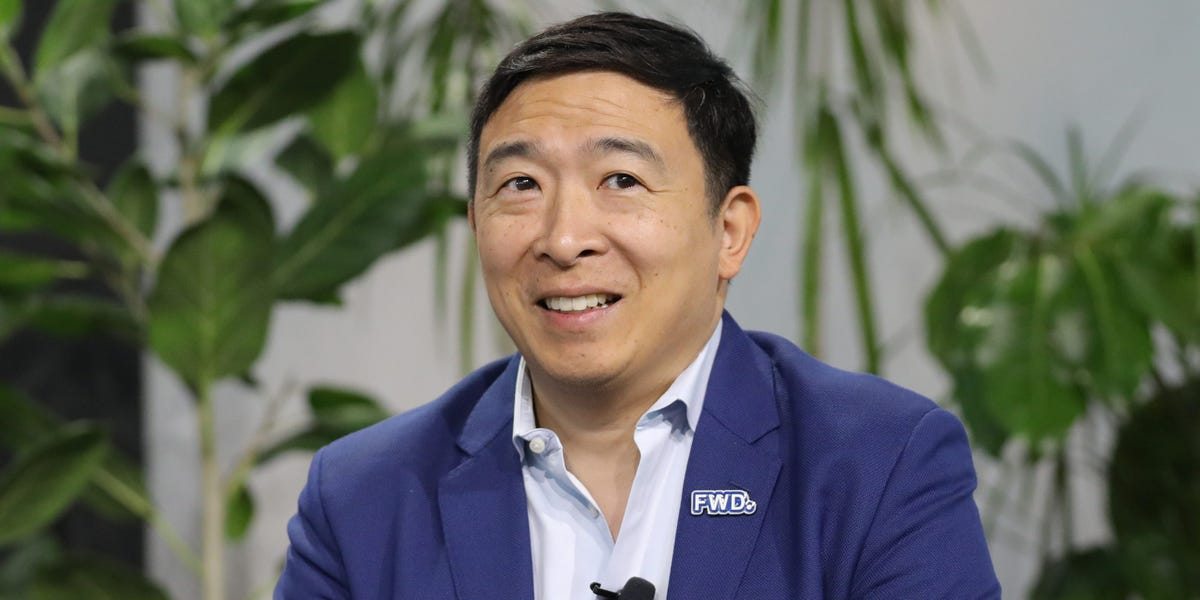
AI-related layoffs are already hurting the U.S. job market, and former presidential candidate Andrew Yang believes the impact could be substantial.
In an interview on the New York Times podcast “Hard Fork,” Yang said that this technology, when combined with the current American economy, could create “inequality on an epic and unprecedented scale.”
“We’re going to have our first millionaires. People at the very top of American life are going to get richer. It’s going to get more complex,” Yang said. “Then there will be a lot of families wondering what happened. My kids studied hard, but they don’t have jobs, they have school loans, they’re in the basement, and they’re becoming depressed.”
He said a basic income policy would be “necessary” to address these issues. Universal basic income, a program in which the government provides regular, unconditional checks to all citizens, was a key part of Yang’s 2020 presidential campaign. During that time, he introduced Freedom Divided, a universal basic income program that would provide all American adults with $1,000 monthly payments without conditions.
At the time, Yang faced pushback from some lawmakers, including Democratic Sen. Bernie Sanders, who instead proposed a federal jobs guarantee to address workforce automation.
Lawmakers are divided on basic income. Some believe it could increase economic stability, but others worry it could discourage Americans from working and make it too expensive. Many Big Tech luminaries are advocating for basic income programs in response to the impact of AI on employment.
Tesla billionaire Elon Musk, a longtime supporter of basic income, recently said that the “best way” to deal with AI-related unemployment would be “universal high income.”
“Inflation will not occur because AI/robotics will produce far more goods and services than the increase in money supply,” he wrote this month.
In an interview, Yang said AI should be taxed “100%” to balance income inequality in the U.S. economy.
“We should burden the people and workers in various ways. We should look for ways to avoid taxing human labor,” Yang said.
He added: “So tax AI. Tax bots. Don’t tax humans.”