
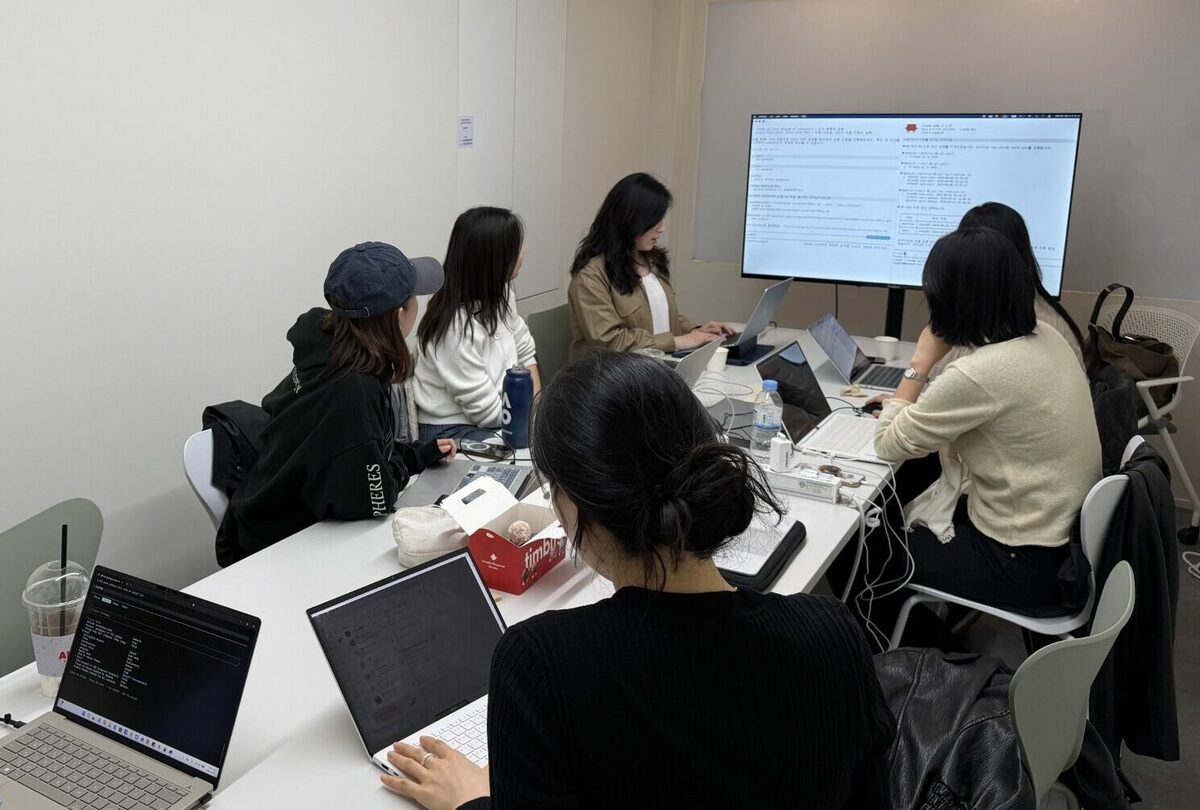
SEOUL – On a Tuesday night in April, seven office workers gathered around a table in a co-working space in southern Seoul and each paid 70,000 won ($50) for a 90-minute hands-on lesson in Claude Code, an agent-coding tool developed by American AI company Anthropic.
Ok Ye-jin (33) was among them. She works at a direct-to-consumer online store for the Korean division of a multinational brand. Oku said he signed up voluntarily to learn how to use the smart assistant. Smart assistants design computer programs based on a user’s natural language description of desired functionality.
“My company’s security policy does not allow most external AI tools to be used in the workplace,” she said, explaining that she came anyway to learn AI tools on her own time and at her own expense.
Instructor Kim Soo-ha is a 33-year-old corporate strategy and investment expert who teaches students how to comfortably interact with AI agents to make their jobs, and ultimately their lives, easier as technology advances.
Each of her five sessions had only seven seats available and sold out immediately after she announced. This is part of a broader trend of South Korean office workers learning AI on their own, outside of work, often without encouragement from their employers.
A recent study by researchers at the Bank of Korea found that there is a notable gap in the adoption of generative AI between South Korean workers and employers, with employees using tools that many companies have not yet officially approved.
Another government survey cited in the study found that by 2023, only 6.2% of medium to large enterprises had formally adopted generative AI. However, as of the BOK survey in mid-2025, 51.8% of workers reported using such tools on the job, and 78.6% of those users spent more than an hour a day using those tools.
Recognizing the growing interest, South Korea’s Ministry of Education announced in February that it would expand the number of university-run AI training programs for adults to 38 institutions this year, up from 30 in the first year, which attracted nearly 12,000 participants.
Heo Da-eun, 34, an investment analyst at a Korean venture capital firm, agreed that office workers need formal training. Her workplace does not offer this, even though it encourages staff to use generative AI in their daily work. That’s why she paid for Kim’s course, too.
Like most people, Kim thought that code-related tasks were something that had to be delegated to a developer.
But late last year, when she saw her husband, who is also not a programmer, use ChatGPT to analyze TikTok hashtag data in just a few minutes, she realized this was not the case.
She then started using Claude Code to visit various websites and collect reviews about her work. This task was completed in a fraction of the time I would have spent collecting reviews myself. “That little victory was the starting point,” she said.
She said the biggest change since then has been in the way she approaches the work itself. “I feel like I’ve changed from a doer’s perspective to a planner’s perspective,” Kim said.
She made the transition from student to teacher in March, after using Claude Code for a week, which she called the most important transition in recent years.
Friends and acquaintances started asking her to show them how it worked, and those requests eventually led to five sold-out sessions.
Also at the table that night was Park Jeong-ah, a 33-year-old content marketer. The company regularly holds in-house AI training sessions for its staff. She said those programs left her wanting to learn more, so she enrolled in external sessions.
But not everyone is eager to learn the technology.
In May 2025, Now & Survey conducted a survey of 1,000 Korean office workers and found that 27.3 percent said they felt stressed about keeping up with generative AI in the workplace.
However, the same survey showed that respondents’ overall optimism towards technology was 7.1 out of 10, which is still higher than their anxiety score of 5.9.
Ms Oku, an e-commerce manager, said it was anxiety that drove her to sign up.
“I always felt that if I didn’t learn how to use AI better, I would fall behind,” she said.
Within a few days, Kim said, most students will be asking the same question: “Is the technology dangerous?” Are their jobs disappearing? And before the answers to these questions are clear, how can you turn it into a career asset?
Kim said she has no intention of running a business and has no plans to hold any more sessions. She wants to return to her AI projects and drive the company toward what she calls “AX,” or AI transformation.
She said that what motivates her is the image she got from an AI camp she once attended. That is, on a highway full of self-driving cars capable of traveling at 500 kilometers per hour, except for one human driver who insists on driving himself.
“Everyone else has to slow down to 100 degrees because of that one car,” Kim said.
“I want to be in a place where everyone is going as fast as their cars will allow,” she added.


