
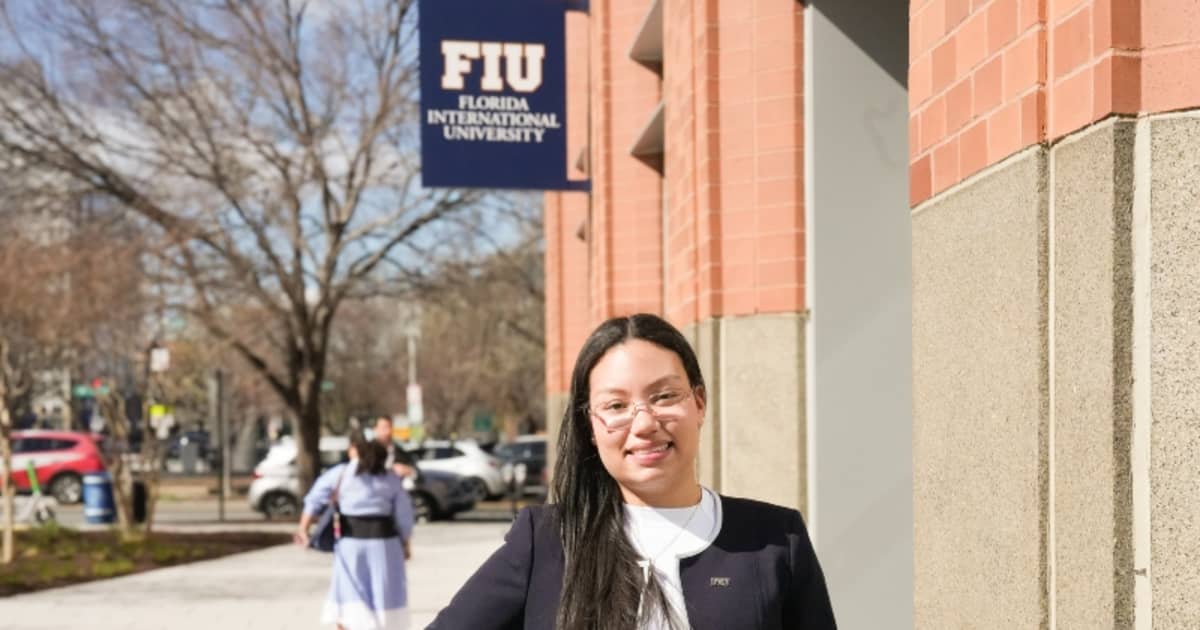
In this article, Rocío Peña, a business analytics major and freshman in the Honors College, shares her journey from applying to attend FIU’s “Future of Artificial Intelligence” fly-in seminar in DC to interacting with leaders in the nation’s capital during a three-day visit.
When I first heard about FIU at DC’s “Future of Artificial Intelligence” fly-in seminar, I was excited about the idea. But I also hesitated. I kept thinking that opportunities like this were for students who already had some experience.
I remember sitting with my laptop open and reading the application over and over, trying to decide whether I should try it or not. Eventually, I told myself the truth. The worst thing that can happen is to be rejected and you can always try again. So, I applied. Little did I know then that a small decision would shape how I saw myself at FIU.
The interview process was both exciting and terrifying. I remember seeing how prepared and accomplished the other students were. Some spoke so confidently about their research interests and career goals, which made me think more honestly about myself. Instead of getting discouraged, I started to get curious about where I wanted to grow. I also learned from the conversations themselves, listening to students share what brought them there. This made the experience feel more like a shared learning space than a competition.
Pre-trip: Learn more about AI
When I received the acceptance email, I stopped in my tracks. I remember staring at the screen and reading the words “Congratulations” over and over again. I wanted to be prepared for the trip, so I started paying more attention to AI news, reading about emerging technologies, and trying to understand the ethical and policy issues surrounding them. The more I learned, the more questions I had. So I became more interested in the subject.
Before the trip, the FIU team in DC made sure we were ready to discuss AI. They didn’t just send instructions. They guided us step by step. Learn about topics like AI ethics, governance, and innovation through webinars, selected articles, and email updates. One of the most influential sessions was a webinar hosted by the RAND Corporation. The way they break down complex policy and research topics makes AI more accessible to even those still in their early academic careers.
In the pre-trip session, Endowed Professor and Director of Computer Science in the Knight Foundation School of Computing and Information Sciences Jason Liu helped connect AI to real-world policy discussions and showed how much AI is already present in everyday systems. It can be difficult for students to know which sources to trust and how to make sense of such a rapidly changing field. So having that kind of structure and guidance made a huge difference.
DC’s FIU Experience
The trip has finally arrived. I met the students I would be spending the next few days with, and slowly the experience began to feel more like a shared journey than an event. I tried to talk to as many people as possible, from my roommates to my hackathon group. Although everyone had different majors and backgrounds, there was a common curiosity that connected us all.
By the end of the trip, those small conversations turned into real friendships. We went out for dinner the night before we left. We sat around the table and talked about everything we had experienced together. At that moment, I felt like this was the kind of community I had hoped to find when I chose FIU.
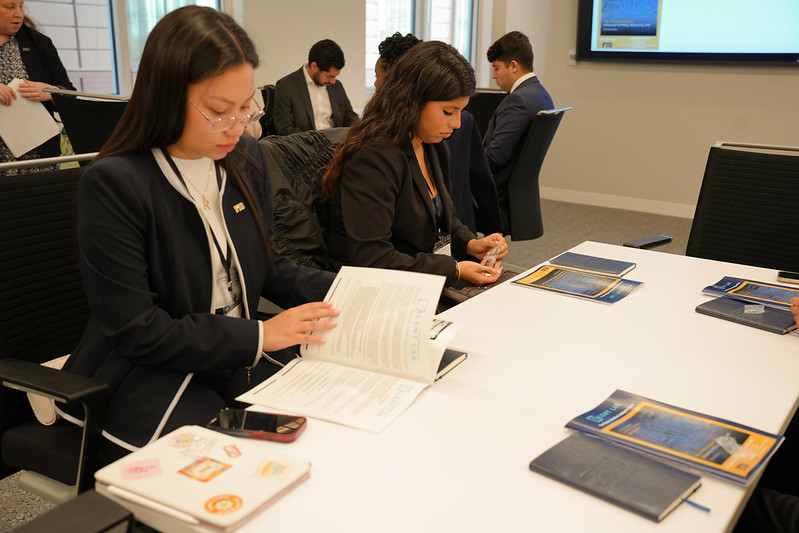

During my trip, the FIU team in Washington, DC, Honors College and Student Experience staff made me feel supported every step of the way. Being in Washington DC can be overwhelming, but I found it rather manageable and meaningful. There was always someone to guide us, whether we were moving around the city or preparing for a specialist visit.
Conversation with the leader
We visited organizations such as Qualcomm, the German Marshall Fund, Punchbowl News, and the National Cancer Institute. I also met with staff from the U.S. House of Representatives. Each visit demonstrated different aspects of artificial intelligence, not just as a technology, but as having deep implications for policy, healthcare, communication, and global innovation. I remember hearing conversations about deepfakes, misinformation, and regulation. These problems were not theoretical but practical and urgent.
One memorable visit was to the Ronald Reagan Institute. Through their student programs and initiatives, I learned how they work to advance the legacy of President Ronald Reagan through bipartisan dialogue and leadership development. Hearing about their approaches to citizen engagement and policy debates made me think differently about how institutions shape long-term ideas in government and society. It was not about one point of view, but about encouraging thoughtful conversations across differences, which felt especially important in today’s environment.
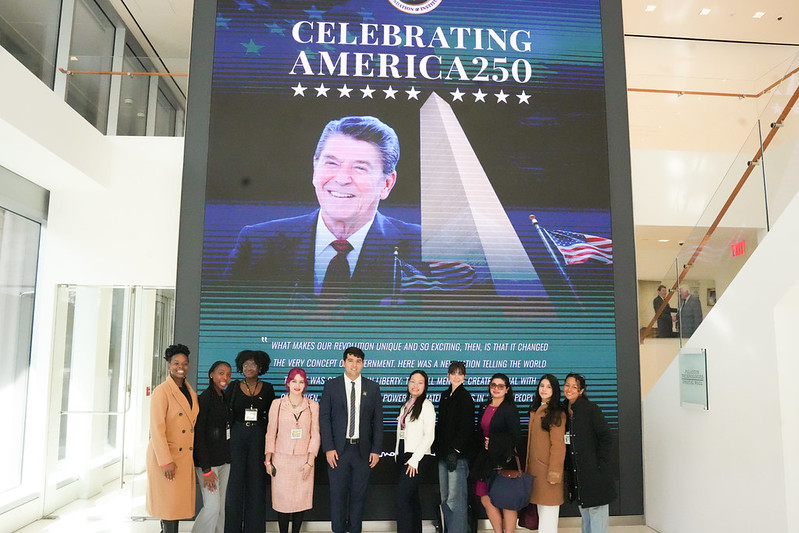
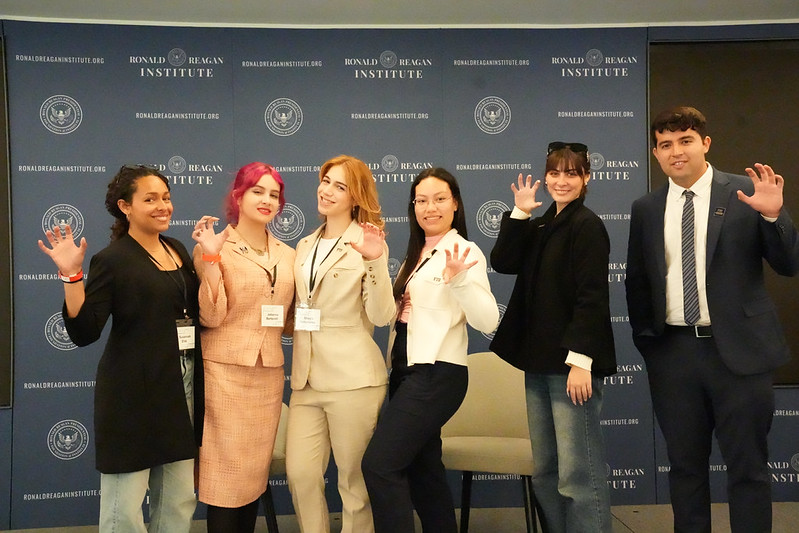
Pictured above and below: Peña (white blazer) and FIU students at the Ronald Reagan Institute.
Another unexpected surprise from my trip was how much I came to appreciate Washington DC itself. As I walked through the city, listening to the constant movement, conversation, and energy of people, I began to imagine myself there differently. I felt like it was no longer just a place I was visiting for a program, but a place I could come back to in the future for an internship or even a semester.
One of the most rewarding parts of this experience was being able to speak directly with experts who are actively shaping their respective fields. These conversations made everything feel more grounded. AI was no longer just a class topic or something you read about online, it was something people were actively working on in real time, with real consequences and responsibilities. We also enjoyed talking with Amazon Web Services to learn more about how AI is being used in education and local communities.
I also appreciated the opportunity to meet with members of FIU’s Board of Directors during my trip. It felt surreal talking to them so early in my college career. It reminded me that opportunities can open doors you didn’t even know existed, and that growth often begins with simply showing up.
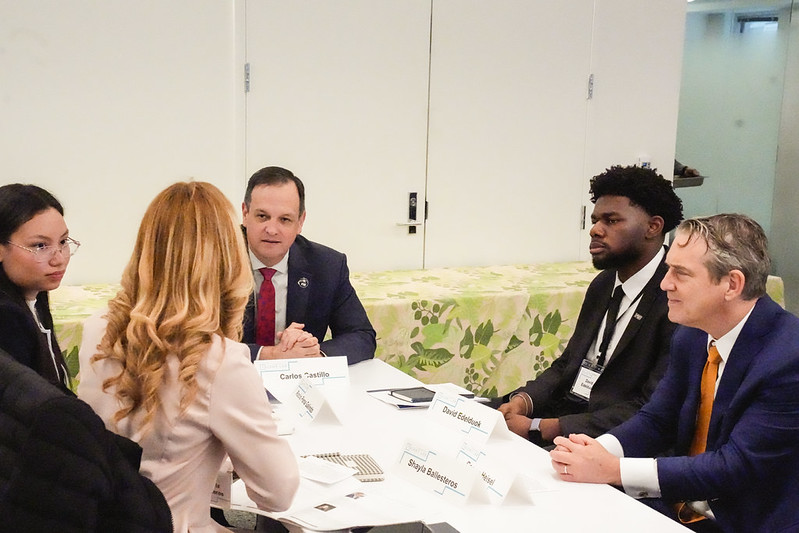
Peña (left, wearing a blue blazer) and FIU students met with FIU General Counsel Carlos Castillo and Board of Trustees member George Heisel.
Main points
I approached this experience with an attitude of learning, but I left with something deeper. I left with a clearer sense of direction, a stronger connection to FIU, and relationships with people I know I can stay in touch with long after this trip. More importantly, I left with a new mindset.
If there’s one thing I take away from this experience, it’s to just apply. Even when you feel anxious. Even if you think you don’t have enough experience. The process itself will teach you something, and the decision to give it a try can make all the difference.
This experience didn’t just teach me about AI. It helped me imagine a future where I could actually be a part of these conversations. It reminded me that I too can make a difference.
Want to learn more? FIU in Washington, DC is recruiting interns for Fall 2026 and Spring 2027 as part of our 50 Interns Campaign. Through hands-on internships and immersive academic programs, students build skills and networks while connecting classroom learning with real-world impact. Opportunities include the Honors Hamilton Scholars Program, Green School Academic Semester, Caplin News Program, and Ileana Ros-Lehtinen Fellows Program. For more information, visit washingtondc.fiu.edu.


