
image:
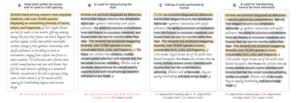
How DraftMarks works
view more
Credit: Georgia Tech
Generative artificial intelligence (AI) has transformed college writing. As papers are increasingly being drafted in collaboration with AI, professors are wondering not if their students are using AI, but how.
2025 AI in education According to a trend report, 90% of college students are using AI in their classes, and almost half are using AI in their drafting process. As AI becomes more integrated into everyday writing, traditional tools like Grammarly and Turnitin for assessing student learning will no longer be sufficient. If AI is expected to be present in most students’ writing, detecting its presence is not enough.
DraftMarks is a new open source tool developed by researchers at Georgia Tech and Stanford University that visualizes the writing process itself. Rather than trying to assess how much of a finished document was written by AI, DraftMarks shows where students iterated on AI prompts, what full AI is, and how the work evolved, revealing the invisible collaboration between human writers and AI.
Acting as an enhanced reading tool, DraftMarks overlays visual cues of different types of AI involvement directly onto documents. Eraser scraps mark areas that have been significantly revised. Staining indicates changes in the strength of the AI-generated arguments, rather than changes in content. The masking tape highlights the sentences originally generated by the AI. Glue residue indicates where AI-generated text was later removed. Ghost text indicates when the author prompted the AI but chose not to use the output. Different fonts distinguish human-written text from AI-generated text.
Combining marks not only reveals the presence of AI; They tell stories about the writer’s process.
“By making the invisible parts of the process visible, authors are faced with the question of whether they are really working with AI or just passively accepting it,” said Momin Siddiqui, a master’s student at the University of Computing and lead author of the project. “Ultimately, it will help writers make more intentional decisions about how they want to collaborate with AI in the future.”
The researchers debuted DraftMarks at the Association for Computing Machinery’s Conference on Human Factors in Computing Systems in Barcelona in April.
Designed for educators
Rather than starting with detection algorithms, the researchers started with educators. The first study of 21 people looked at how instructors review student writing and what cues they look for when assessing learning, revision, and originality. These insights informed the design of DraftMarks’ visual language, which intentionally mimics the physical artifacts of writing, such as eraser shards, tape, and smudges, to reflect processes that instructors are already aware of.
“These marks are intended to emulate the writing process in a way that we are already familiar with,” said Adam Kosia, Ph.D. in Computing. student. “These help students and teachers see the effort behind the writing and whether students have actually achieved their learning goals.”
Behind the scenes, DraftMarks tracks a document’s draft history, categorizing different types of edits and AI interactions as they occur, and allowing you to view visual cues in near real-time.
Reading draft marks
To assess how the tool works beyond the lab, the team conducted a follow-up study with 70 participants, including students, teachers, journalists, and general readers. Their reactions when reviewing DraftMarks annotated documents were decidedly mixed.
Instructors were most interested in seeing the writing process unfold, including how ideas develop, how often AI is used, and where students make decisions. Ordinary readers, on the other hand, used marks to assess something less measurable but equally important: trust. For them, DraftMarks provided clues about an author’s intentions and trustworthiness, helping readers decide how much trust to place in a text.
Moving from discovery to reflection
Unlike AI detectors that simply provide percentages, DraftMarks is designed to encourage reflection in writers and readers.
“DraftMarks has completely changed the way I think about my writing,” says Kosia. “When I first saw how the AI affected my tone, I was surprised at how much I cared about the author’s intent. I realized that small choices in the AI could subtly change what I was trying to say.”
As AI continues to reshape how writing works, the research team hopes DraftMarks will help shift the conversation toward transparency. Such tools could clearly show educators and students how learning occurs when humans and AI write together.
Disclaimer: AAAS and EurekAlert! We are not responsible for the accuracy of news releases posted on EurekAlert! Use of Information by Contributing Institutions or via the EurekAlert System.


