
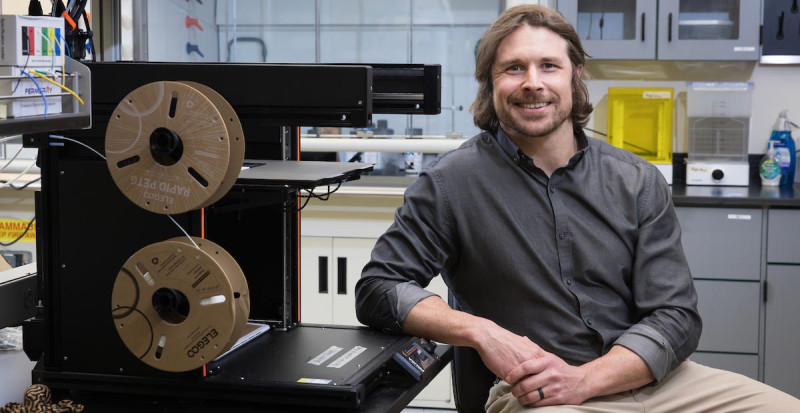
The world of polymers is complex. These long string-like molecules make up many of our materials, from the plastic in our water bottles to the tissues in our bodies. However, while stretchable, soft, or hard materials can be obtained, how exactly the molecular structure of these components contributes to the mechanical properties we see, and vice versa, can be lost in translation.
But Assistant Professor Robert Wagner recently received a National Science Foundation CAREER Award, and researchers may finally be able to close those gaps. This is NSF’s highest honor given to young faculty who have the potential to be pioneers as researchers and educators.
Wagner, a faculty member in the Department of Mechanical Engineering in the Thomas J. Watson College of Engineering and Applied Sciences, will receive $569,573 to fund research that bridges the gap between what happens molecularly and what we can observe by incorporating machine learning into both simulated and real-world experiments to analyze the behavior of polymer chains.
“Our group is all about bridging these scales, which is very important because it not only gives us a deeper understanding of how materials work, such as how the physics drives their mechanical properties, but also helps with predictive design,” Wagner said. “For example, if we want to design a more rigid system, how do we tune synthesis and processing?”
intertwined polymers
There are several ways that polymers can be combined to form materials. They may have chemical bonds, or they may loop and wrap around each other, becoming physically entangled.
If the number of entanglements is greater than these chemical crosslinks, the resulting material can be up to three orders of magnitude much stronger. Wagner hypothesizes that this is because, in chemically bonded polymers, the stress from breaking a single strand can ripple through to the remaining strain in its neighbors, which “have to pick up the slack, so to speak.”
However, if a chain breaks in a tangled network, it doesn’t really matter because the chain is very long and gets entangled with many other chains. In other words, it is tougher and requires more energy to destroy.
“When a crack occurs, it actually distributes the stress over a wider area of the network, so it’s no longer concentrated and crack propagation is blocked,” he said.
This type of behavior affects the reinforcement of all kinds of polymers, from everyday rubbers and adhesives to cutting-edge biomedical devices and soft robotic components.
For example, entanglement may prove essential for designing effective biomimetic tissue implants. Our tissues are networks of matter and require space for nutrients and waste to move. Hydrogels (polymer networks that contain water between molecular chains) are the perfect synthetic material to mimic tissue because water acts like a highway for these products. But our tissues are harder than you think, and current stem cell gels are too soft.
If these gels cannot adequately mimic the mechanical properties of our natural tissues, stem cells will have difficulty differentiating into the actual cells we need.
Wagner argues that entanglement is a great design knob that allows researchers to fine-tune the stiffness, strength, and toughness of these gels. “Entanglements transfer load from chain to chain in more places, making the network stiffer,” he added. “But unlike chemical links, it does not make the network more vulnerable.
His research will ultimately map not only how different synthesis and processing choices drive different entangled structures, but also how and why those structures result in different beneficial mechanical properties across length and time scales.
Tangle testing and prediction
At present, entanglement is difficult to study. Researchers can’t tag them because they’re just physical tangles and not separate chemicals. These are molecular signatures in large amounts of material that researchers cannot dissect or observe, even with the most advanced microscopes.
An alternative to real-world experimental studies is simulated experiments. Traditionally, this is done using molecular dynamics models, where researchers represent polymer chains as a series of beads connected by springs. Although these models can provide high-resolution insight into how the chains are physically intertwined, this method is computationally too expensive given the enormous length and time scale of networked polymer models required to make meaningful predictions about mechanical properties.
Wagner proposed a novel approach with the CAREER project. Instead, his research group takes a more holistic approach, using machine learning to recognize and characterize patterns of entanglement. (You’re not looking at individual beads, just where those beads intertwine with other threads.)
The result is a type of graph neural network that researchers can theoretically train to quickly predict how one tangled network will respond mechanically compared to other networks. This reduces computational costs and the need for physical creation and testing of materials.
Think of these graphs as social network plots. There, all “entanglements” with other people, such as friends of friends, or friends of friends, become nodes. Machine learning can predict how your behavior changes depending on the number of people who make up your immediate or broader circle.
“Here’s the idea: Because polymers are networked materials, we should be able to represent them as graphs and use all the machine learning tools that have been developed for graphs,” Wagner said.
Wagner also plans to validate these basic experiments with physical tests of hydrogel models synthesized in-house.
“We want to use the model to first understand the ‘why’ and then tell engineers, including our group, how to design materials that optimize those properties,” he said.
These new machine learning models are just the foundation of what Wagner hopes will become a set of resources for future engineers and materials scientists.
“How do we connect what we see macroscopically in materials mechanics, especially in polymers, with the fundamental physics that’s going on inside? The better materials science engineers get at bridging these gaps, the better we can predictively design new materials,” he said. “On the contrary, it helps us understand basic science: When you look at something macroscopically, what is the most likely cause?”
Developing future engineers
Beyond the lab, Wagner plans to bring his research into K-12 classrooms, from hands-on demonstrations of creating intertwined networks using toys to visualizing machine learning with graphs. He also plans to share what he learned through the project with students at the university.
But Wagner’s education plan will also focus specifically on an underserved population: incarcerated students.
According to Wagner, implementing STEM in correctional facilities can be difficult for a variety of reasons. Practical demonstrations are not so feasible, and the academic background of the students is also different.
“But then the question becomes, how do we, as STEM educators, give them the background they need? How do we make sure they understand math and physics and not just teach them?” he said.
So Wagner turns to the computer lab instead. By partnering with the company that developed MATLAB, Wagner and his team will work to install the program in computer labs, starting at Cayuga Correctional Facility.
“Instead of giving them a hands-on demonstration that fortunately can be done in a K-12 setting, we’re going to do the same thing on a computer,” he said. “I’m really excited about this. I don’t think there’s a lot of effort to bring STEM into these programs.”
Wagner considers himself a lifelong learner, and it was precisely because he fell down the materials science rabbit hole that he returned to graduate school.
“My uncle always says, ‘You’re either a student or a teacher. You just have to know which one.’ But when you’re a professor and a researcher, you can be both at the same time,” Wagner said. “Every time I teach something, I feel like I understand it better. I’m not just an educator; I’m learning as I teach.”
Wagner’s CAREER proposal is just another learning step for both him and Binghamton’s broader research group in pivoting to machine learning and tackling a fairly elusive engineering problem.
He added that the support of students and fellow faculty members, as well as programs like the Office of Strategic Research Initiatives’ Commit to Submit program, helped him secure the grant on his first attempt, rather than a solo effort.
“Now we have to work,” he said. “For me, this is the first stepping stone in what I hope will be a very productive body of work.”


