Read other stories in the “These Stories Were Not AI-Generated” special edition here.
There’s only so much artificial intelligence can do when it comes to smelling fish.
As AI integration becomes more prominent, local businesses are deciding how far to incorporate AI into their systems. For some, AI serves as a tool for brainstorming ideas, managing inventory, and scheduling shifts. For others, it’s an unnecessary tool that can’t replace human interaction, and experts say customers are skeptical.
Lee Dedrick, 60, co-owner of Northwest Seafood in the Millhopper section of north Gainesville, doesn’t see a need for that.
Because Northwest Seafood’s products rely heavily on freshness and quality, the company prioritizes hands-on testing and trusted relationships with suppliers, which he said cannot be replaced by AI.
“We focus on directly testing the quality of seafood,” he said. “See, feel, smell, touch, and talk.”[ing] to those who capture, produce, and import it; ”
Dedrick said he knows friends and colleagues who are using AI in marketing, but Northwest Seafood’s service model remains centered around human operations. Even when tracking inventory, Dedrick says visual inspection is still more practical.
“We are a small business,” Dedrick said. “It takes less than 10 seconds to walk in and look at everything piled up in labeled boxes.”
But other companies are also finding uses for AI. According to the U.S. Chamber of Commerce’s annual report, small business use of AI increased by 18% nationwide from 2024 to 2025. More than half of retail and restaurant owners report using technology.
Eros Puentes, 38, general manager of La Maracucha Restaurant & Creperie, said that while AI is useful for internal operations, it cannot replace human interaction with customers.
The restaurant operated as a food truck from 2017 to 2023 before moving to a brick-and-mortar location on West University Avenue.
When it comes to marketing and promotions, he said they don’t use AI to create posts. However, they leveraged AI to help visualize the restaurant’s logo redesign as it moved to a brick-and-mortar location.
Are you enjoying what you’re reading? Get content from The Alligator delivered to your inbox
Currently, Puentes uses AI for internal operations, tracking inventory, and changing online menu items, but not for front-end services.
“Our customers do not interact with AI when trying to use our services,” Puentes said.
Puentes is breaking away from the norm for small business owners by decoupling customer relationships from AI. Among owners who reported implementing technology in the 2025 Chamber of Commerce report, 87% agreed that AI helps them increase communication with customers, and a similar percentage said AI helps them find new customers and build stronger relationships.
La Maracucha uses Toast as its management software to optimize operations and sales. Puentes said he uses a POS system provided by Toast. The system includes a proprietary version of ChatGPT that allows restaurant owners to ask restaurant-related questions.
“It’s great for restaurant questions,” he said. “If you want a quick fix, ask a question and get an answer.”
He said AI services have allowed restaurants to more efficiently manage menus for online orders. Adjust online menu items in real time if you run out of ingredients used in multiple dishes. This saves staff from manually updating each dish, he said.
“Otherwise they [employees] We have to go through each category and ‘out of stock’ and that takes time,” Puentes said.
Puentes said he is looking forward to AI tools that allow him to create websites based entirely on his artistic vision and tastes. You can also use an AI chat assistant to address simple customer questions.
However, he acknowledged that many people prefer talking to an actual human rather than an AI. He said if the company broadly determines that customers don’t like the service, it will remove the feature.
“They want to hear real people’s stories,” he says. “If it makes a difference, I’ll keep answering the phone.”
Despite widespread adoption, UF advertising assistant professor Won-Ki Moon said the use of AI remains a divisive topic.
Small businesses typically face backlash when using AI for promotions and marketing, he said, because AI often lacks the “warm atmosphere” typical of mom-and-pop stores.
He said some local companies may rely on AI because they have fewer resources and staff than larger companies. However, patrons may view the use of AI as prioritizing profit over personal touch.
“Sometimes it’s [can] “I feel like they don’t want to talk to us directly. Rather, they only care about their money and efficiency,” he said.
President Moon expects the use of AI to increase further as it becomes more integrated into daily life and work, but he said it is important for companies to be transparent about it.
“They can clearly say, ‘I used AI because it’s better than my hand drawings and allows me to see our food more accurately,'” he said.
Moon’s research, which focused on public trust in AI, found that many consumers pay close attention to how companies use AI. He found that there is a positive response to AI when it can help existing employees rather than completely replace them.
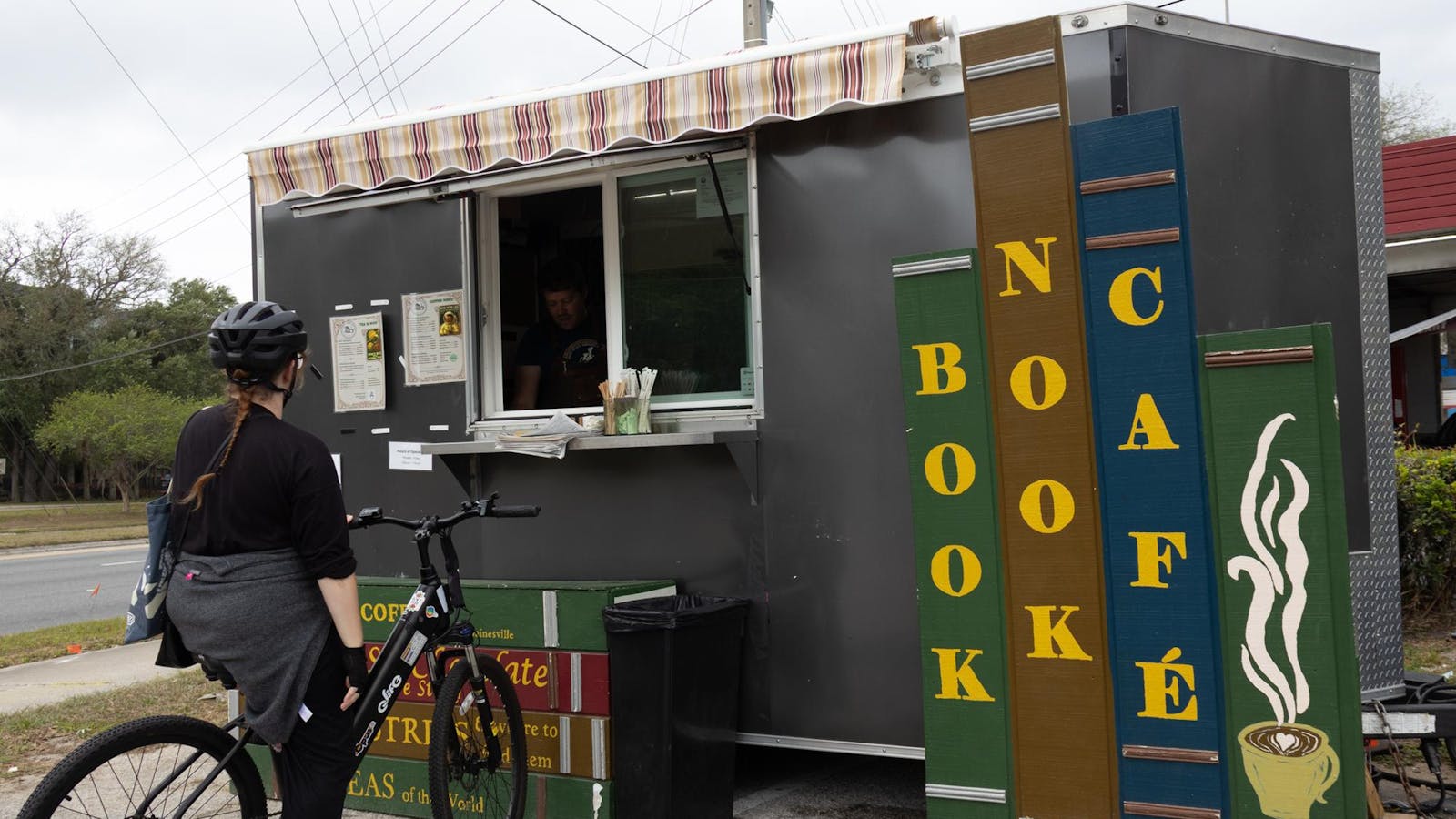
Breton Homewood, 41, co-owner of Book Nook Cafe, experienced customer backlash first-hand after leveraging AI in the early stages of business development.
“When I was first writing my business plan, I generated an idea that I was thinking about myself. [ChatGPT]”I said, ‘How can I make this look like what I want to see?'” Homewood said.
A beekeeper and space enthusiast, he wanted to combine his two interests into the concept of “space bees.” Homewood said using ChatGPT to generate ideas helped him overcome the barrier between his creative vision and the challenge of explaining design concepts to others.
When he introduced his ideas to the AI model, he said ChatGPT did a better job of creating what he wanted than other AI models. He said other AI models he tested felt like “sloppy AI.”
“ChatGPT somehow knew what I was thinking at the time and did it for me,” he said. “That’s exactly what I was looking for.”
Homewood said she has tried to distance herself from AI-generated images after receiving backlash for using them in her menus through reviews on Google Maps and comments on her Facebook posts.
He said the company may continue to use AI as a visualization tool, but will rely on local artists for the actual product.
“I really love this area,” Homewood said. “I think that’s where small businesses can really be competitive and have an advantage over people.”
Ultimately, he wants his business’ identity to remain rooted in originality and local collaboration.
“At the end of the day, it has to be our own product,” he said. “I’m going to work on this business from now on.”
Please contact Lily Hartzema at lhartzema@alligator.org. X Follow her at @lilyhartzema.
The Independent Florida Alligator has been independent of the university since 1971. Your donation today could help us #SaveStudentNewsrooms. Please consider making a gift today.
Lily Hartzema is a second-year journalism major. She is Metro’s spring 2026 general assignment reporter. She previously enjoys reading, exploring new trails, and photographing things that catch her eye.