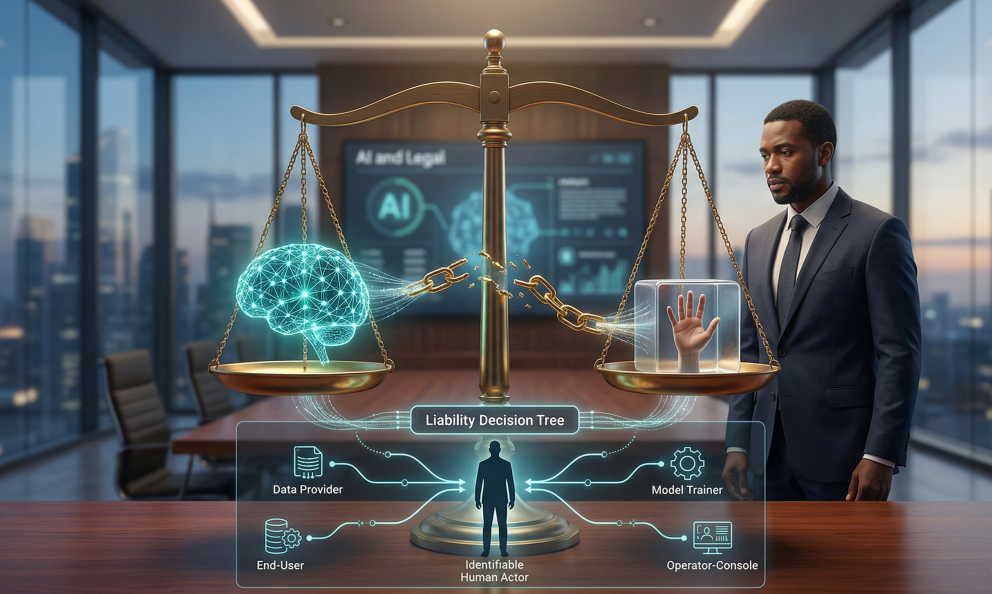
This article discusses the legal issues surrounding harm caused by artificial intelligence and who is responsible when neural networks malfunction in the real world.
Artificial intelligence (AI) is permeating from laboratories to courtrooms, clinics, cars, and stock exchanges, with neural networks increasingly diagnosing diseases, approving loans, and performing tasks long considered the domain of humans. However, when such systems fail in the real world, they have serious, even fatal, consequences.
As a personal injury plaintiff lawyer in Ontario, Canada, and a current PhD candidate in Business Administration studying the intersection of business, law, and technology, I am increasingly being asked a simple question: Who is responsible if harm occurs to AI?
The answer is actually more complicated. AI challenges the principles of negligence, causation, and foreseeability, and raises fundamental questions about how the law should respond to machine decisions.
Expanding role of AI in high-risk decision making
AI is no longer limited to low-skill task automation and machine learning platforms. It now makes decisions about health care, finance, employment, transportation, law enforcement, and legal analysis.
Modern AI models typically consist of deep neural networks. Deep neural networks can detect complex patterns in large datasets, but remain virtually opaque to developers. Scholars have observed that AI systems pose problems such as: Unpredictability and autonomy It has been incorporated into laws that were once strictly regulated by foreseeability and intent. This creates a contradiction between innovation and accountability.
While the legal system treats the harm caused as caused by humans, AI distributes responsibility to the engineers who create the datasets, the deployers, and the end users. Responsibility will be dispersed.
Liability gap: When the cause of damage cannot be easily determined
Legal scholars are increasingly referring to the emergence of a “responsibility gap” in AI governance. Traditional tort law relies on identifying:
- duty of care
- violation of that duty
- causal relationship
- compensation for damages
AI complicates each element. For example, developers may not know how a model will behave after deployment, and organizations may use third-party machine learning (ML) systems. From the end user’s perspective, the mechanism that determines the output is opaque.
Academic research points out that proving failure becomes more difficult when AI systems operate semi-autonomously or adapt autonomously through processes such as machine learning. This fragmentation calls into question doctrines that rely on human agency.
In personal injury cases, courts traditionally examine whether the defendant acted reasonably under the circumstances. But how should courts assess rationality when decision-making is partially delegated to probabilistic models?
Neural networks and explainability issues
Deep learning systems often operate as “black boxes.” Their internal decision-making processes are not easily interpreted, even by experts. This lack of explainability has significant legal implications.
Who would be held responsible if a medical AI system misdiagnosed cancer? It could be:
- how the model was trained
- Is the training data biased?
- Whether the verification process was appropriate
- Are clinicians overly reliant on automated output?
Legal literature recommends distinguishing between: Causal responsibility, role responsibility, responsibility responsibility For attributing responsibility for harm caused by AI.
However, in practice, liability may extend to a range of actors.
- data provider
- software developer
- model trainer
- Adopter
- Organizations using AI output
- Experts rely on AI recommendations
AI redistributes responsibility rather than eliminating it.
Lessons from self-driving cars: A case study on AI responsibility
Self-driving car cases offer an early glimpse into how courts will address AI-related harms. Since then, courts have begun applying customary principles of negligence and product liability to new technologies that cause injury. In recent cases, juries have begun apportioning liability between human drivers and the technology companies that develop self-driving systems.
Legal commentators have suggested that existing product liability principles, such as design defects, manufacturing defects, and failure to warn, are relevant to AI-enabled systems.
However, self-driving cars reveal the limitations of the current legal framework. Should responsibility be placed on: the car manufacturer? the software developer? the human operator? Or is it the data used to train the algorithm?
Some scholars have suggested that by analogy with product liability principles, responsibilities between upstream and downstream parties can be effectively clarified.
From the plaintiff’s perspective, these cases demonstrate that courts may still apply customary principles to new technologies, but it requires a truly sophisticated level of expert evidence and technical knowledge.
Strict liability and negligence: conflicting legal theories
The debate centers on whether the conventional negligence framework can be applied to AI systems. Some scholars advocate a strict liability system, arguing that victims should not bear the burden of proving negligence in highly complex technological environments.
Strict liability is particularly useful when harm is foreseeable but unavoidable, when AI systems are deployed at scale, and when risk is socially distributed. Alternatively, it is not easy to prove technical causation.
It is also argued that negligence law can adapt to technological changes. Comparative legal research argues for building on existing legal doctrines, taking advantage of their inherently stabilizing effects and gradual adaptation to new harms.
Strict liability and negligence represent policy priorities for innovation, fairness, and how risks and costs are allocated.
Should innovators be held responsible for technological risks, or should the costs of progress be broadly shared by society?
Business perspective: risk allocation and insurance
From a business perspective, AI liability is not just a legal issue, but a risk management issue. Organizations implementing AI systems are starting to focus on contractual risk allocation issues: 2. professional liability insurance, 3. cybersecurity coverage, 4. indemnification, and regulatory compliance frameworks.
Insurance markets can play an important role in establishing accountability for AI. Some research suggests that certain harms from AI may ultimately be best addressed by hybrid compensation systems that combine insurance and tort.
Companies incorporating AI into business decision-making must consider the litigation risks of digital transformation. Failure to do so may expose such organizations to reputational damage, regulatory sanctions, and civil liability.
Ethical responsibility vs. legal responsibility
Legal responsibility often does not equate to ethical responsibility. The AI governance discussion includes the following principles:
- fairness
- transparency
- accountability
- explainability
However, legal obligations do not automatically flow from ethical considerations.
Recent research has proposed conceptual frameworks for building evidentiary rules that allocate responsibility and link design decisions to legal outcomes in multi-actor AI ecosystems. Therefore, legal systems that seek to foster innovation must also consider those who will be harmed by new technologies. This balancing act will shape the future of AI governance.
The future of negligence in the age of artificial intelligence
Artificial intelligence challenges the assumption that decision-making authority always resides with identifiable human actors. However, legal responsibility ultimately remains with humans.
It is unlikely that courts will recognize AI systems as legal entities in the near future. Instead, we expect to see individuals developing, deploying, and profiting from AI systems held accountable.
As AI systems become more independent, hybrid models that combine different forms of regulation are likely to evolve.
- principle of negligence
- Product liability principles
- Regulatory oversight
- Insurance compensation system
Rather than replacing common law concepts, AI may simply force courts to clarify them. From the plaintiff’s perspective, the question is what happened.
Who creates risks? Who can best prevent risks that harm individuals?
Until Congress embraces inclusive technology. In a neural AI liability regime, courts apply existing legal doctrine to new technology. Neural networks may be new. Negligence is not.