
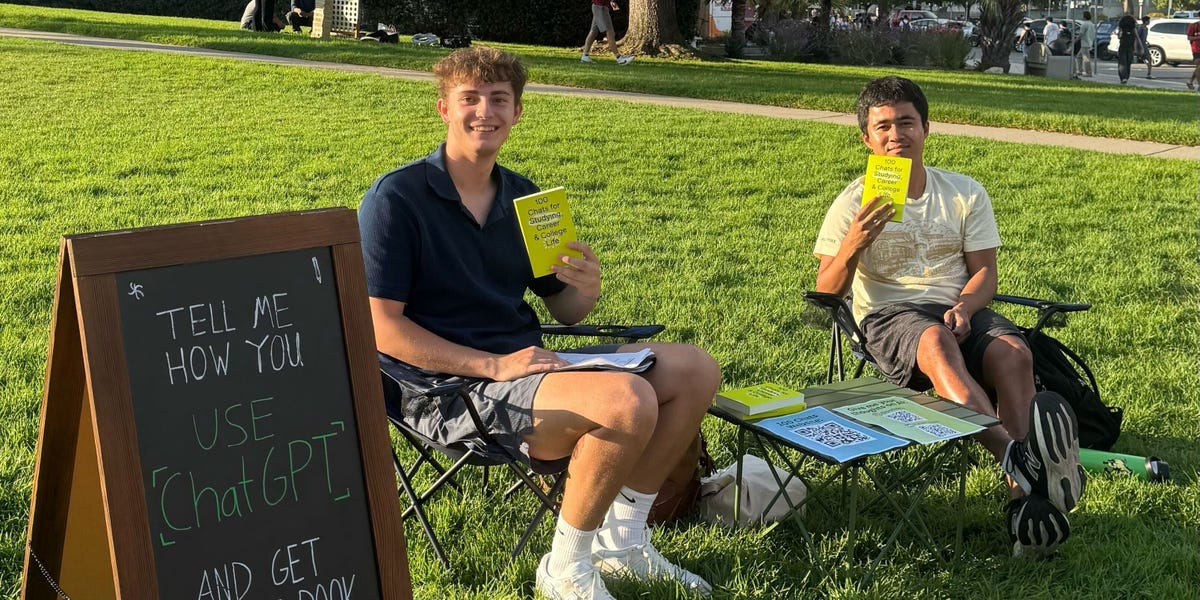
Parker Jones, a software engineering student at the University of California, wasn’t trying to challenge his professors. Now that’s effectively what he’s doing.
After interviewing more than 50 students about how to use AI tools like ChatGPT, Jones came to a clear conclusion. earlier than the teacher planned to teach.
What he found on campus was in sharp contrast to the dominant discourse promoted by the university and, in many cases, the professors themselves.
While the headlines focused on fraud and abuse, Jones found that most students were using AI in more mundane, practical ways, such as assisting with “24/7 office hours.” Ask follow-up questions, clarify confusing lectures, organize assignments, and sharpen your thinking. It’s less about shortcuts and more about staying in the flow of learning, according to research he recently published on OpenAI’s ChatGPT for Education blog.
But despite how widespread and normalized the practice is, many professors remain hesitant, silent, or outright skeptical, Jones said. He is a former member of OpenAI’s Student Research Program, a program that brings together undergraduate students to discuss how to use ChatGPT.
“The most common thing is not to deal with it,” he told me in a recent interview.
When AI emerges, it is often viewed negatively. This disconnect creates strange dynamics, he said, where students become heavily reliant on tools they feel they shouldn’t talk about.
For Jones, the real problem is not the misuse of AI, but organizational inertia. He specifically expected computer science professors to: Lead the charge. Instead, he found that many are falling behind, waiting for clearer rules and more research before incorporating AI into education.
“There’s a certain tendency in academia to wait things out and move in the right direction, and I think it’s with good intentions,” he says. “I think that also causes us to miss moments.”
Cal Poly responded
Matt Lazier, a spokesperson for UC Poly, said the university is focusing on AI and machine learning within its computer science and software engineering majors, supported by an expanded effort from the Noyce School of Applied Computing.
These include the Advanced AI Factory, powered by Nvidia, and a new data science degree program launching in fall 2027. Events like PolyPrompt also power hands-on AI learning.
AI is also integrated across disciplines, co-curricular programs and other initiatives, giving students broad hands-on exposure to AI technology, ethics and real-world applications, he added.
The California State University System, a public university network that includes Cal Poly, also launched an AI strategy that encompasses tools such as an education-focused version of ChatGPT, faculty grants, training, and industry partnerships.
Students have other concerns about AI
Still, Jones’ concerns were echoed in another recent interview I conducted. This time, we interviewed Kiran Maya Sheikh, who graduated from the University of California, Irvine in June 2025 with a degree in computer science. She said she has been taught programming languages and other software development and deployment skills, but AI tools were not on the curriculum.
Other recent graduates have previously spoken to Business Insider about the unique challenges they face in the tech job market, including AI that is transforming the workplace.
“I felt like I graduated a little too quickly, especially with AI,” Sheikh told me.
With limited formal curriculum support, students are teaching themselves and each other how to use new AI tools, Jones said. Said. He explained how he implemented AI coding tools such as: I shared OpenAI’s Codex with my classmates during a senior project and dramatically improved their results.
This kind of bottom-up hiring is happening across campus, he told me, and mostly without formal guidance.
Jones isn’t advocating abandoning the basics or blindly embracing AI. In fact, many of the students he spoke to are cautious about relying too heavily on AI. But he believes universities should meet students already using these tools, already experimenting and already adapting.
His message to professors is simple. Catch up or at least join in the conversation. Today, students are almost single-handedly navigating the biggest technological change in education.
Sign up for BI’s Tech Memo newsletter here. Please contact us by email. abarr@businessinsider.com.