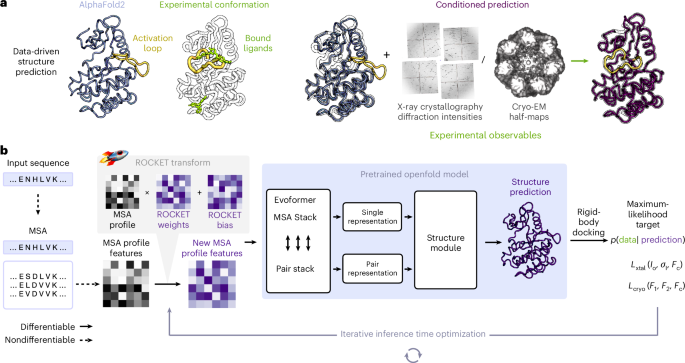
Jumper, J. et al. Highly accurate protein structure prediction with AlphaFold. Nature 596, 583–589 (2021).
Google Scholar
Baek, M. et al. Accurate prediction of protein structures and interactions using a three-track neural network. Science 373, 871–876 (2021).
Google Scholar
Jumper, J. et al. Applying and improving AlphaFold at CASP14. Proteins 89, 1711–1721 (2021).
Google Scholar
Pereira, J. et al. High-accuracy protein structure prediction in CASP14. Proteins 89, 1687–1699 (2021).
Google Scholar
Karelina, M., Noh, J. J. & Dror, R. O. How accurately can one predict drug binding modes using AlphaFold models? eLife 12, RP89386 (2023).
Google Scholar
Terwilliger, T. C. et al. AlphaFold predictions are valuable hypotheses and accelerate but do not replace experimental structure determination. Nat. Methods 21, 110–116 (2024).
Google Scholar
He, X.-H., Li, J.-R., Shen, S.-Y. & Xu, H. E. AlphaFold3 versus experimental structures: assessment of the accuracy in ligand-bound G protein-coupled receptors. Acta Pharmacol. Sin. 46, 1111–1122 (2025).
Google Scholar
Buttenschoen, M., Morris, G. M. & Deane, C. M. PoseBusters: AI-based docking methods fail to generate physically valid poses or generalise to novel sequences. Chem. Sci. 15, 3130–3139 (2024).
Google Scholar
Abramson, J. et al. Accurate structure prediction of biomolecular interactions with AlphaFold 3. Nature 630, 493–500 (2024).
Google Scholar
Brändén, G. & Neutze, R. Advances and challenges in time-resolved macromolecular crystallography. Science 373, eaba0954 (2021).
Google Scholar
Hekstra, D. R. Emerging time-resolved X-ray diffraction approaches for protein dynamics. Annu. Rev. Biophys. 52, 255–274 (2023).
Google Scholar
Turk, M. & Baumeister, W. The promise and the challenges of cryo-electron tomography. FEBS Lett 594, 3243–3261 (2020).
Google Scholar
Nogales, E. & Mahamid, J. Bridging structural and cell biology with cryo-electron microscopy. Nature 628, 47–56 (2024).
Google Scholar
McCoy, A. J., Sammito, M. D. & Read, R. J. Implications of AlphaFold2 for crystallographic phasing by molecular replacement. Acta Crystallogr. D 78, 1–13 (2022).
Google Scholar
Millán, C. et al. Assessing the utility of CASP14 models for molecular replacement. Proteins 89, 1752–1769 (2021).
Google Scholar
Liebschner, D. et al. Macromolecular structure determination using X-rays, neutrons and electrons: recent developments in PHENIX. Acta Crystallogr. D 75, 861–877 (2019).
Google Scholar
Murshudov, G. N., Vagin, A. A. & Dodson, E. J. Refinement of macromolecular structures by the maximum-likelihood method. Acta Crystallogr. D 53, 240–255 (1997).
Google Scholar
Yamashita, K., Wojdyr, M., Long, F., Nicholls, R. A. & Murshudov, G. N. GEMMI and Servalcat restrain REFMAC5. Acta Crystallogr. D 79, 368–373 (2023).
Google Scholar
Langer, G. G., Cohen, S. X., Lamzin, V. S. & Perrakis, A. Automated macromolecular model building for X-ray crystallography using ARP/wARP v.7. Nat. Protoc. 3, 1171–1179 (2008).
Google Scholar
Terwilliger, T. C. Improving macromolecular atomic models at moderate resolution by automated iterative model building, statistical density modification and refinement. Acta Crystallogr. D 59, 1174–1182 (2003).
Google Scholar
Terwilliger, T. C. et al. Iterative model building, structure refinement and density modification with the PHENIX AutoBuild wizard. Acta Crystallogr. D 64, 61–69 (2008).
Google Scholar
The wwPDB Consortium. EMDB—the Electron Microscopy Data Bank. Nucleic Acids Res. 52, D456–D465 (2024).
Google Scholar
Headd, J. J. et al. Use of knowledge-based restraints in phenix.refine to improve macromolecular refinement at low resolution. Acta Crystallogr. D 68, 381–390 (2012).
Google Scholar
Liwo, A., Lee, J., Ripoll, D. R., Pillardy, J. & Scheraga, H. A. Protein structure prediction by global optimization of a potential energy function. Proc. Natl Acad. Sci. USA 96, 5482–5485 (1999).
Google Scholar
Raman, S. et al. Structure prediction for CASP8 with all-atom refinement using Rosetta. Proteins 77, 89–99 (2009).
Google Scholar
Stahl, K., Graziadei, A., Dau, T., Brock, O. & Rappsilber, J. Protein structure prediction with in-cell photo-crosslinking mass spectrometry and deep learning. Nat. Biotechnol. 41, 1810–1819 (2023).
Google Scholar
Zhang, Y. et al. Distance-AF improves predicted protein structure models by AlphaFold2 with user-specified distance constraints. Commun. Biol. 8, 1392 (2025).
Google Scholar
Jamali, K. et al. Automated model building and protein identification in cryo-EM maps. Nature 628, 450–457 (2024).
Google Scholar
Terwilliger, T. C. et al. Accelerating crystal structure determination with iterative AlphaFold prediction. Acta Crystallogr. D 79, 234–244 (2023).
Google Scholar
Feng, S. et al. Integrated structure prediction of protein–protein docking with experimental restraints using ColabDock. Nat. Mach. Intell. 6, 924–935 (2024).
Google Scholar
Levy, A. et al. Solving inverse problems in protein space using diffusion-based priors. Preprint at https://arxiv.org/abs/2406.04239 (2024).
Maddipatla, A. et al. Inverse problems with experiment-guided AlphaFold. Preprint at https://arxiv.org/abs/2502.09372 (2025).
Ahdritz, G. et al. OpenFold: retraining AlphaFold2 yields new insights into its learning mechanisms and capacity for generalization. Nat. Methods 21, 1514–1524 (2024).
Google Scholar
Li, M., Dalton, K. & Hekstra, D. SFCalculator: connecting deep generative models and crystallography. Preprint at bioRxiv https://doi.org/10.1101/2025.01.12.632630 (2025).
Wayment-Steele, H. K. et al. Predicting multiple conformations via sequence clustering and AlphaFold2. Nature 625, 832–839 (2024).
Google Scholar
Bryant, P. & Noé, F. Improved protein complex prediction with AlphaFold-multimer by denoising the MSA profile. PLoS Comput. Biol. 20, e1012253 (2024).
Google Scholar
Xie, T., Song, Z. & Huang, J. Conditioned protein structure prediction. PRX Life 2, 043001 (2024).
Google Scholar
Monteiro da Silva, G., Cui, J. Y., Dalgarno, D. C., Lisi, G. P. & Rubenstein, B. M. High-throughput prediction of protein conformational distributions with subsampled AlphaFold2. Nat. Commun. 15, 2464 (2024).
Google Scholar
Stein, R. A. & Mchaourab, H. S. SPEACH_af: sampling protein ensembles and conformational heterogeneity with AlphaFold2. PLoS Comput. Biol. 18, e1010483 (2022).
Google Scholar
Budziszewski, G. R., Snell, M. E., Wright, T. R., Lynch, M. L. & Bowman, S. E. J. High-throughput screening to obtain crystal hits for protein crystallography. J. Vis. Exp. 193, e65211 (2023).
Boby, M. L. et al. Open science discovery of potent noncovalent SARS-CoV-2 main protease inhibitors. Science 382, eabo7201 (2023).
Günther, S. et al. X-ray screening identifies active site and allosteric inhibitors of SARS-CoV-2 main protease. Science 372, 642–646 (2021).
Google Scholar
Fearon, D. et al. Accelerating drug discovery with high-throughput crystallographic fragment screening and structural enablement. Appl. Res. 4, e202400192 (2025).
Google Scholar
Dalton, K. M., Greisman, J. & Hekstra, D. A unifying Bayesian framework for merging X-ray diffraction data. Nat. Commun. 13, 7764 (2022).
Google Scholar
Zhong, E. D., Bepler, T., Berger, B. & Davis, J. H. CryoDRGN: reconstruction of heterogeneous cryo-EM structures using neural networks. Nat. Methods 18, 176–185 (2021).
Google Scholar
Kimanius, D. et al. Data-driven regularization lowers the size barrier of cryo-EM structure determination. Nat. Methods 21, 1216–1221 (2024).
Google Scholar
Wang, X. et al. CryoREAD: de novo structure modeling for nucleic acids in cryo-EM maps using deep learning. Nat. Methods 20, 1739–1747 (2023).
Google Scholar
Croll, T. I. ISOLDE: a physically realistic environment for model building into low-resolution electron-density maps. Acta Crystallogr. D 74, 519–530 (2018).
Google Scholar
Wang, X., Zhu, H., Terashi, G., Taluja, M. & Kihara, D. DiffModeler: large macromolecular structure modeling for cryo-EM maps using a diffusion model. Nat. Methods 21, 2307–2317 (2024).
Google Scholar
He, J., Lin, P., Chen, J., Cao, H. & Huang, S.-Y. Model building of protein complexes from intermediate-resolution cryo-EM maps with deep learning-guided automatic assembly. Nat. Commun. 13, 4066 (2022).
Google Scholar
Sjodt, M. et al. Structure of the peptidoglycan polymerase RodA resolved by evolutionary coupling analysis. Nature 556, 118–121 (2018).
Google Scholar
McCoy, A. J. et al. Phaser crystallographic software. J. Appl. Crystallogr. 40, 658–674 (2007).
Google Scholar
Read, R. J., Millán, C., McCoy, A. J. & Terwilliger, T. C. Likelihood-based signal and noise analysis for docking of models into cryo-EM maps. Acta Crystallogr. D 79, 271–280 (2023).
Google Scholar
Wang, W., Gong, Z. & Hendrickson, W. A. AlphaFold-guided molecular replacement for solving challenging crystal structures. Acta Crystallogr. D 81, 4–21 (2025).
Google Scholar
Gabriel, F. et al. Structural basis of thiamine transport and drug recognition by SLC19A3. Nat. Commun. 15, 8542 (2024).
Google Scholar
Torino, S., Dhurandhar, M., Stroobants, A., Claessens, R. & Efremov, R. G. Time-resolved cryo-EM using a combination of droplet microfluidics with on-demand jetting. Nat. Methods 20, 1400–1408 (2023).
Google Scholar
van Beusekom, B. et al. Homology-based hydrogen bond information improves crystallographic structures in the PDB. Protein Sci 27, 798–808 (2018).
Google Scholar
Bond, P. S. & Cowtan, K. D. ModelCraft: an advanced automated model-building pipeline using Buccaneer. Acta Crystallogr. D 78, 1090–1098 (2022).
Google Scholar
Brünger, A. T. Free R value: a novel statistical quantity for assessing the accuracy of crystal structures. Nature 355, 472–475 (1992).
Google Scholar
Jendrusch, M. et al. AlphaDesign: a de novo protein design framework based on AlphaFold. Mol. Syst. Biol. 21, 1166–1189 (2025).
Google Scholar
Wicky, B. I. M. et al. Hallucinating symmetric protein assemblies. Science 378, 56–61 (2022).
Google Scholar
Frank, C. et al. Scalable protein design using optimization in a relaxed sequence space. Science 386, 439–445 (2024).
Google Scholar
De Zitter, E., Coquelle, N., Oeser, P., Barends, T. R. M. & Colletier, J.-P. Xtrapol8 enables automatic elucidation of low-occupancy intermediate-states in crystallographic studies. Commun. Biol. 5, 640 (2022).
Google Scholar
Waschbüsch, D. et al. Structural basis for the specificity of PPM1H phosphatase for Rab GTPases. EMBO Rep. 22, e52675 (2021).
Google Scholar
Pullen, K. E. et al. An alternate conformation and a third metal in PstP/Ppp, the M. tuberculosis PP2C-family Ser/Thr protein phosphatase. Structure 12, 1947–1954 (2004).
Google Scholar
Christou, N.-E. et al. Time-resolved crystallography captures light-driven DNA repair. Science 382, 1015–1020 (2023).
Google Scholar
Litscher, E. S. & Wassarman, P. M. The mammalian egg’s zona pellucida, fertilization, and fertility. Curr. Top. Dev. Biol. 162, 207–258 (2025).
Google Scholar
Bokhove, M. & Jovine, L. Structure of zona pellucida module proteins. Curr. Top. Dev. Biol. 130, 413–442 (2018).
Google Scholar
Nishio, S. et al. ZP2 cleavage blocks polyspermy by modulating the architecture of the egg coat. Cell 187, 1440–1459 (2024).
Google Scholar
Okumura, H. et al. A newly identified zona pellucida glycoprotein, ZPD, and dimeric ZP1 of chicken egg envelope are involved in sperm activation on sperm–egg interaction. Biochem. J. 384, 191–199 (2004).
Google Scholar
Cao, H., Li, T., Chen, J., He, J. & Huang, S.-Y. Improving cryo-EM maps by resolution-dependent and heterogeneity-aware deep learning. Preprint at bioRxiv https://doi.org/10.1101/2025.09.03.674102 (2025).
Stsiapanava, A. et al. Cryo-EM structure of native human uromodulin, a zona pellucida module polymer. EMBO J 39, e106807 (2020).
Google Scholar
Evans, R. et al. Protein complex prediction with AlphaFold-Multimer. Preprint at bioRxiv https://doi.org/10.1101/2021.10.04.463034 (2021).
Zheng, H., Hou, J., Zimmerman, M. D., Wlodawer, A. & Minor, W. The future of crystallography in drug discovery. Expert Opin. Drug Discov 9, 125–137 (2014).
Google Scholar
McCoy, A. J. et al. Phasertng: directed acyclic graphs for crystallographic phasing. Acta Crystallogr. D 77, 1–10 (2021).
Google Scholar
Millán, C., McCoy, A. J., Terwilliger, T. C. & Read, R. J. Likelihood-based docking of models into cryo-EM maps. Acta Crystallogr. D 79, 281–289 (2023).
Google Scholar
Read, R. J. & McCoy, A. J. A log-likelihood-gain intensity target for crystallographic phasing that accounts for experimental error. Acta Crystallogr. D 72, 375–387 (2016).
Google Scholar
Read, R. J. Structure-factor probabilities for related structures. Acta Crystallogr. A 46, 900–912 (1990).
Google Scholar
Fletcher, R. Practical Methods of Optimization 2nd edn (John Wiley & Sons, 1987).
Pintilie, G. et al. Measurement of atom resolvability in cryo-EM maps with Q-scores. Nat. Methods 17, 328–334 (2020).
Google Scholar
Punjani, A., Rubinstein, J. L., Fleet, D. J. & Brubaker, M. A. cryoSPARC: algorithms for rapid unsupervised cryo-EM structure determination. Nat. Methods 14, 290–296 (2017).
Google Scholar
Lawrence, J., Bernal, J. & Witzgall, C. A purely algebraic justification of the Kabsch–Umeyama algorithm. J. Res. Natl Inst. Stand. Technol. 124, 1–6 (2019).
Google Scholar
Klug, A., Crick, F. H. C. & Wyckoff, H. W. Diffraction by helical structures. Acta Crystallogr 11, 199–213 (1958).
Google Scholar
Frank, J. et al. SPIDER and WEB: processing and visualization of images in 3D electron microscopy and related fields. J. Struct. Biol. 116, 190–199 (1996).
Google Scholar
Pettersen, E. F. et al. UCSF Chimera—a visualization system for exploratory research and analysis. J. Comput. Chem. 25, 1605–1612 (2004).
Google Scholar
Kidmose, R. T. et al. Namdinator—automatic molecular dynamics flexible fitting of structural models into cryo-EM and crystallography experimental maps. IUCrJ 6, 526–531 (2019).
Google Scholar
Casañal, A., Lohkamp, B. & Emsley, P. Current developments in Coot for macromolecular model building of electron cryo-microscopy and crystallographic data. Protein Sci 29, 1069–1078 (2020).
Google Scholar
Afonine, P. V. et al. Real-space refinement in PHENIX for cryo-EM and crystallography. Acta Crystallogr. D 74, 531–544 (2018).
Google Scholar
Heo, L. & Feig, M. One bead per residue can describe all-atom protein structures. Structure 32, 97–111.e6 (2024).
Google Scholar
Yamashita, K., Palmer, C. M., Burnley, T. & Murshudov, G. N. Cryo-EM single-particle structure refinement and map calculation using Servalcat. Acta Crystallogr. D 77, 1282–1291 (2021).
Google Scholar
Burnley, T., Iadanza, M., Joseph, A., Palmer, C. & Winn, M. CCP-EM 2.0: software tools for efficient, accurate and reproducible management and automation of cryo-EM processing from images to structures. Acta Crystallogr. A 79, C17 (2023).
Google Scholar
Kovalevskiy, O., Nicholls, R. A., Long, F., Carlon, A. & Murshudov, G. N. Overview of refinement procedures within REFMAC5: utilizing data from different sources. Acta Crystallogr. D 74, 215–227 (2018).
Google Scholar
Afonine, P. V. et al. New tools for the analysis and validation of cryo-EM maps and atomic models. Acta Crystallogr. D 74, 814–840 (2018).
Google Scholar
Sun, C., Gonzalez, B. & Jiang, W. Helical indexing in real space. Sci. Rep. 12, 8162 (2022).
Google Scholar
PyMOL v.1.8 (Schrödinger, LLC, 2015).
Sanchez, F. Moorhen: a web browser molecular graphics program based on the Coot desktop program. Zenodo https://doi.org/10.5281/zenodo.14923759 (2025).
Williams, C. J. et al. MolProbity: more and better reference data for improved all-atom structure validation. Protein Sci 27, 293–315 (2018).
Google Scholar
Fadini, A. & Li, M. AlphaFold as a prior: experimental structure determination conditioned on a pretrained neural network. Zenodo https://doi.org/10.5281/zenodo.15084557 (2025).