
SINGAPORE – New committee to guide next steps Use and deployment of AI across Singapore’s higher education sector.
The Commission on Artificial Intelligence in Higher Education will provide strategic direction and oversight to improve collaboration across all Higher Education Institutions (IHL), Education Minister Desmond Lee said on April 1.
There will also be greater sharing of good practices and developments in AI, he added.
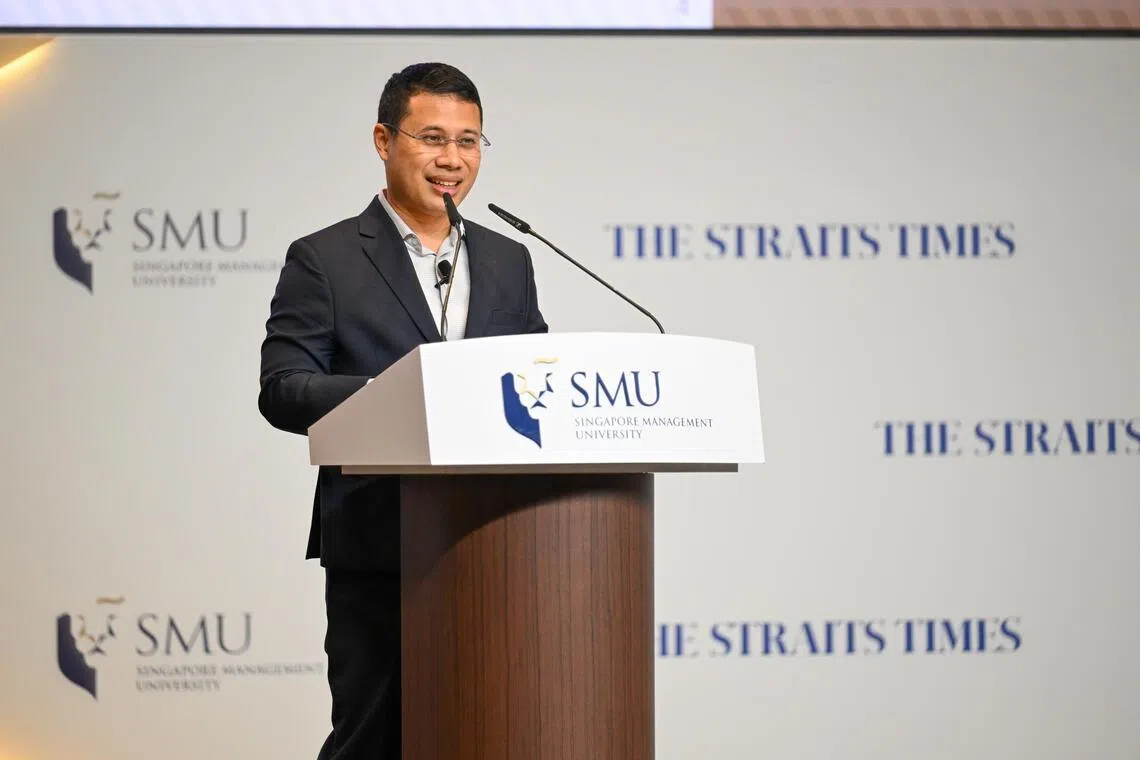
Mr Lee was speaking at the Straits Times Education Forum titled AI in Higher Education: Hype or Hope? held at Singapore Management University’s (SMU) Yong Pun Hau School of Law on April 1.
The 2026 Forum, held in partnership with SMU, focused on the use of AI in higher education and discussed learning and assessment in the machine age.
The committee, which will be chaired by Mr Lee, will include Senior Education Minister Janil Puthuchary, as well as presidents, principals and chief executives of Singapore’s universities, polytechnics and Institute of Technology Education (ITE).
Lee said agencies already have workgroups to share best practices, but as AI continues to evolve rapidly, a “systems-level” approach is needed to identify opportunities and collectively address challenges.
“By increasing sharing and collaboration at the leadership level…we can build on existing efforts and act with greater purpose and ambition, not only adapting to change but proactively shaping the future of higher education and our campuses as it evolves,” he said.
Mr Lee said the Ministry of Education will strengthen research on how AI can advance higher education by supporting inter-IHL AI projects through the Higher Education Research Fund.
“This will bring educators and researchers together to explore innovative learning approaches, generate evidence of what works, and apply these insights to educational practice across institutions,” he added.
He added that this initiative in the higher education sector supports broader initiatives led by educational institutions. New National AI Council The Prime Minister serves as the chairperson.
Speaking to a general audience of 500 people, Lee pointed out that the education system is never static and has adapted to changes in society and technology.

Education Minister Desmond Lee said his ministry will strengthen research into how AI can advance education at the tertiary level by supporting inter-IHL AI projects through the Higher Education Research Fund.
ST photo: Shintaro Tei
But the rapid rise of AI marks another “major technological shift” that brings both opportunities and risks, he said.
AI excels at “horizontal” capabilities, or common tasks such as summarizing information, while “vertical” capabilities include deep domain-specific expertise and real-world judgment, Lee said.
“We must equip students not only with the ability to use ‘horizontal’ AI tools, but also with the deep knowledge and judgment to put them to good use in ‘vertical’ applications that will be a real game changer,” he added.
These competencies will be built in stages from elementary school to IHL level, and will “fundamentally reshape classrooms and campuses” into spaces for active questioning, problem-solving, teamwork and continuous learning, Lee said.
AI is Introduced only at primary 4 levelLearning the basics, with close supervision and “low exposure,” will be a priority, he said.
In the future, the use of AI will increase and such tools will act like teachers, encouraging students to think and asking questions rather than spoon-feeding them answers or giving them lazy shortcuts.
At the IHL level, students need to both utilize AI and develop independent thinking, Lee said.
This vision requires educators to rethink how they teach and work, and such initiatives are already being implemented across campuses in Singapore, he added.
Mr Lee said AI is being leveraged at the National University of Singapore to increase productivity by freeing educators from repetitive tasks, with AI tools being used to score English proficiency tests for 3,000 students a year.
The tool saved more than 100 man-days of work while maintaining 95% accuracy, he added.
Similarly, ITE staff uses AI tools to create early drafts of the materials, which are then customized to meet students’ specific needs, Lee said.
Lee said the five polytechnics have launched a joint project to use AI analytics to identify at-risk and underperforming students earlier, allowing for more timely intervention.
At Singapore University of Social Sciences, an adaptive learning system flags individual learning gaps and provides real-time feedback and tips to help learners improve.
Meanwhile, Lee said students must also have the ability to meaningfully apply AI within their fields of expertise, while strengthening “uniquely human abilities” such as critical thinking and cross-cultural understanding that cannot be imitated by AI.
He cited the example of the Singapore University of Technology and Design, where master’s students used a custom-built AI agent to instantly transform urban planning ideas into visuals and provide technical feedback.
At SMU, students in the ‘Storytelling with AI’ course created a marketing video that impressed industry representatives.
Mr Lee said equipping students with skills continues throughout their careers after graduation, adding that a new tool developed by SkillsFuture Singapore and Singapore University of Technology aims to help individuals assess their AI readiness and find suitable courses.
Starting in the second half of 2026, all IHLs will be offering selected AI-related courses to graduates at a significant discount for one year, he added.
“If we treat AI simply as a shortcut to avoid thinking, we will undermine the very purpose of education,” Lee said. “But if we treat AI as a catalyst tool, a powerful tool to hone in on what really matters in education, we can strengthen IHL and our workforce.”


