
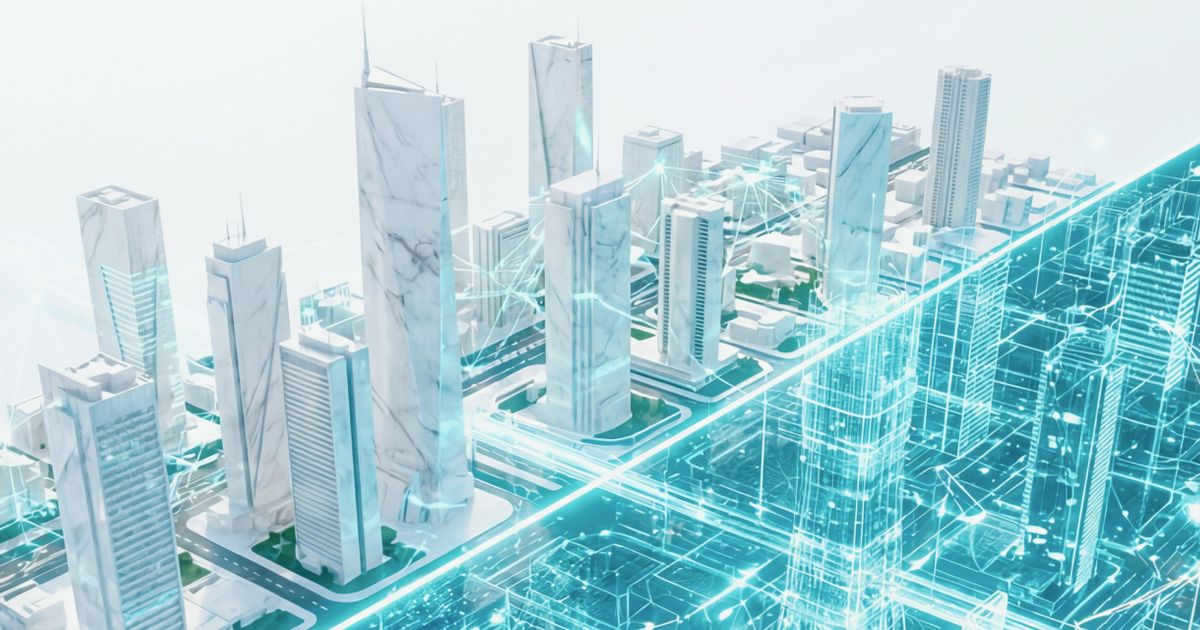
How can digital twins power smart cities?
As cities develop and grow, their complexity increases. High-stakes decisions are made every day, from traffic congestion and aging infrastructure to medical needs, crime prevention, and natural disaster preparedness. Balancing energy, manufacturing, and sustainability goals adds another layer to the challenge. Digital twins provide a powerful solution to create real-time virtual models of city systems to simulate, predict, and optimize city operations before decisions are made in the real world.
What is a digital twin?
A digital twin is a virtual representation of a physical object, process, or system that leverages real-time data to accurately reflect the behavior, performance, and state of its real-world counterpart. By continuously collecting data from physical entities using connected sensors, digital twins synchronize virtual models with reality and adhere to the laws of physics. This enables continuous monitoring, simulation, and analysis to provide deeper insights and support more informed decision-making. With these capabilities in mind, it is clear why digital twin technology has become an important tool for planning AI cities, or AI-enhanced smart cities.
For example, in roadside parking management, training an AI model requires thousands of license plate images taken under different lighting, angles, and weather conditions, which is highly labor-intensive. By building digital twins, cities can generate synthetic data (artificially created data) that reproduces the statistical patterns and characteristics of real-world data without having to collect it directly from real-world events or individuals.
Rather than relying solely on data from real users or sensors, synthetic data is generated using algorithms, simulations, or AI models. This approach provides comprehensive coverage of different license plate types and environmental conditions, while significantly reducing the time and costs associated with data collection and annotation. As a result, highly adaptive roadside parking AI systems can reduce human error, ensure accurate billing for each vehicle, and support fair user payment models, promoting a broader vision of smart city development.
By reducing the cost and risk of physical testing, digital twins can also generate hard-to-obtain data, predict potential disruptions, and improve preparedness for unexpected events.
Where are digital twins used in cities?
Digital twins are being applied in various fields. This includes simulating city-wide infrastructure systems, energy consumption, utilities, and urban planning scenarios to enhance operational efficiency, sustainability, and long-term resilience. Key areas include:
- Transportation: Predict traffic patterns, manage fleets, and optimize logistics and mobility networks to reduce congestion and improve transportation efficiency.
- health care: Model hospital operations, patient pathways, and disease outbreak simulations to improve resource allocation, capacity planning, and public health response.
- Manufacturing: Optimize production lines, monitor equipment, predict maintenance needs, and reduce downtime with virtual simulation.
- Public safety and disaster response: Simulate emergency scenarios, natural disasters, and evacuation strategies to increase preparedness and response effectiveness.
Why are digital twins important for AI cities?
While digital twins are widely used in a variety of industries, their true value in AI cities lies in their collective impact. From infrastructure and transportation to healthcare, manufacturing, and public safety, city systems are deeply interconnected. By integrating digital twin technology across these domains, cities can create integrated, data-driven ecosystems that enable comprehensive planning, predictive governance, and coordinated decision-making. Together, these industry applications form a comprehensive blueprint for building smarter, more resilient, and sustainable AI-powered cities.
Achieving this vision requires a robust and scalable technology backbone that supports high-performance computing, real-time data integration, secure connectivity, and cross-domain collaboration. This foundational layer enables digital twin systems to operate efficiently, share data seamlessly, and provide advanced simulation and AI-powered insights across urban ecosystems.
What digital twin technology does ASUS have for smart cities?
Previously, digital twin city models relied on satellite imagery, cartography, and BIM (Building Information Modeling). Today, AI-driven digital twin technology, powered by advanced simulation engines and large 3D scene databases, enables faster and more accurate urban modeling.
Platforms such as AI True Cloud, developed by Taiwan AI Cloud, leverage high-speed computing and cloud infrastructure to support digital twin development.
- A.I. True cloud: 3D modeling and digital twin collaboration platform built for cities and industry. Reduce computing and implementation costs while supporting urban planning, public infrastructure management, operational optimization, and interagency coordination.
- AI factory concept: ASUS, in collaboration with Taiwan AI Cloud, is actively working on an AI factory concept in the healthcare sector that integrates robotics, AI, and digital twin technology and introduces a new operating model. Hospitals have long faced labor shortages and efficiency bottlenecks. By combining virtual hospital simulation with AI-powered robotics for patient transport, medication, equipment distribution, and disinfection, facilities can optimize workflows, predict equipment maintenance needs, and improve overall efficiency.
- Platform-level integration: Additional initiatives include the Taiwan Health Bio Databank’s digital twin platform, which supports public health disaster prevention, low-carbon modeling, FHIR (Fast Healthcare Interoperability Resources) compliant sovereign health data services, and enables secure and interoperable public health digital twin applications.
- AI Digital Twin Lab: ASUS and NVIDIA partner with NTUST to establish Taiwan’s first AI Digital Twin Lab, bringing advanced AI and advanced technology.‑Bringing performance computing to academia. Powered by ASUS AI laptop powered by NVIDIA® GeForce RTX™ 4070 GPU, large scale in lab‑Scale deep learning, digital modeling, and predictive analytics. students join hands‑Applications span smart manufacturing, autonomous driving, construction, and smart city governance. This initiative will strengthen Taiwan’s AI ecosystem and accelerate innovation across diverse industries.
Developing AI human resources in Taiwan
Through initiatives such as Taiwan AI Cloud’s AIHPC Accelerator, an urban transformation and innovation consortium is being built in Taiwan to connect startup applications with national-level computing resources and foster smart city use cases. Together, these efforts will support next-generation applications, cultivate young talent, and strengthen Taiwan’s AI ecosystem.
By combining hardware innovation, AI technology, and industry-academia collaboration, ASUS is driving future innovation and helping Taiwan remain at the forefront of global AI development. These programs, in conjunction with the Digital Twin Initiative, will enable cities to simulate, optimize, and scale their solutions, strengthening Taiwan’s leadership in sustainable and intelligent urban transformation.


