
Amazon is moving deeper into Walmart territory with a new kind of supercenter. Internal documents show how that strategy is taking shape.
The e-commerce giant plans to build a number of large-format stores that combine Walmart-style supercenters with robot-powered warehouses, including in previously unreported locations, according to internal documents obtained by Business Insider.
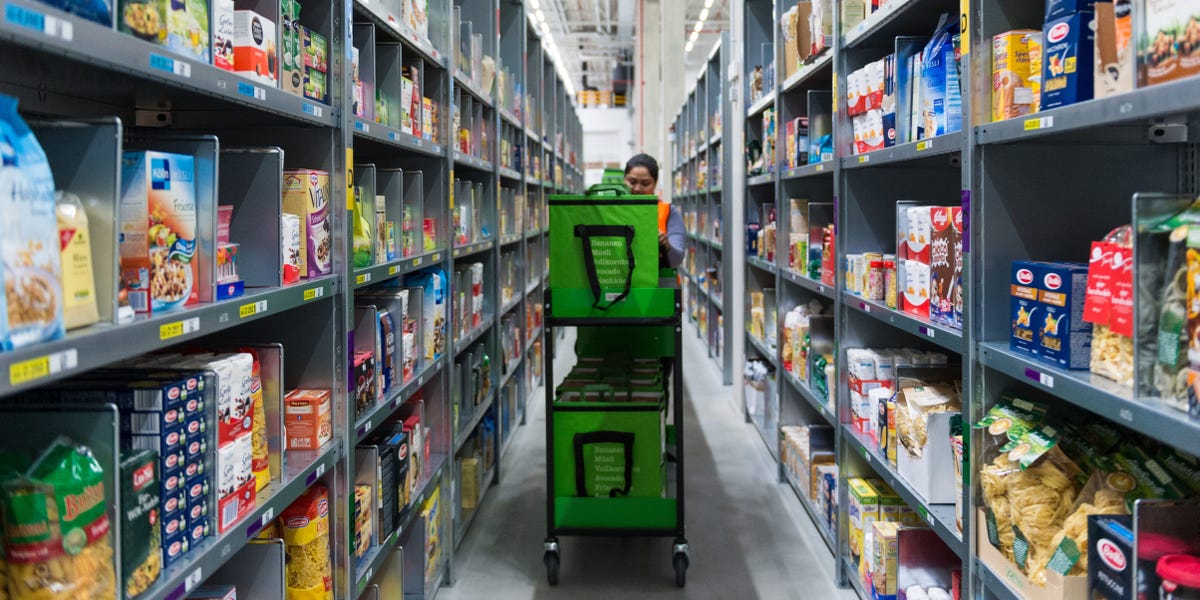
The initiative, known internally as Project Kobe, is one of Amazon’s most ambitious efforts to date to reimagine its brick-and-mortar stores. The store is a combination of grocery and household items, with an automated fulfillment center built into the back designed to handle in-store shopping, pickup, and delivery within the same building.
The concept also relies on AI-driven tools to help decide what each store should carry, but overall costs are expected to be higher than existing operations.
Image of Amazon’s new supercenter Amazon
The move follows years of uneven performance from Amazon’s grocery and brick-and-mortar retail businesses, including the recent closures of its Go and Fresh store networks. Whole Foods, which the company acquired for $13.7 billion, has yet to significantly expand its share of the U.S. grocery market.
An Amazon spokesperson told Business Insider that the concept for these stores is still in the “early stages of development.”
“The new supercenter concept we are testing will allow customers to conveniently shop a wide selection of high-quality products, from fresh produce to household goods and general merchandise, all in one trip,” the spokesperson said. “As with any new format, the details will continue to evolve as we develop the concept that works best for our customers and our business.”
Costs are high, goals are big
Amazon announced earlier this year that it plans to open its first Kobe store in Orland Park, a suburb of Chicago. The company is adding locations in Cherry Hill and Edison, New Jersey, and Oak Brook, Illinois, according to internal documents.
The document also mentions long-term plans for potentially opening dozens or more stores if initial trials are successful.
The approximately 225,000 square foot Kobe store superficially resembles a Walmart Supercenter, combining grocery and general merchandise under one roof. But internally, their functionality is very different.
Rather than treating fulfillment as an add-on, each location incorporates fulfillment as a core part of the store, dedicating a large portion of the building to automated storage, picking, and packaging.
Amazon told the Orland Park Planning Commission in January that it would dedicate about 100,000 square feet, or about half of the building, to warehouse space. That’s much larger than the estimated 18,000 to 36,000 square feet that Walmart typically uses for back-of-store fulfillment, said Lingwei Xin, an associate professor at Cornell University who specializes in supply chain management.
“As far as I know, there is no clear precedent,” Singh told Business Insider.
Amazon’s Kobe store is also expected to carry far more products than a typical Walmart supercenter. The facility will display or store about 250,000 items, nearly twice what most Walmart stores carry, according to an internal document.
“Amazon’s proposal calls for integrating large-scale retail and online order fulfillment solutions,” Mark Wolflert, president of logistics consultancy MWPVL, told Business Insider.
trade off
Image of Amazon’s new supercenter Amazon
This kind of scale comes with trade-offs.
According to internal estimates, Kobe Format will cost more to operate than comparable fulfillment systems Amazon already operates. Shipping costs for each item are estimated to be approximately 12% higher than Amazon’s same-day network (which typically delivers over 4 hours) and significantly higher than highly automated facilities.
Fresh produce is a major contributor to these costs. The documents estimate that such orders could cost about $2 per item, or about 10% more than Amazon’s same-day delivery. The main reason for this is that many products are still being picked from the sales floor, requiring employees to walk more than 500 feet to retrieve them and return them to the fulfillment area.
One of the documents states that the Orland Park project site is estimated to require a total of $33 million in capital expenditures.
These inefficiencies could become even more difficult as Amazon expands its model into mass markets, where demand for groceries is estimated to be more than three times higher, according to the document.
Future locations are expected to move more grocery inventory to the rear of the facility to reduce crowding on the sales floor. This could create new constraints on cold storage and warehouse space, the document added.
Robots provide power behind the store
Amazon’s move into big-box stores comes as it continues to lag behind Walmart in the grocery space.
Despite surpassing Walmart in annual sales last year, Amazon only has a 3% share of the U.S. grocery market compared to Walmart’s 21%, according to Molecule. Walmart also has one important advantage in delivery. Our location with many supercenters allows us to provide same-day service to 93% of households.
An Amazon spokesperson said the molecular data underestimated Amazon’s grocery share because it does not include non-food consumer packaged goods such as toothpaste, diapers and shampoo. Amazon is one of the largest grocery stores in the United States, including fresh produce, with total sales expected to exceed $150 billion by 2025.
Jason Buchel, CEO of Whole Foods and Vice President of Amazon Worldwide Grocery Lee Vogel/Getty Images, Concordia Summit
Project Kobe is one of the most high-profile initiatives under Jason Buchel, head of Amazon’s grocery division and CEO of Whole Foods. Since taking the role last year, Buchel has focused on restructuring Amazon’s grocery business and integrating it more closely with Whole Foods.
Inside Amazon, the Kobe project is heavily guarded. About 50 employees in Seattle, New York and Austin are directly involved in the effort, according to people familiar with the matter, and planning documents are highly restricted.
According to the document, the core of the Kobe store’s warehouse uses a robotic storage system from warehouse automation company Autostore. The system uses a grid of stacked boxes over which a robot moves to retrieve items.
One of the reasons Amazon chose AutoStore is its storage density, which allows it to fit large amounts of inventory within a limited footprint. As grocery volumes increase, more space within each store must be dedicated to staging and order fulfillment, leaving less room for automation. An AutoStore spokesperson did not respond to a request for comment.
At the same time, Amazon is internally developing a new internal system known as Orbital, Business Insider previously reported. The system is designed to process ambient, refrigerated, and frozen products within a single automated setup with a small footprint. Orbital could also be used at a future Kobe facility, but it would take about two years to launch, according to the document.
Manual work remains
Robotic drive unit moves pods at Amazon fulfillment center Bloomberg/Getty Images
Even with a high degree of automation, stores will still rely on manual labor. Bulky, unsortable items are expected to be processed through a two-stage picking system, while perishables are often picked directly from the sales floor.
A single order may require purchasing items from multiple stores, such as manual shelving, refrigerated cases, and a high-demand “premium” section, all of which must be integrated within a limited time frame.
Amazon previously said its first Kobe store in Orland Park is scheduled to open in late 2027.
AI helps decide what to sell in stores
Behind the Kobe model, Amazon is building an AI layer that helps each store decide what to carry.
According to the document, the company is developing an AI-driven tool that allows category managers to input their strategic goals, such as expanding specific product categories, and the model generates recommendations based on demand and space constraints.
The AI system leverages internal optimization models and a custom AI assistant known as Frida, designed to reduce manual planning and scale decision-making across stores. According to the document, Amazon plans to continue its transition from a highly curated, human-driven experience to a fully automated, model-driven selection process.
However, the system is not ready yet. One of the documents points out that Amazon is not at the “North Star” and highlights how much remains unproven.
Any tips? To contact this reporter via email, please specify the following address: ekim@businessinsider.com or on Signal, Telegram or WhatsApp 650-942-3061. Use a personal email address, non-work WiFi network, and non-work device. Here’s a guide to sharing your information securely.