
A growing number of data points show that China has nearly caught up with the US in AI.
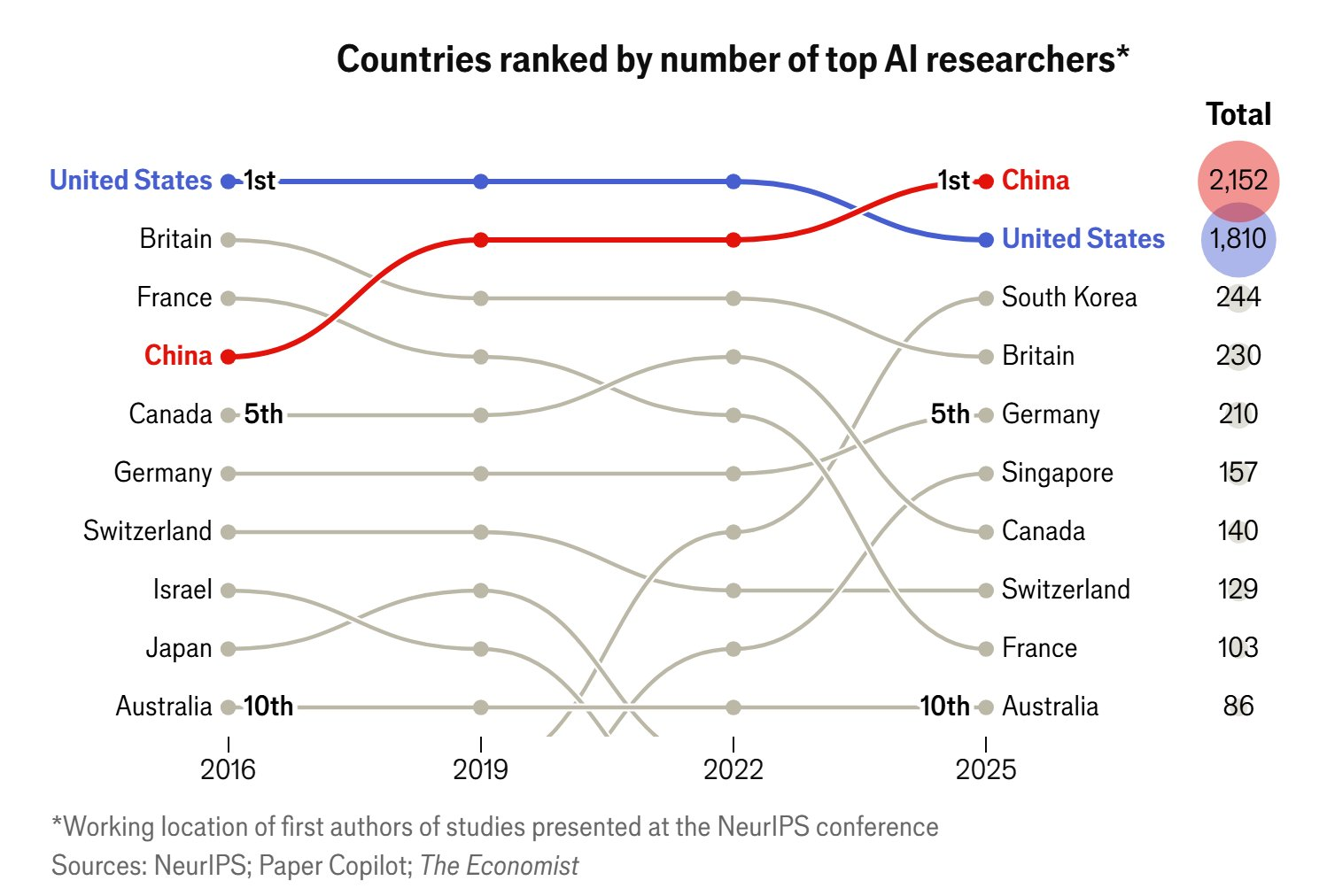
The latest information comes from NeurIPS, the world’s premier machine learning conference, where China has overtaken the US for the first time as the lead author’s base of operations. According to data from NeurIPS and Paper Copilot, economistAccording to this index, China currently has 2,152 top AI researchers, compared to 1,810 in the United States. Although this difference is not large, it marks a symbolic and substantive turning point. In 2019, China fell behind not only the US but also the UK.
Trend lines tell a more important story. In 2016, China ranked fourth after the United States, United Kingdom, and France. By 2025, it would reach number one. Meanwhile, the United States fell to second place. All other countries in the top 10, South Korea (244th), Great Britain (230th), Germany (210th) and Singapore (157th), are far behind both countries, effectively making it a two-horse race.

This change in the study area is consistent with a broader pattern. Jensen Huang pointed out that 50% of the world’s AI researchers are Chinese, and China accounted for 70% of the AI patents filed last year. Meanwhile, Databricks co-founder Andy Konwinski observes that Western open science is “losing the number one spot to China,” with PhD students at Stanford and Berkeley now reading more interesting papers from Chinese startups like DeepSeek and Moonshot AI than from American research institutions.
The movement of researchers to migrate is also worth noting. For years, researchers from China have immigrated to the United States in search of better pay and more ambitious labs. That calculus is changing. OpenAI has already lost researchers to Tencent, and China’s domestic AI scene now offers a real frontier opportunity for the country, with companies like Deep Seek, Alibaba, ByteDance, and Moonshot AI releasing competitive models.
The results of these researchers are becoming increasingly difficult to ignore. Chinese open source models surpassed US models in global downloads for the first time, and 80% of startups identified on a16z are now using Chinese AI models. Demis Hassabis, CEO of Google DeepMind, acknowledged that the US lead may now be measured in months rather than years.
NeurIPS data is a lagging indicator. It reflects where researchers work, not just where they were trained. China’s lead in this index suggests that talent is not only being educated abroad but also being developed domestically. For a research institution dependent on U.S. AI policy and attracting global talent, this is a remarkable number.


