
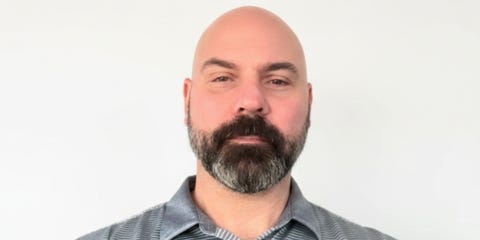
This narrated essay is based on a conversation with former film producer Srdjan Stakić, 49. He vibe-coded an AI system to monitor his elderly parents and detect falls. He is currently starting a company aimed at providing this technology to others. This interview has been edited for length and clarity.
AI became essential when I was diagnosed with stage 4 cancer two years ago.
Everything happened so quickly. The doctors talked to me for 15 minutes and had more questions than answers. AI has given me an objective way to document and understand what is going on.
I am currently in remission. As my health improved, my parents’ health worsened, and I started helping them with things like cooking, cleaning, and making doctor’s appointments.
Communication with health care workers was difficult because English was not their first language. I recorded my conversation with the doctor and used AI to compare it to the post-visit summary. I will compile all this information and translate it into Serbian for them.
But soon they wanted more than what chatbots could offer. I wanted a system where I could observe what was happening to my parents and other patients and assess it in terms of safety and dignity. I thought about how much guilt I would feel if something happened and I wasn’t there. What kind of son will I be?
I had never coded before and didn’t have millions of dollars in initial investment
I have no coding experience. I have a doctorate in health education and a master’s degree in film production, and I have also produced several films of my own.
I used Gemini and ChatGPT to outline my idea and started thinking about it from a technical and ethical perspective. I created this document documenting what I want to achieve. I kept asking families what kind of care they wanted in each scenario, such as a fall or a medical emergency, and wanted the system to be flexible.
After that, I transferred to Loveable. Lovable gave us a live development environment where we could write what we needed, see the build, test, and iterate in real time. Frontends, backends, databases, authentication, integrations, and other pieces that we didn’t even know we needed were connected until they actually existed. Chatbots helped us plan. Loveable helped me build.
I’ve uploaded hundreds of training videos for training AI for nurses and healthcare workers. Created a high-fidelity validation pipeline and labeled dataset. I labeled real-world caregiving footage with established clinical benchmarks, such as Stanford University’s CI-CARE framework. When you approach a patient and introduce yourself, tell them why you are there, ask for their name and pronouns, and introduce what you are going to do. We’ll walk you through next steps and ask if you have any questions or concerns.
We also started building an AI with a camera to identify falls. I collapsed in the middle of my living room to see if the system would recognize it and how long it would take.
It took several months to get it working
I tried different cameras and protocols, but ultimately had to hire an IT company to help me connect multiple cameras. The system can now identify falls, send notifications to loved ones and emergency personnel, and provide a quick overview of health records at the location. The system also analyzes interactions between caregivers and parents. It is so advanced that it can analyze in real time whether a caregiver is being rude or unprofessional based on audio and video. My parents felt safer since I built this. We also built the ability to scan the environment for tripping hazards such as cables.
I don’t actively review all video footage because I don’t want to snoop on my family. When a concern is flagged, the system captures about 30 seconds of that moment and provides a summary of what it observed and why. You can also generate advocacy letters from the same analysis. That is, what was said, what was done, and how that interaction compares to the CI-CARE framework for assessing caregiver behavior.
I started a company to bring this technology to others.
This all started as an idea for my family, but the more I talked about it, the more people said they wished their parents had this. So I decided to start a startup called Alvis to make this system available to others.
It detects falls in real time, recognizes when caregivers have overreached, and generates advocacy letters if something goes wrong. This is a private beta and we are accepting waitlist applications for the pilot cohort starting April 13th. This model will be a monthly subscription similar to what families already pay for camera cloud storage, with a premium tier of AI-assisted analytics.
My mom was hospitalized this week, so I used AI in 4 ways
First, I used this as a real-time medical interpreter. All test results were sent directly to Claude so he knew what was going on right away, rather than the next morning when the doctor was available.
Srdjan Stakic used the software he vibcoded while his mother was in the hospital. Srdjan Stakić
AI was also my clinical advocate. Claude discovered this because her medical history and physical exam had underestimated her cancer history. Claude warned him when his blood sugar levels started to rise due to the steroids.
Third, we used AI to translate the latest information into patient-friendly languages in both English and Serbian.
Finally, the camera system I designed, Alvis, was running live throughout the night in her hospital room, with her permission and consent from her care team. It picked up her saying quietly in Serbian, “I put up with it too much.” When I visited, it was flagged down and we recorded together.
It’s amazing how vibecoding is democratizing access to AI tools. You can start a company to help a very niche group that needs something specific. I still don’t fully understand the code or the scope of what I’ve built, but it seems to be working.