
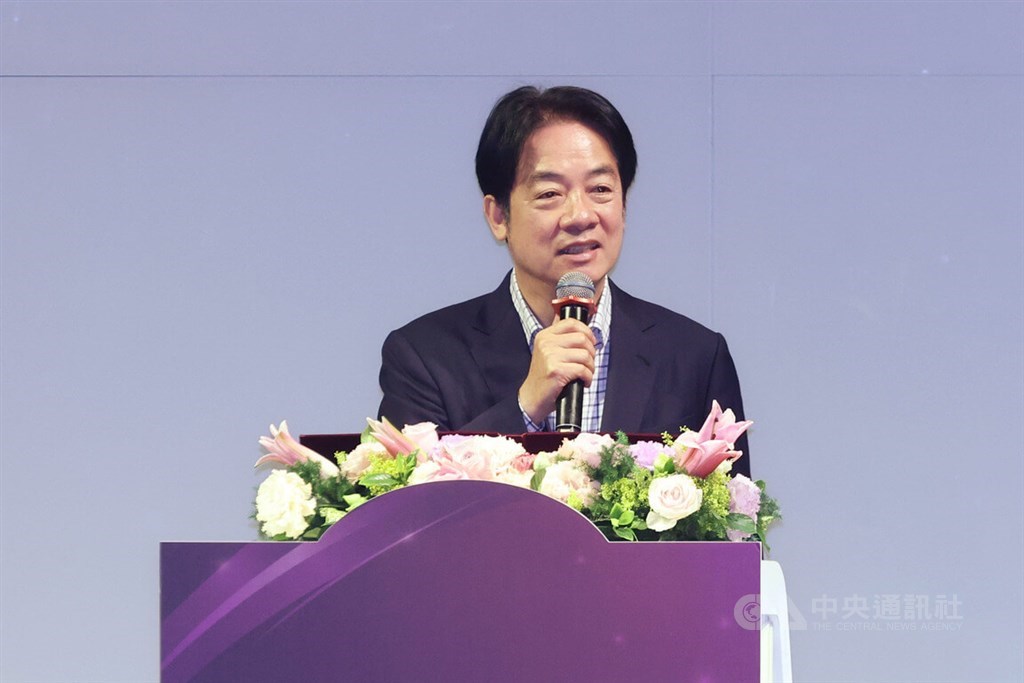
Taipei, March 21 (CNA) Taiwan will be able to have a stable electricity supply until 2032 without nuclear power, President Lai Ching-de said on Saturday, but also hinted that he is open to restarting two decommissioned nuclear power plants to meet the expected increase in power demand from the AI field.
Speaking to business leaders in Taichung, Lai said the potential for disruption in energy supplies due to the ongoing Middle East war is a pressing concern, as Qatar will account for 33.7% of Taiwan’s liquefied natural gas (LNG) imports in 2025, making it the largest share among supplier countries.
Lai said at an event hosted by the Entrepreneurs Club that Taiwan’s current LNG inventory is about 12 to 14 days’ worth, beyond the legal requirement of 11 days, and oil reserves are over 100 days’ worth, beyond the statutory requirement of 90 days.
Lai assured that oil and LNG energy supplies will be secured until April, but said May will be “a little tight” until shipments of oil and LNG purchased from the United States begin arriving in Taiwan in June.
LNG is critical to Taiwan as the Democratic Progressive Party (DPP) government, which took power back to power in 2016, made a conscious decision to phase out nuclear power by 2025 while increasing support for LNG and renewable energy.
In support of this policy, which Mr. Lai championed and implemented as prime minister from September 2017 to January 2019, the Democratic Progressive Party government predicted that the share of natural gas in Taiwan’s electricity mix would significantly increase from 30.6 percent in 2015 to 50 percent in 2025.
At the same time, it planned to reduce the share of coal from 45.4 percent to 30 percent and increase renewable energy from 4.1 percent to 20 percent over the same period.
In fact, according to Bureau of Energy statistics, natural gas accounted for 47.8% of Taiwan’s electricity in 2025, falling short of the renewable energy goal by about 7 percentage points.
Taiwan phased out nuclear energy in May last year following the shutdown of the Ma’anshan Nuclear Power Plant (No. 3 Nuclear Power Plant).
As head of state, Mr. Lai has taken a more open stance toward nuclear energy as public support for nuclear power has grown in recent years.
He has repeatedly said that if future technological advances can solve safety and nuclear waste issues and the public agrees, Taiwan will be happy to accept the benefits.
In his speech on Saturday, Lai confirmed that work has begun to secure approval to restart the decommissioned No. 2 (Guosheng) New Power Plant in New Taipei City and the Maanshan Nuclear Power Plant in Pingtung City.
Lai said Taiwan Power, Taiwan’s state-run power company, has started relevant preparatory procedures and plans to submit the restart plan to the Nuclear Safety Commission (NSC) for review by the end of this month.
He reiterated that nuclear safety, nuclear waste disposal, and public consensus are three important factors for the NSC to consider.
Lai said Taiwan’s daily reserve margin is currently over 10%, indicating that a stable power supply is possible without relying on nuclear power.
However, Lai said there are several factors behind the government’s efforts to restart nuclear power, including continued economic growth, global demand for low-carbon electricity, and rising electricity consumption due to developments in the AI sector.
In response, the opposition Kuomintang party said Lai had finally acknowledged that the Democratic Progressive Party’s “nuclear-free homeland” plan was a complete failure by being willing to restart two nuclear power plants, which together could account for about 11% of Taiwan’s energy mix.
Kuomintang spokesperson Yin Nai-ching (尹乃菁) called on Mr. Lai to issue an “urgent order” to restart the No. 3 nuclear power plant immediately to ensure Taiwan’s energy security as soon as possible.
Given the tense situation in the Middle East, Taiwan still faces an imminent risk of large-scale gas supply interruptions despite its reserves, Yin said, adding that a review scheduled for March would be too late to address the threat.


