
Latest AI techniques can bridge the gap between historical and computational studies of games – Getty Images
For the first time, an international team of researchers has used artificial intelligence (AI) to decipher the rules of an ancient board game, pioneering a new way to uncover long-lost historical secrets.
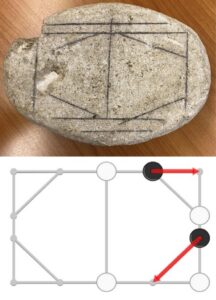
By analyzing carved limestone objects excavated in the Roman Netherlands, the team was able to determine possibly the rules of the game based on their unique markings.
The new study, published in the journal Antiquity, was led by Maastricht University (Netherlands) and Leiden University (Netherlands), with collaboration from Flinders University (South Australia), Catholic University of Leuven (Belgium), the Roman Museum in Heerlen and Restoration Studio Restaura.
The object, discovered in what is now Heerlen, the Netherlands, features an unusual pattern of intersecting lines that has puzzled archaeologists for decades.
Most of Rome’s everyday games were drawn in dust or carved into wood (materials unlikely to survive), so this carefully shaped piece of limestone provided a rare opportunity to investigate ancient gameplay.
“The stone has geometric patterns and visible wear consistent with game pieces being slid across the surface, which strongly suggests that it was played repeatedly rather than for a different purpose,” said lead author Dr. Walter Crist, an archaeologist at Leiden University who specializes in ancient games.
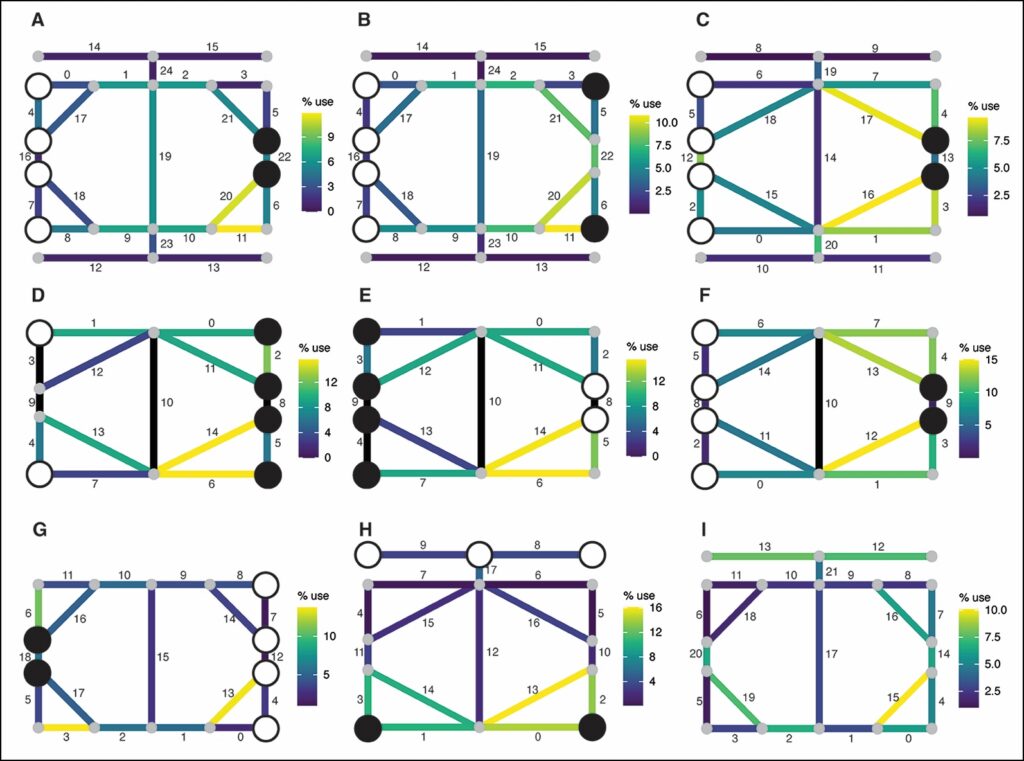
To determine whether the stone is a game board and how it functions, the researchers used AI to simulate hundreds of possible rule sets to see which ones would cause the same wear patterns seen on the object.
“Uneven wear along the engraved lines raises important questions about whether the same patterns can be reproduced in simulated play with AI,” says Dr. Crist.
The researchers used the AI-driven play system Ludii to allow two AI agents to play against each other using objects as boards, leveraging the rule sets of many ancient board games documented in Europe, such as Scandinavian haretavl and Italian gioco dell’orso.

Flinders University computer scientist Dr Matthew Stevenson says using the latest AI techniques can bridge the gap between historical and computational research into games.
“We ran the simulation repeatedly, adjusting the rules each time to see which movements caused the same intensive friction seen in the original stone,” says Dr Stevenson, from Flinders University’s School of Science and Engineering.
“The simulation strongly suggested that it was a type of strategy game known as a blocking game, in which players attempt to trap their opponent’s pieces by blocking their movement rather than capturing them.”
While the findings suggest that such games may have a deeper history than previously documented, as block games are poorly documented before the Middle Ages, the study also points to the transformative potential of AI in archeology.
“This is the first time that AI-driven simulated play has been used in conjunction with archaeological methods to identify a board game,” says Dr. Crist.
“This provides archaeologists with a promising new tool for understanding ancient games that are unlike anything known from extant documents or artwork.”
This research was carried out as part of the Digital Ludeme project between Maastricht University and Europe. This project used artificial intelligence to create a more reliable reconstruction of an ancient game that is both historically and mathematically plausible.
By merging archaeology, digital modeling and cultural history, the team was able to gain a clearer understanding of objects that once seemed inexplicable.
“The success of this approach suggests that many other mysterious artifacts may harbor hidden stories, waiting to be revealed with the help of modern technology,” says Dr. Stevenson.
“This shows how AI can contribute to the understanding of materials that are otherwise difficult to interpret.”
Paper “Ludas Coriovari: Identifying the rules of an ancient board game using artificial intelligence-driven simulation”, authors: Walter Crist (Leiden University), Éric Piette (Université Catholique de Louvain), Karen Jeneson (Het Romeins Museum), Dennis JNJ Soemers (Maastricht University), Matthew Stephenson (Flinders University), Luk van Goor (Restauratieatelier Restaura) and Cameron Browne (Maastricht University) published in Antiquity. DOI: 10.15184/aqy.2025.10264
Acknowledgments: This research was funded by the European Research Council as part of Consolidator Grant #771292 “Digital Ludeme Project”. Computing resources were provided by the Dutch National Electronic Infrastructure with support from the SURF cooperative (EINF-3845 “Analysis of properties and concepts of traditional games”, EINF-4028 “Evaluation of trained AI for general game play”) of the research program Computing Time on National Computer Facilities (partly funded by Dutch government agencies). Wetenschappelijk Onderzoek). Further discussion on the results and applications was made possible through the European Cooperation in Science and Technology (COST) action #CA22145 “Computational technologies for tabletop gaming heritage (GameTable)”. Open access funding provided by Leiden University.
/Open to the public. This material from the original organization/author may be of a contemporary nature and has been edited for clarity, style, and length. Mirage.News does not take any institutional position or position, and all views, positions, and conclusions expressed herein are those of the authors alone. Read the full text here.


