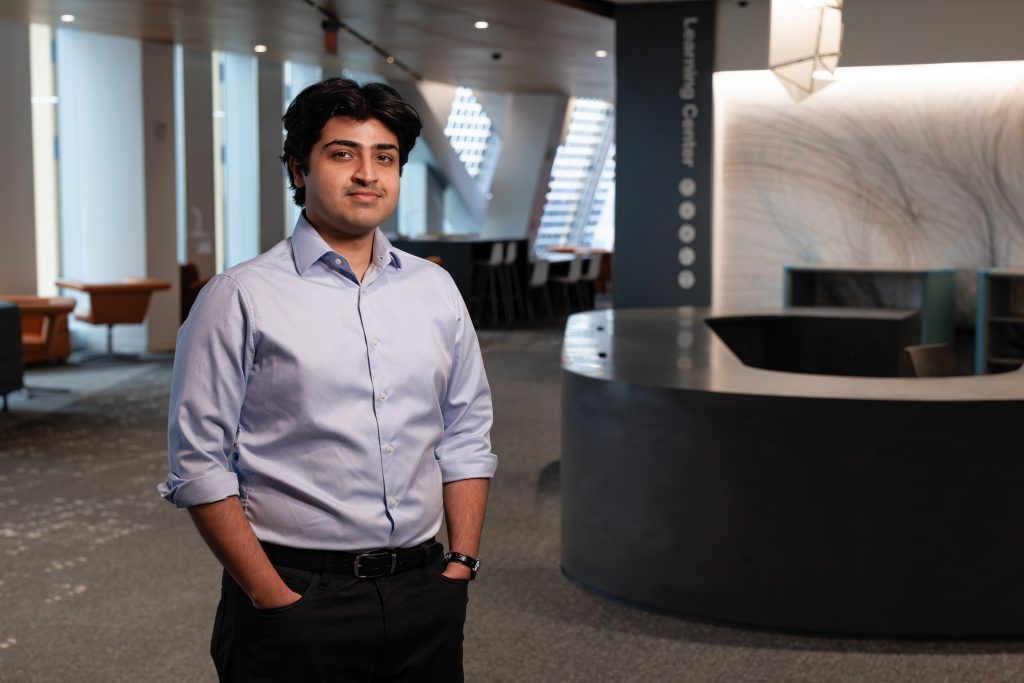
When Shehryar Khan was considering graduate school programs in computer science, Virginia Tech quickly rose to the top of his list.
“I completed my bachelor’s degree from Lahore University of Management Sciences in Pakistan,” Khan said. “Virginia Tech was a natural choice for my interests, especially applied machine learning. It is considered a Tier 1 university, and I had many friends here who valued the academic culture and community.”
Currently a graduate student working toward a master’s degree in engineering in computer science and applications at the Institute for Advanced Computing in Alexandria, Khan’s research interests include applied machine learning, machine learning optimization, post-training reputation building, and machine learning security. His accomplishments reflect Virginia Tech’s strengths at the intersection of advanced computing, research innovation, and real-world impact.
“My work focuses on optimizing and building systems that make research information more organized, accessible, and accurate,” says Kahn. “We derive meaningful insights from the most messy data sources. I like to say we do ‘research within research.'”
In his second semester, Khan accepted a graduate assistant position in the University Libraries’ Research Impact and Intelligence team and began working with Sarah Over, assistant director of research intelligence and engineering analyst who oversees the University Libraries’ Patent and Trademark Resource Center at Virginia Tech. This role allows him to apply his technical expertise to support research across the university.
“Patents, like other forms of publication, are becoming increasingly difficult for even experts in the field to keep up with, as the number of patents granted annually has more than doubled over the past 15 years,” Over says. “The research Kahn is proposing and working on with me has the potential to determine whether a new idea is innovative enough to warrant a new patent.”
Mr. Khan conducts research at the intersection of patents and machine learning under Mr. Ober’s direction. This new field of research explores how machine learning techniques can be applied to patent data, opening new possibilities for understanding innovation trends and research implications.
“We are researching how to push models like ChatGPT to generate new ideas. To try this, we aim to have these models generate patents while avoiding ideas that already exist,” Khan said. “This is very exciting because current models can naively think, ‘Oh, they’re just predicting the next word based on what they already know.’ Tackling this in the field of machine learning is the next big challenge, and we’re proposing ideas that are under-discussed in these fields. The combination of machine learning, research evaluation, and intellectual property is full of possibilities.”
“Virginia Tech needs to continue to advance in areas like machine learning and AI. [artificial intelligence]. “Even if it’s just one project, this ties in with other research that the University Libraries is doing. We can contribute in a unique way by providing analysis on research publications, in this case patents, that fills in the gaps in the AI-related work that other researchers at Virginia Tech are doing,” Over said. In short, one might say that this is a study of studies for this kind of work. ”
Kahn’s research on patents and machine learning, particularly on assessing novelty in patent applications, will likely be published with him as the lead author.
“Khan has already contributed to conference papers that are under peer review and to a number of projects as part of our Research Impact Intelligence Division,” Over said.
Mr. Khan plans to pursue a career in industry, ideally in a role focused on machine learning engineering or research. He believes the opportunity to collaborate with Virginia Tech and the University Libraries helped bridge the gap between advanced theory and applied research.