
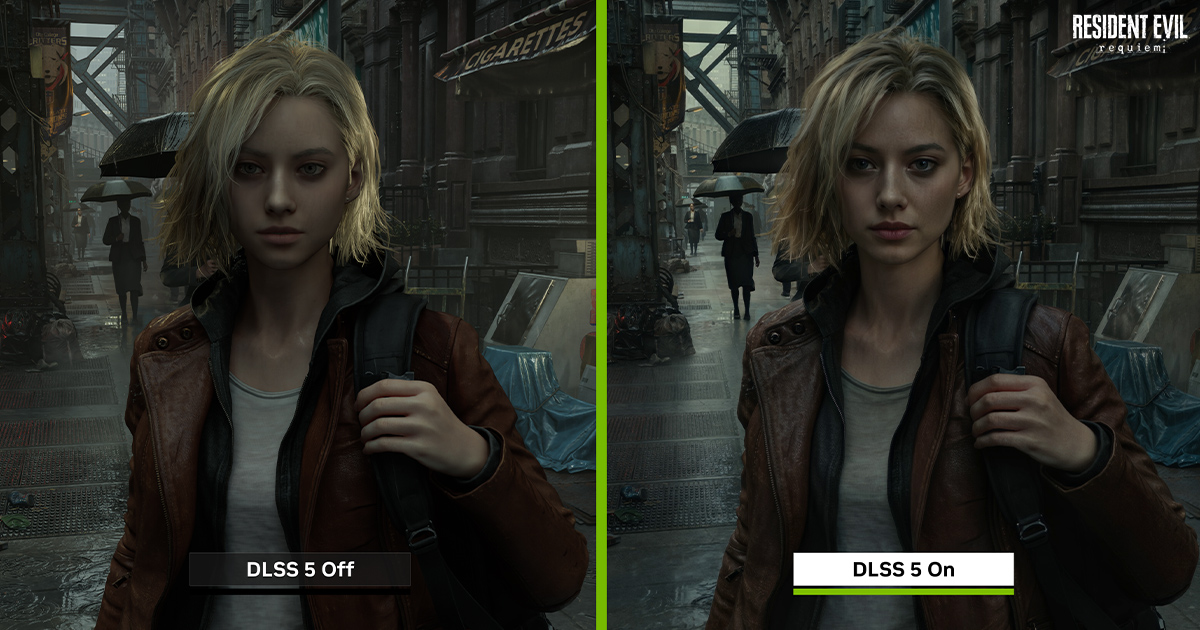
Since the early days of GeForce, NVIDIA has strived to give game developers the graphics power they need to create incredibly realistic worlds where lighting, reflections, and shadows obey the laws of nature.
From programmable shaders with GeForce 3 in 2001, to CUDA with GeForce 8800 GTX in 2006, to real-time ray tracing with GeForce RTX 2080 Ti in 2018, to path tracing and neural shaders with GeForce RTX 5090 in 2025, NVIDIA has delivered major architectural innovations and massive capabilities. To meet this challenge, we increased computing by 375,000x.
However, the rendering horsepower available in 16ms game frames is only a fraction of the rendering horsepower available in photorealistic Hollywood VFX frames, which can take minutes to hours to render. In real-time rendering, brute force alone cannot bridge the gap to photorealism.
NVIDIA DLSS was released in 2018 as an AI technology that improves performance by first upscaling resolution and then generating entirely new frames. It’s integrated into over 750 games and is the gold standard in the industry. DLSS 4.5, announced at this year’s CES, uses AI to draw 23 pixels for every 24 pixels displayed on the screen. Now, DLSS has evolved beyond performance and is transforming the visual fidelity of games.
Video AI models have quickly learned how to produce photorealistic pixels, but they often lack predictability because they run offline, are difficult to control precisely, and produce bespoke content each time a new prompt is created. For games, pixels must be definitive, delivered in real-time, and firmly grounded in the game developer’s 3D world and artistic intent.
DLSS 5 takes as input the game’s color and motion vectors for each frame and uses AI models to infuse the scene with photorealistic lighting and materials that are anchored to the source 3D content and consistent from frame to frame. DLSS 5 runs in real-time at up to 4K resolution for smooth, interactive gameplay.


