
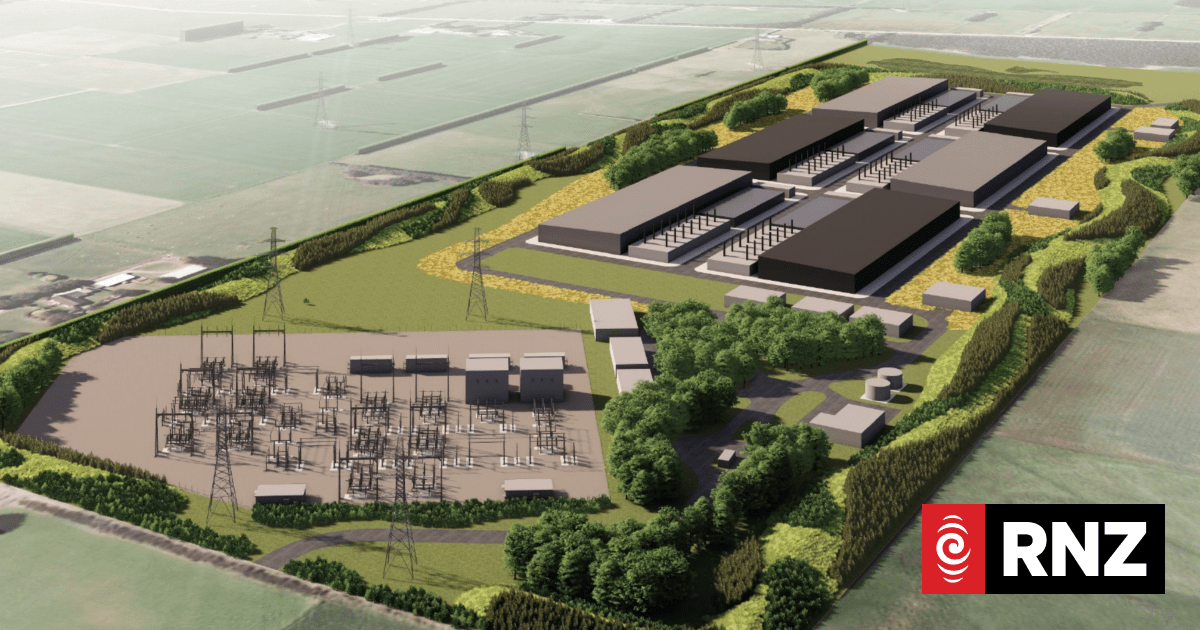

An artist’s impression of what the data center will look like.
photograph: Data grid / included
A new $3.5 billion data center near Invercargill is being touted as the country’s first “artificial intelligence factory”, but technology experts say New Zealand is currently “AI ignorant” and the country’s economic growth is at risk without urgent action.
Datagrid New Zealand has secured resource consent for a 78,000 square meter data center to be built in Makarewa, north of Invercargill. The company was founded in 2021 by Remi Galasso and Malcolm Dick.
“This approval is the result of many years of dedication and collaboration, and we are excited about the transformative impact this project will have on Southland and New Zealand as a whole,” Mr Galasso said.
The center will have a dedicated substation and will consume 280 megawatts of electricity, making it the country’s second largest electricity consumer after the Tiwai Point aluminum smelter and approximately 6 per cent of New Zealand’s total annual electricity demand.
Energy-guzzling data centers are booming in New Zealand, and international companies want to harness the country’s renewable power to reduce their climate impact.
Technology expert Mark Lawrence said the term “AI factory” was coined by Jensen Huang, CEO of American technology company NVIDIA. It describes a data center built to deliver AI technology through training and inference.
AI training involved teaching the model by feeding it a dataset to learn patterns, while AI inference was the application of that knowledge.
“Take ChatGPT, for example. When OpenAI decides to train the next version of ChatGPT, it basically takes a bunch of data, feeds it all to an algorithm, and throws it all into a data center. That data is processed over many months by AI algorithms to create the next version of ChatGPT,” Lawrence said.
“Every time you use an AI tool like ChatGPT or Copilot, every time you type something and press Enter, that’s called inference,” he said.

ChatGPT ignited the recent artificial intelligence hype with its 2022 release.
photograph: Cohen van Weer / ANP MAG / ANP via AFP
Lawrence runs Ten Past Tomorrow, a strategic advice and AI training company that aims to improve AI literacy and competency in New Zealand.
He said demand for training and inference is increasing as more people use AI tools, and New Zealand is geographically and climatically well placed to host data centers to do that work.
“Data centers use a lot of water, and the huge computers inside them generate so much heat that they need to be cooled as well,” he said.
“The average annual temperature in Invercargill is around 10 degrees, which means we can cool these centers with outside air.”
The Invercargill facility is not New Zealand’s first large-scale data center. Microsoft will open a data center in Oakland in 2024, and Amazon Web Services (AWS) has spent $7.5 billion building a cluster of data centers in the city.
Explaining the capabilities of the AI Factory, he said that when completed, it will have the capacity to process approximately 960 million ChatGPT conversations per day, which is equivalent to 5 to 10 percent of the conversations handled by AI chatbots worldwide each day.
Who benefits from the data created in these centers?
Mr Lawrence said that while Microsoft and AWS supply output from their centers to organizations and public services in New Zealand, output from data grid centers will instead be sent offshore via undersea cables to serve overseas markets.
DataGrid has not disclosed who its customers will be or how the information generated by the center will be used.
Mr Lawrence said he wanted to see a commitment from the government that New Zealand could use and benefit from the technology promoted by centers such as DataGrid’s AI factory.
Mr Lawrence said the country was at risk of becoming “AI illiterate”, with statistics showing New Zealanders had less training and competency in the use of AI tools than most developed countries around the world, meaning the country was falling behind in its ability to keep pace with international markets.
“We are still a country that uses AI to change the tone of an email or summarize long documents, while other countries around the world are leading the way in redesigning entire workflows and taking full advantage of the capabilities of agent AI.
“While it is great to see infrastructure being built, especially when it contributes to the economy, what needs to go hand in hand are national capacity training programs to ensure that the fruits of this infrastructure can actually be harnessed and used for the benefit of people, businesses, organizations and ultimately the economy.”
A project that has been in development for many years
Southland Business Chamber CEO Shelley Casey said the new data center provides an opportunity for the region to expand its economic horizons.
“Once operational, Datagrid estimates that exports of data services could generate hundreds of millions of dollars annually, increasing GDP by approximately $60 million annually.”
The construction phase alone was expected to create more than 1,200 skilled jobs and inject approximately $4 billion into the economy.
He said Southland had a strong base in traditional industries and adding a “zero-gravity export” sector, where the region provides digital services to the world, could be a natural complement.

Proposed Tasman Ring Network.
photograph: Data grid / included
TransPower said it is confident the national grid will be able to meet the energy demands of the new data center.
Matt Webb, executive general manager of grid development, said the center requires a large load, but there is also a lot of new generation being generated and TransPower has a responsibility to promote a balance between the two.
He said the national grid operator has been in serious discussions with DataGrid for over a year and a formal connection application process is currently underway.
Mr Webb said a number of significant wind projects in the Southland region were going through the consent process, along with solar projects.
Transpower expects 1300MW of new projects (power generation and battery storage systems) to come online in 2026, increasing capacity by approximately 13%.
Mr Webb said seeing a power load of this size gives investors confidence in investing in renewable energy.
Sign up for our daily newsletter, Ngā Pitopito Korero Handpicked by our editors and delivered straight to your inbox every weekday.


