
GSMA / Keyword: Other/Other
[MWC 2026] GSMA releases experience specification for AI that calls native applications
March 12, 2026 / 06:30 CET/CEST
The publisher is solely responsible for the content of this announcement.
BARCELONA, Spain, March 12, 2026 /PRNewswire/ — At the 5G Futures Summit hosted by the GSMA during MWC Barcelona 2026, the GSMA launched a white paper. Giga Uplinks, Deterministic Latency, and Network Evolution in the Mobile AI Era. The whitepaper outlines trends, application scenarios, and business models for the development and evolution of carrier native voice services in the mobile AI era. It also details specifications for evaluating AI calling experiences, helping carriers build voice experience-centric networks and significantly improve the user experience of voice services.
The white paper points out that due to the synergy between 5G-A and AI, mobile communications has entered the era of mobile AI. Telcos are converting native voice services from traditional voice calls to AI voice calls. By integrating AI algorithms and computing power into native IMS voice networks, traditional voice calling is evolving toward enhanced services and innovative applications. This evolution provides users with a stable, HD, visual, intelligent, and efficient next-generation calling experience. Emerging AI calling services, such as AI immersive calling and AI interactive calling, bring new requirements to network connectivity and AI capabilities.
According to the white paper, AI-based noise reduction is a typical application for AI immersive calls. By leveraging AI algorithms to filter out ambient noise in various scenarios, operators can deliver clearer native calls and create a more immersive experience for users. The AI-based noise reduction algorithm allows it to be used in a variety of situations, such as offices (noise level > 40 dB), streets (noise level > 60 dB), construction sites (noise level > 80 dB), and allows you to enjoy high-quality voice services without depending on the device. AI-powered real-time translation is a typical application of AI conversational calling. Enhanced voice network capabilities are beginning to eliminate long-standing language barriers. AI Calling can provide accurate and real-time audio transcription and translation during video calls, effectively assisting businessmen, international travelers, and hearing-impaired people participating in international online meetings.
As highlighted in the white paper, carriers can integrate AI capabilities into their native voice services to upgrade their business models and breathe new life into everyday calls. After paying a subscription, users can enjoy AI-driven enhancements during traditional calls, allowing carriers to transform one-dimensional traffic monetization into multi-dimensional experience monetization.
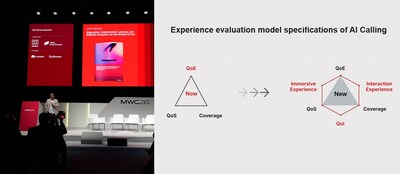
In AI calling scenarios, how to measure user experience is a new challenge for operators. The whitepaper systematically defines the specifications for the AI Calling experience evaluation model. In addition to the three experience metrics of traditional HD voice services (QoE, QoS, and coverage), the AI Calling experience evaluation model specifications have added three metrics: AI immersive experience, AI interactive experience, and QoI. Immersive calling greatly improves the user experience for basic voice calls. For example, MOS and SNR are significantly improved. Interactive calling requires equipping your network with new interaction channels and capabilities, such as data channels (DCs) and video channels (VCs), to provide enhanced experiences such as screen sharing, real-time translation, and agent interactions. QoI is a key metric for measuring the intelligence of a voice network. This measurement includes high-quality AI models, flexible AI management, AI-based network/user status awareness and decision-making, and comprehensive AI service capabilities. These provide basic network guarantees for voice experience upgrades.
The ITU has launched a work project named P.AI-MOS to evaluate the user experience of multimodal AI applications, and a proposal for a voice experience standard for AI Calling is under study. To accelerate the development of experience rating models, the GSMA and industry partners are calling for a joint effort to establish rules for mapping AI application key quality indicators (KQIs) to network key performance indicators (KPIs). These efforts aim to accelerate the development of mobile AI service experience standards and strongly support the development of the mobile AI industry.
Photo – https://mma.prnewswire.com/media/2932226/image1.jpg
 View original content: https://www.prnewswire.co.uk/news-releases/mwc-2026-gsma-releases-experience-specifications-for-ai-calling-native-applications-302711905.html

12 March 2026 CET/CEST Distribution of company news sent by EQS News, a service of the EQS Group.
The publisher is solely responsible for the content of this announcement.
EQS distribution services include regulatory announcements, financial/corporate news, and press releases.


