
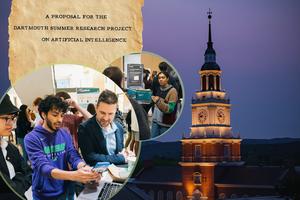
Seventy years ago this summer, a small group of mathematicians and scientists gathered in Hanover, New Hampshire, to participate in the Dartmouth Summer Research Project on Artificial Intelligence. This two-month workshop coined the term “artificial intelligence” and launched a field that is currently reshaping science, technology, and everyday life.
Dartmouth is celebrating 70 years of AI with a yearlong series of events, gatherings, and public conversations designed to reflect on its legacy and help shape what comes next.
This year’s highlight eventDartmouth Conference Revisited” will connect the founding vision of AI with a mission for the future of responsible innovation. Inspired by the Summer Workshop of 1956, the conference will bring together researchers, developers, creators, and institutional leaders at Dartmouth from October 29 to 30 to discuss how artificial intelligence can responsibly enhance human judgment and creativity and clarify the role of higher education in preserving and developing uniquely human abilities.
If the first conference asked whether machines can think, today’s questions are more complex and more human. As AI systems generate text, images, code, and predictions with incredible efficiency, the central question has shifted from “Can machines think?” “How do humans think, create, make ethical decisions, and act alongside machines?”
“Our legacy includes a responsibility to lead higher education in anchoring innovation in human judgment, asking tough questions about the role of new tools in education and research, and defining how this technology advances knowledge with integrity and purpose,” said Cognitive Scientist Chancellor Sian-Lee Beilock.
That responsibility begins in the classroom. Rather than circumventing student thinking, instructors across disciplines are using AI to sharpen student thinking, visualize reasoning, test hypotheses, and push ideas into new realms. This anniversary year will also unveil Dartmouth’s new Code for Responsible AI Use, developed through faculty leadership and ongoing campus dialogue, creating a model for institutions to address similar questions.
“Students learn to develop and defend interpretations, challenge assumptions, and push ideas into uncharted territory, while identifying when automation should replace human judgment and imagination,” says President Santiago Schnell.
According to him, the measure of excellence is not so much what can be produced as the rigor of reasoning, the originality of the questions posed, and the ability to deal with complexity clearly and carefully. The aim is to prepare students to act thoughtfully, critically, and ethically wherever AI exists, not just as engineers and users but also as citizens, creators, and decision-makers.
“Our legacy has a responsibility to anchor innovation in human judgment and to ask tough questions about the role of new tools in education and research.”
President Darmouth Sian Leah Beilock
Dartmouth’s strength as a liberal arts research university, where computational science blends with philosophy, ethics, media studies, the arts, and social sciences, means we can address these issues from all angles. Researchers are evolving AI’s capabilities while examining its risks, from hallucinations and biased training data to the broader challenge of making powerful tools work rather than replace human judgment. This integration of depth and breadth produces scholarship that informs institutions, policy makers, and the general public. Work underway at Dartmouth includes:
Dartmouth’s graduate and professional schools are also rolling out new services related to AI. The Thayer School of Engineering has a new AI track as an option in its Master of Engineering program, allowing undergraduate students pursuing a Bachelor of Engineering degree to choose an AI concentration area.
Meanwhile, AI is now featured across the curriculum at the Tuck School of Business, appearing in every course through teaching, research and hands-on learning, with at least 10 electives dedicated to AI this academic year.
Set the challenge for AI’s next chapter
The commemoration will kick off on February 26 and 27 with the presentation of the McGuire Award for Social Impact to Hany Farid, a renowned expert in digital forensics whose technology to detect deepfakes and child exploitation content is widely used today. A professor at the University of California, Berkeley, who spent 20 years on the faculty at Dartmouth, Farid’s innovations include PhotoDNA, a technology deployed globally to identify and remove images of child exploitation that is now an essential tool for law enforcement, human rights activists, and major technology companies.
The 70th anniversary of Farid’s recognition underscores this year’s central theme: that rigorous innovation must be combined with ethical responsibility and accountability. The first meeting asked how machines could be created to solve human problems. As the field matures and expands, the question is now more nuanced: “How do we enhance human judgment and creativity in the age of AI?” “What is the role of higher education in expanding these capabilities?”
“These questions go to the heart of higher education’s responsibilities in the age of AI,” said Peter Chin, professor of engineering and co-chair of the Dartmouth Faculty Leadership Group on AI. “Framing this conversation through the committee’s role of identifying where AI can accelerate our mission and where thoughtful restraint is needed will ensure that critical thinking and ethical inquiry remain central to building evidence-based approaches that can guide the rest of academia.”
The conference aims to create practical guidance, a public framework, to center human judgment, creativity, and ethical responsibility as AI capabilities expand.
A year of conversations
A series of events over the anniversary year will expand on Dartmouth’s leadership and explore how AI will reshape not just research and decision-making, but imaginative work across disciplines, and what institutions must do in response.
among them:
Students will be competing this spring. DALI TechniGala Student AwardDartmouth’s first AI Innovation Award. This competition recognizes outstanding student work at the intersection of design, technology, and human-centered innovation. This is a showcase of how the next generation is building with AI, prioritizing creativity, responsibility, and real-world impact.
In September, Dartmouth Entrepreneurial Forum at the Magnuson Center The San Francisco event will bring the University’s perspective to the innovation and venture capital communities, making the case that entrepreneurship in the age of AI still relies on human judgment, creative vision, and ethical considerations.
and, “Future of Work” event held in New York City In spring 2027, we will consider how organizations can structure work to preserve human judgment, creativity, and ethical responsibility as AI capabilities expand, and how universities can develop leaders to overcome these challenges.
Further events and details will be announced on the AI at Dartmouth website in the coming months. As the first institution to launch this field, Dartmouth is now convening a broader conversation about what remains human and how institutions can sustain that capacity.


